Test report DSG-9624 · Rev C · tested October 10, 2026
Memory & StorageDevice under test
Samsung to outsource custom DRAM, redirect fabs to HBM for AI
Samsung Electronics plans to outsource custom DRAM production and shift internal capacity to HBM for AI workloads, insiders told Mezha, in a strategic pivot targeting the fastest-growing segment of the memory market.
- Read
- 3 min
- Words
- 529
- Node
- 7nm
- Operator
- Marcus Bennett
Spec summary
- Samsung will outsource custom DRAM production and redirect capacity to HBM, insiders told Mezha
- HBM3E stacks deliver bandwidth exceeding 1 TB/s per stack
- Samsung, SK Hynix, and Micron are the only three qualified HBM suppliers
- SK Hynix holds the leading HBM share after first-mover position in HBM3
- HBM qualification cycles typically span 12 to 18 months from sampling to volume production
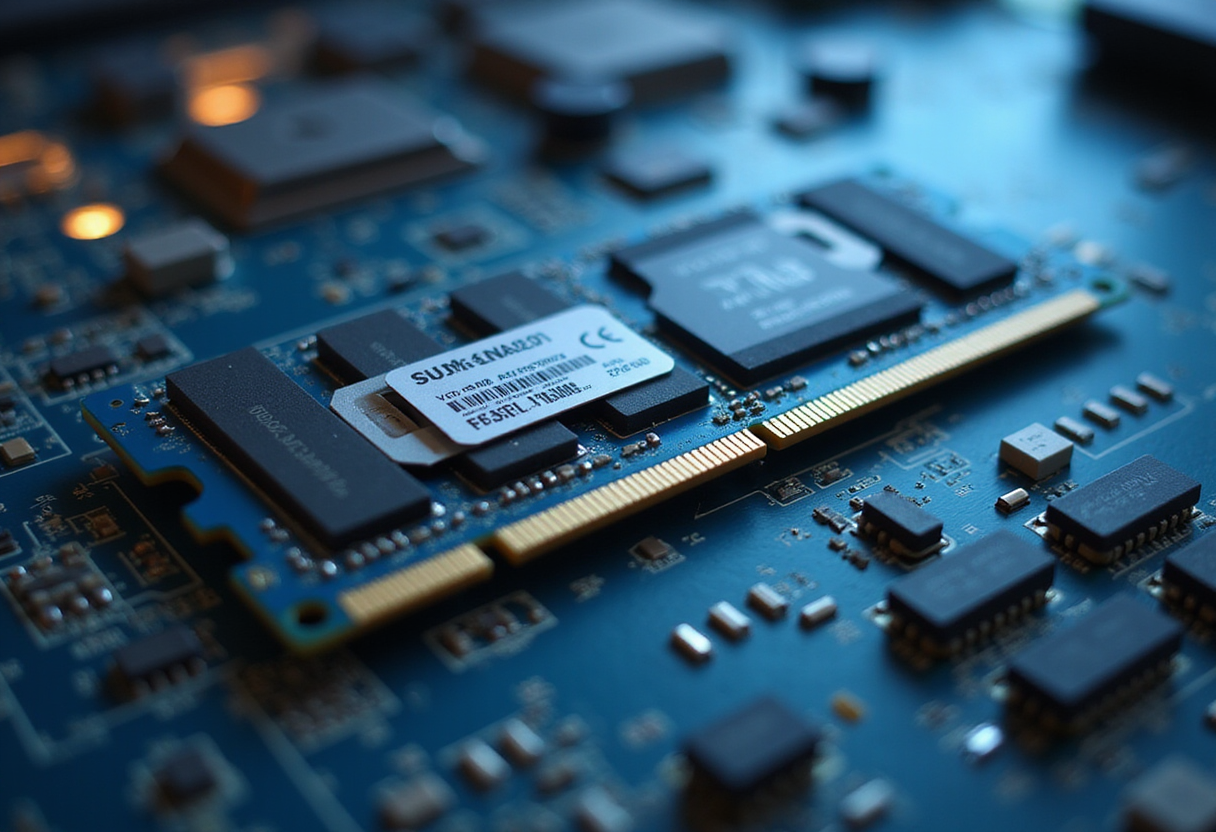
Samsung Electronics will outsource production of its custom DRAM and redirect internal capacity toward high-bandwidth memory (HBM) for artificial intelligence workloads, insiders told the Ukrainian tech publication Mezha.
The pivot targets the fastest-growing slice of the memory market.
HBM stacks multiple DRAM dies vertically using through-silicon vias. Current-generation HBM3E parts deliver bandwidth exceeding 1 terabyte per second per stack. Each HBM package consumes several times the wafer-equivalent capacity of a standard DDR5 module, turning fab-line allocation into a strategic decision.
What does "custom DRAM" outsourcing actually mean?
Custom DRAM covers customer-specific memory dies, integrated circuits, and packaging configurations produced under dedicated process flows. The category includes specialized memory for networking chips, mobile processors, and embedded systems that require non-standard densities, interfaces, or packaging.
Outsourced volumes typically move to test, packaging, or foundry partners. Freeing those lines lets Samsung's memory division convert clean-room space and engineering effort toward HBM stacking. HBM production requires additional bonding, test, and qualification capacity that conventional DRAM lines do not provide.
The move trades margin control in low-volume specialty products for capacity access in high-volume AI parts. Samsung retains customer relationships but loses direct oversight of process tuning for those accounts.
Why HBM, and why now?
Demand from AI accelerator suppliers has reshaped memory allocation since 2023.
Graphics processors and custom AI chips from hyperscalers consume HBM in volumes that pushed the segment into allocation through 2024 and 2025. Average accelerator HBM content has risen sharply compared with earlier-generation parts, multiplying memory-industry consumption at a structural level.
Samsung, SK Hynix, and Micron remain the only three qualified HBM suppliers. SK Hynix holds the leading share after a first-mover position in HBM3 and an early HBM3E ramp.
Samsung has worked to qualify its HBM3E product with leading accelerator buyers. Redirecting custom-DRAM capacity to HBM production compresses that qualification timeline, according to insiders cited by Mezha.
What does Samsung risk?
Outsourcing custom DRAM does not eliminate the business. The move shifts margin and yield control to partners and reduces Samsung's visibility into customer-specific design changes.
In conventional DDR4 and DDR5, where Samsung competes on volume and price, the company's share has trended lower through 2024 according to TrendForce tracking. Samsung's quarterly memory revenue has been pressured by contract-price softness in PC and server DRAM.
Concentrating engineering on a three-supplier market with rising demand offers margin upside. Qualification cycles at hyperscalers and accelerator vendors remain strict, however. A failed qualification round can shift multi-billion-dollar orders between suppliers. HBM qualification typically spans 12 to 18 months from sampling to volume production.
What remains unclear?
Insiders did not specify a timeline or production volume. The reported shift aligns with Samsung's public messaging through 2024 and early 2025 that the memory division would prioritize high-margin, AI-driven products.
Specific customer allocations, foundry partners, and capacity percentages remain undisclosed. The outsourcing decision also raises questions about which partners Samsung will use, whether qualification cycles will accelerate as planned, and how competitors SK Hynix and Micron will respond to a more focused Samsung in the HBM segment.
via Google News: HBM memory (Source)
More from Marcus Bennett
Show full bio
News editor covering marketplaces and e-commerce at Die Signal.
274 articles
Same lot · LOT-C1C6
- DSG-502510nmSamsung Exec: HBM to Reach Nearly 30% of Global DRAM Capacity
- DSG-25935nmSamsung, SK Pivot Memory Back-End to Vietnam, India, Philippines
- DSG-909628nmSamsung: HBM to Hit Nearly 30% of Industry DRAM Capacity Next Year
- DSG-995110nmSamsung: HBM to Absorb Nearly 30% of Global DRAM Capacity Next Year
- DSG-75607nmSamsung Forecasts HBM at 30% of DRAM Capacity by 2027