Test report DSG-4835 · Rev F · tested October 10, 2026
Processors & AcceleratorsDevice under test
Huawei Kirin 2026 Posts 66% NPU Power Drop, 55% Density Gain
Huawei has published measured data for the first LogicFolding chip, the Kirin 2026, on ChinaXiv. Density climbs 55% over its predecessor, NPU power drops 66% at equivalent throughput, and GPU power falls 58%.
- Read
- 4 min
- Words
- 823
- Node
- 14nm
- Operator
- Marcus Bennett
Spec summary
- Kirin 2026 measured data published September 4, 2026 on ChinaXiv by Huawei semiconductor chief He Tingbo
- Transistor density up 55% versus predecessor; NPU power consumption down 66% at 29 TOPS with voltage cut from 0.85V to 0.55V
- GPU power drops 58% at 61 fps; CPU performance-core power falls 41%
- LogicFolding shrinks typical core wire length by 20% and reduces clock buffers from ~43,600 to 19,000
- Huawei states hundreds of chips have already been mass-produced under τ principles; first LogicFolding Kirin ships fall 2026
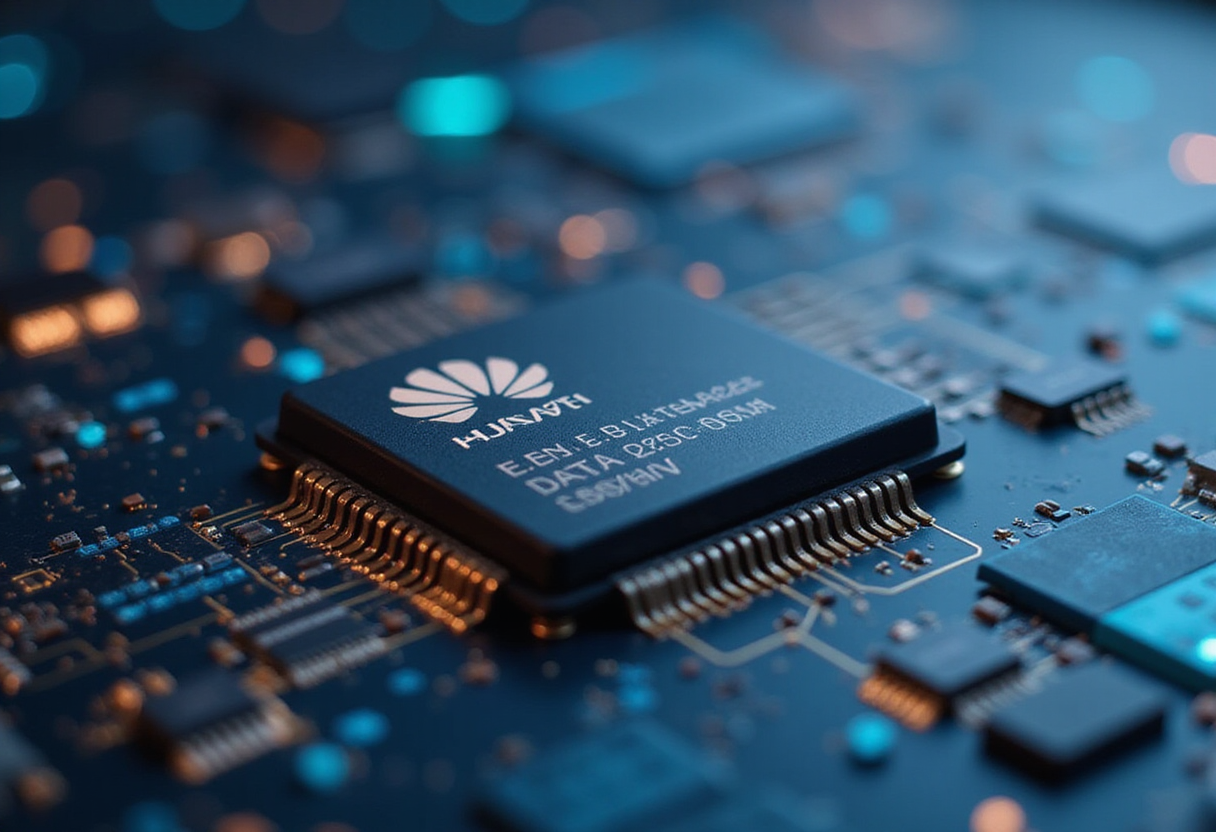
Huawei's Kirin 2026, the first chip built on LogicFolding technology, delivers a 66% drop in NPU power consumption at equivalent AI throughput and a 55% increase in transistor density over its predecessor, according to measured data published September 4 on the ChinaXiv preprint platform by He Tingbo, head of Huawei's semiconductor business.
The disclosure arrives ahead of the chip's commercial debut. Huawei has previously stated that the first LogicFolding-based Kirin SoC will ship in fall 2026, framing the 2026 part as a proof point for τ ("Tao's Law"), introduced publicly in May 2026 as a post-Moore technical framework.
What does the chip actually measure?
The Kirin 2026 was disclosed block by block in a paper titled "Huawei's τ Chip Was Supposed to Melt?" At equivalent performance:
- NPU: −66% power at 29 TOPS of AI inference; clock frequency down 63%, voltage 0.85 V → 0.55 V; power density down 73%. The folded NPU can also reach 70 TOPS — a 141% jump versus the previous generation.
- GPU: −58% power at the same 61 fps frame rate; voltage reduced by roughly 200 mV.
- CPU performance cores: −41% power at equivalent performance, with frequency down only 9%.
- DSP: area shrunk 40%; power down 25%, though power density is up 24%. The Kirin 2027 DSP redesign addresses this, with power down 47% and power density below the planar baseline.
What's actually new about LogicFolding?
LogicFolding is not 3D die stacking in the conventional sense. It re-architects the circuit layout, folding a previously flat, horizontally spread design into two vertical layers connected by hybrid bonding. Long horizontal connections become short vertical ones.
Measured effects on the Kirin 2026:
- Typical core wire length shrinks 20%.
- Critical-path wires shorten by up to 70%.
- Clock routing length drops 28%.
- Number of clock buffers falls from ~43,600 to 19,000.
For the Kirin 2027, bond pitch narrows to 1 µm, with vertical interconnect points exceeding 100 million. Huawei targets 720 nm bond pitch within three years, with vertical interconnect counts above 200 million.
Why does shorter wiring cut power?
He Tingbo's central thesis is that chip power is dominated not by computation but by data movement. In typical smartphone workloads, dynamic power accounts for roughly 90% of total consumption. Under the standard dynamic-power formula, dominant capacitance now comes from metal interconnects rather than transistors, especially at advanced nodes.
"Every future we can foresee for τ will be won or lost on power," He Tingbo writes in the paper.
The shortened wire lengths made possible by LogicFolding reduce interconnect capacitance directly. The "timing headroom" freed up can either raise frequency or, alternatively, fund additional parallel units running at lower voltage — a tradeoff that cuts switching energy proportionally.
Why didn't 3D stacking make it hotter?
The paper directly addresses the criticism that vertical stacking worsens thermal dissipation. He Tingbo argues thermal risk hinges on junction temperature and hot-spot localization, not total heat output alone.
LogicFolding cuts thermal load in two ways: lower total power at equivalent performance, and rearranged module placement that staggers high-power blocks so hot spots do not stack directly above one another. The Kirin 2026 selectively folds only critical paths and applies thermal-aware layout; not every circuit is stacked.
Where does the CPU gain stop?
CPU performance cores see the smallest gains — 41%, versus 66% on the NPU and 58% on the GPU. He Tingbo attributes this to inherently serial CPU workloads. Voltage reduction through added parallel units works on NPUs and GPUs but not on traditional cores.
"Three to five years of substantial exploration ahead" remain for the CPU side, alongside EDA tool support, inter-layer stress, CMP planarization, hybrid-bond alignment, wafer warpage, and substantially more complex verification.
What does τ actually buy you?
He Tingbo is explicit: τ is a time-scaling law, not an energy-scaling law. The timing headroom gained from LogicFolding can be spent on performance or on power, but not both automatically. The Kirin 2026's measured power profile is the result of designers deliberately spending part of the headroom on energy savings.
The closing line of the paper: "This τ chip that was supposed to burn up instead runs cooler — not because folding made it cool, but because of the folding itself."
Can LogicFolding scale?
Huawei states that hundreds of chips have already been designed and mass-produced under τ principles. The Kirin 2026 is the first LogicFolding-based SoC to reach measurement disclosure. The next milestones are the Kirin 2027 DSP, a bond-pitch shrink to 1 µm, the 720 nm pitch target within three years, and a CPU-side architecture that has not been specified publicly.
The open question is whether LogicFolding's interconnect-driven energy gains survive successive pitch shrinks, mass-production yield, and cost. The Kirin 2026 numbers say the architecture runs cool. They do not yet say it runs at scale.
via img.biggo.com (Original)
More from Marcus Bennett
Show full bio
News editor covering marketplaces and e-commerce at Die Signal.
274 articles
Same lot · LOT-C1C6
- DSG-606120nmHuawei's Next-Gen Ascend NPUs Emerge as China's Strongest AI Bet
- DSG-347428nmHuawei Pulls Ascend NPU Roadmap Forward, Doubles 960PR FP4 Targets
- DSG-83975nmHuawei unveils new chip technologies in escalating AI race with Nvidia
- DSG-72585nmHuawei Sets Q1 2027 Launch For Next AI Chip Targeting Nvidia
- DSG-613365nmDeepSeek Releases Huawei AI Chip Tooling, Targets Nvidia Replacement