Test report DSG-1091 · Rev B · tested October 10, 2026
Processors & AcceleratorsDevice under test
Chinese AI Chipmakers Lift Prices as HBM Shortage Tightens Supply
Chinese AI chipmakers raised accelerator prices citing a high-bandwidth memory shortage, in a Yahoo Finance exclusive. HBM emerges as the binding constraint in China's AI compute supply chain.
- Read
- 3 min
- Words
- 529
- Node
- 14nm
- Operator
- Grace Kim
Spec summary
- Chinese AI chipmakers have raised prices on accelerators, citing a high-bandwidth memory shortage, per a Yahoo Finance exclusive.
- HBM uses vertically stacked DRAM dies connected through through-silicon vias (TSVs) to deliver higher bandwidth per watt than GDDR or DDR memory.
- New HBM production lines typically require 12-18 months from equipment installation to volume qualification.
- HBM stacks are one of the most expensive components on the accelerator bill of materials, transmitting memory-side cost moves directly to chip list prices.
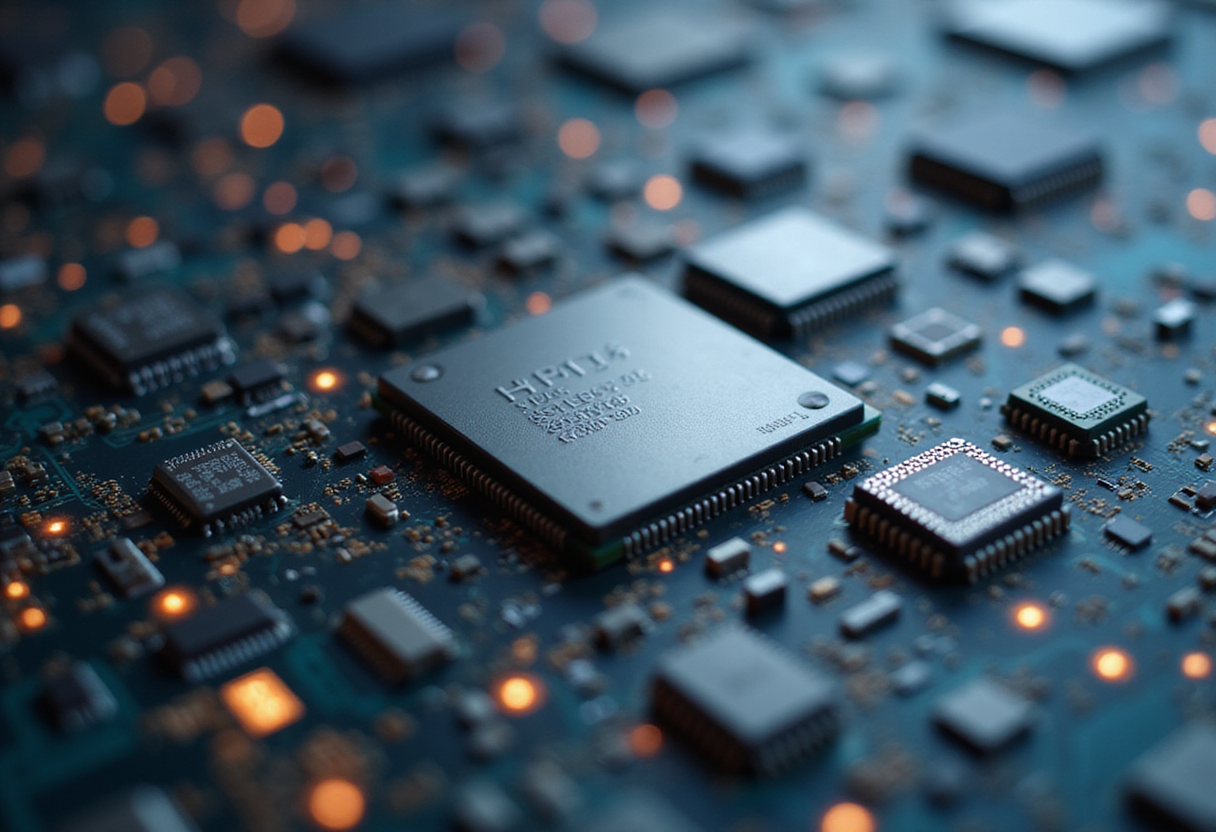
Chinese AI chipmakers have raised prices on their accelerators, citing a sustained shortage of high-bandwidth memory (HBM) as the immediate driver, according to an exclusive report from Yahoo Finance.
The price action translates a memory-side supply constraint into a server-side cost line. HBM stacks account for a meaningful share of the accelerator bill of materials, and contracted HBM pricing has moved upward across the industry as AI chip demand has outpaced available memory output. Chinese vendors, competing for the same constrained HBM allocation, have passed a portion of that increase to buyers.
What is high-bandwidth memory, and why does it sit on the critical path?
HBM is a vertically stacked DRAM form factor that delivers substantially higher bandwidth per watt than conventional GDDR or DDR memory. Dies connect through through-silicon vias (TSVs), enabling wide I/O buses at lower power and shorter signal paths. The technology underpins current-generation AI accelerators, which depend on parallel data movement to feed tensor operations on transformer-scale matrices.
Each HBM stack is one of the more expensive components on the accelerator package. When HBM contract pricing rises, the cost differential transfers directly to chip list prices — particularly for vendors without long-term fixed-price supply agreements.
How does this affect buyers?
Procurement teams face a clearer calculus as price actions become public. Multi-quarter budgets on accelerator deployments will require recalculation. Mid-tier cloud and enterprise buyers — the typical Chinese domestic customer base — see the largest relative cost shifts. Smaller research and AI lab operators, working on tighter capex, face the steepest impact per unit.
Memory-bandwidth-bound workloads, including large-context inference and recommender training, feel the cost pressure most directly. Compute-bound or sparsity-heavy workloads are partially insulated.
How constrained is HBM supply?
The HBM market remains concentrated among a small number of memory producers. Output capacity — built around advanced DRAM process nodes and 2.5D/3D packaging — has lagged accelerator demand as AI workloads have scaled. Memory makers have guided to multi-year capacity buildouts, with stacking and packaging capacity cited as the gating constraint alongside wafer output.
What is the parallel in the broader market?
Chinese AI accelerator pricing is not an isolated signal. Across the global AI hardware market, HBM allocation has become a determining factor in accelerator lead times and total system cost. Where Chinese vendors now raise prices on constrained supply, established accelerator vendors have similarly signaled cost increases or supply allocation changes to customers.
What is the supply outlook?
HBM capacity expansion is in progress. New production lines typically require 12 to 18 months from equipment installation to volume qualification. Until those lines contribute measurable output, the memory-versus-logic capacity imbalance persists, and accelerator pricing will reflect it.
What the report leaves open
The Yahoo Finance exclusive does not disclose the magnitude of the price increases, the specific Chinese vendors affected, or the HBM generations in question. Follow-up reporting is required to quantify the cost pass-through. What the headline establishes is straightforward: HBM is the binding constraint in the Chinese AI compute supply chain, and chipmakers are signaling that constraint to the market through price.
via Google News: HBM memory (Source)
More from Grace Kim
Same lot · LOT-C1C6
- DSG-646165nmHBM Prices Set to More Than Double Next Year, Report Says
- DSG-161214nmAI Demand for HBM Pushes Ordinary RAM Prices Above Cutting-Edge Chips
- DSG-682365nmHBM Prices Set to More Than Double Next Year Amid Ongoing Shortage
- DSG-84123nmHBM Prices Set to Double as Memory Shortage Fuels Samsung Profits
- DSG-776220nmTrendForce Forecasts HBM Prices to More Than Double in 2025