Test report DSG-2264 · Rev A · tested November 18, 2026
AI Datacenter InfrastructureDevice under test
HRT-Beam gains patent and Korean steel-construction certification
Hyundai E&C patented the HRT-Beam, developed with Hyundai Steel for long-span data centers, and earned Korean certification after full-scale seismic testing.
- Read
- 3 min
- Words
- 591
- Node
- 7nm
- Operator
- Elena Vasquez
Spec summary
- Hyundai E&C announced on the 18th that HRT-Beam had received Korean steel-construction certification.
- HRT-Beam was developed jointly with Hyundai Steel and patented by Hyundai E&C.
- The certified system combines HRT-Beam with steel-reinforced concrete columns and underwent full-scale seismic testing.
- Conventional composite beams need wider cross-sections or added reinforcement as loads rise; HRT-Beam changes the cross-section instead.
- The method reduces shoring and formwork operations, with major members fabricated at a plant.
By Elena Vasquez
Hyundai Engineering & Construction (000720.KS) has secured a patent for HRT-Beam, a steel-and-concrete composite-beam method developed jointly with Hyundai Steel (004020.KS). In its announcement on the 18th, the company said the beam-column seismic connection using HRT-Beam had received technology certification from the Korean Society of Steel Construction.
What does the certification cover?
The certified system combines HRT-Beam with steel-reinforced concrete, or SRC, columns. Verification included full-scale seismic testing, and Hyundai E&C said the Korean society recognized the system for structural safety and seismic performance. For project teams, that provides a tested detail to evaluate when specifying seismic connections for data centers and other heavy-load buildings.
The patent and the certification cover different elements: the composite-beam method on one side, and the seismic connection for SRC columns on the other. For engineers, that means the announcement combines a structural design proposal with a separately certified connection detail.
An official at the HMG Construction Technology Research Institute said: "Based on the expertise of Hyundai E&C and Hyundai Steel, we will advance structural solutions needed for high-performance buildings such as data centers and secure differentiated business competitiveness through the synergy of construction and materials technology."
Why do data centers change the load case?
A composite beam combines steel and concrete to support heavy loads while allowing wide spacing between columns in large structures. Hyundai E&C says structural member performance and safety matter more as artificial intelligence spreads and data center equipment becomes denser. Those changes increase the loads buildings must carry, so designers have to solve carrying capacity and span together.
The relevant application is a long-span, heavy-load building with wide, open interior space. Data centers match that profile as equipment density rises inside structures that require long spans. For engineers, the structural problem now has two linked terms: higher required capacity, and more floor area to cover between widely spaced columns.
How does HRT-Beam differ from conventional beams?
- Conventional composite beams: wider member cross-sections or additional reinforcement become necessary as loads increase.
- HRT-Beam: a different cross-sectional configuration supports heavy loads while creating wide, open spaces.
- Target buildings: long-span, heavy-load structures, including data centers.
That comparison matters because the patented configuration seeks to handle rising loads without relying on the same section enlargement. Instead of only increasing the width of a member or adding reinforcement, the design changes the cross-section itself.
What resists earthquake forces?
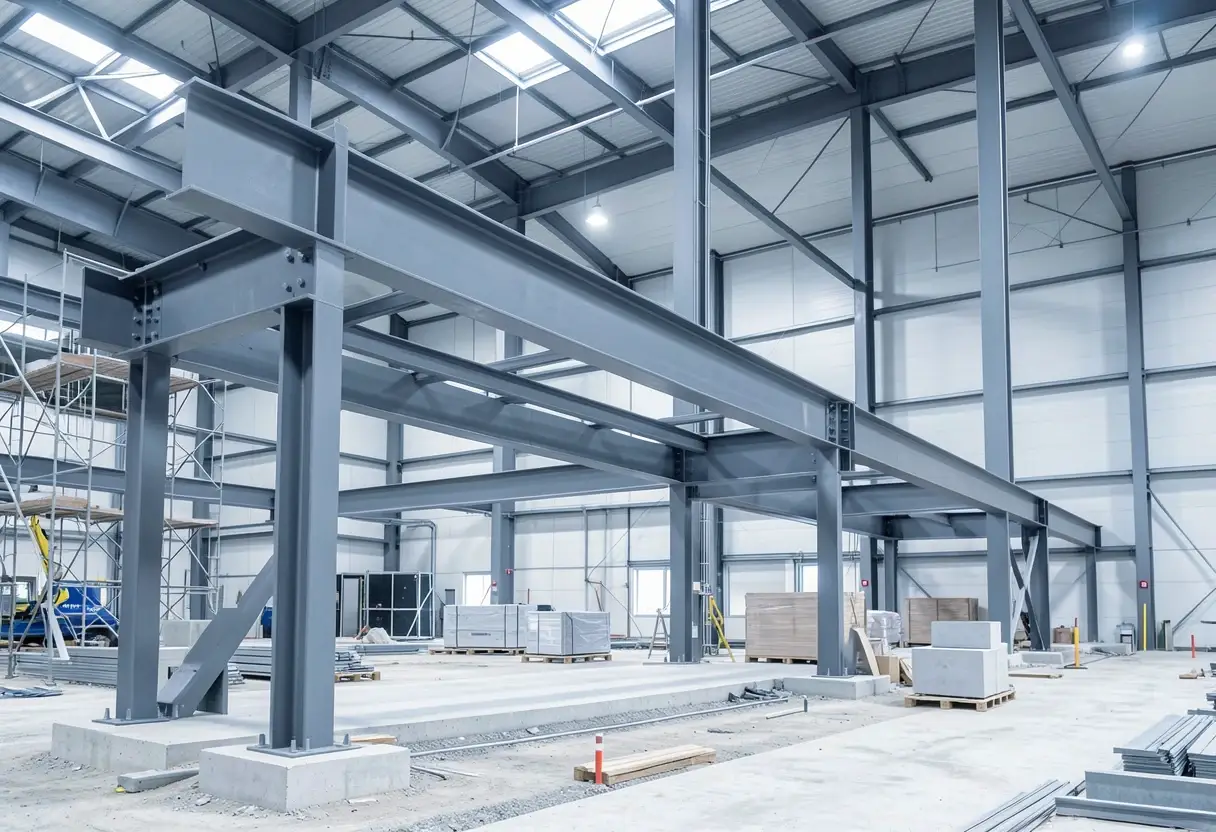
HRT-Beam places ribs inside the steel plate to suppress plate deformation. Its reinforcing bars are designed to induce integrated behavior between the steel and concrete. Together, the ribs and bars absorb and disperse energy during an earthquake, preventing sudden failure or excessive deformation.
The two components divide the work. Ribs control deformation in the plate, while the bars promote interaction between steel and concrete. In the certified beam-column system, their combined action forms the basis of seismic resistance.
What changes during construction?
The method minimizes the installation and dismantling of shoring and formwork. Hyundai E&C says that reduces risk factors linked to work at height and temporary structures. Major members are fabricated at a plant.
For erection teams, the practical change is less installation and removal of temporary works on site; for designers, it is a seismic connection backed by full-scale test evidence. The announcement ties those benefits to a defined building type: data centers carrying heavier equipment loads across long spans, with wide spacing between columns.
via en.sedaily.com (Source)
More from Elena Vasquez
Show full bio
Senior reporter covering people, launches and day-to-day practice in hardware layer of artificial intelligence at Die Signal.
675 articles
Same lot · LOT-362E
- DSG-585128nmGS Group, POSCO Seal MOU on AI Data Center Steel Supply
- DSG-579514nmSK Telecom Taps Hyosung Heavy for 15 GW Data Center Power Push
- DSG-997120nmKorea Robot Agency and LG Electronics Sign Humanoid Safety Deal
- DSG-15555nmLG CNS Jakarta AI Data Center Wins Top Uptime Design Rating
- DSG-958828nmSM+ Opens $300m AI Data Center SMX01 in Jakarta