Test report DSG-1709 · Rev F · tested October 30, 2026
Supply Chain & PolicyDevice under test
Vertical Semiconductor Lands $73m CHIPS Award for vGaN Transistors
Vertical Semiconductor signed a Letter of Intent for up to $73m in CHIPS Act funding to develop vertical gallium nitride power transistors, targeting a 2.5MW AI rack with 30 percent lower energy losses.
- Read
- 3 min
- Words
- 557
- Node
- 3nm
- Operator
- Grace Kim
Spec summary
- Vertical Semiconductor signed an LOI for up to $73m in CHIPS and Science Act funding
- Commerce receives a minority, non-controlling, non-voting equity stake as a funding condition
- Target: a 2.5MW AI rack with 30% lower energy losses and 50% smaller footprint
- The MIT spin-out was founded in 2024 and raised an $11m seed round in October 2025
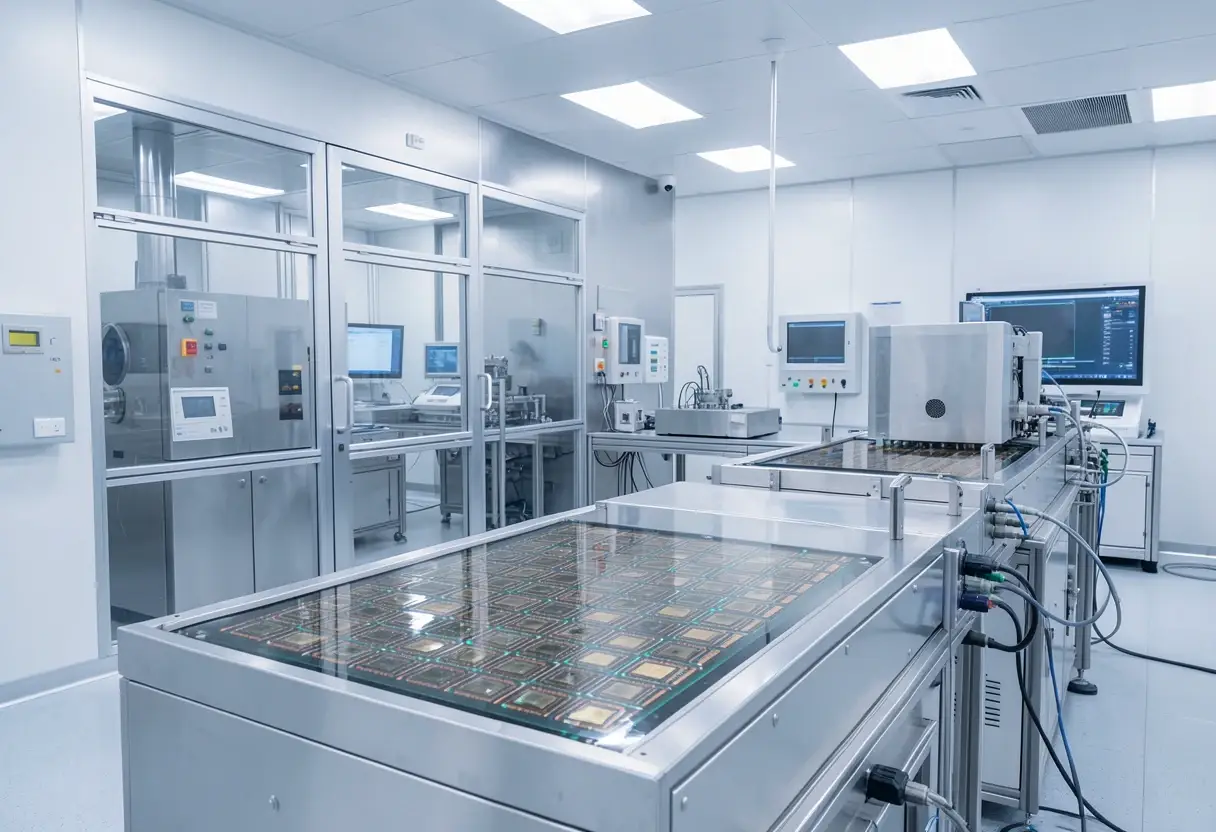
Vertical Semiconductor has signed a Letter of Intent with the US Department of Commerce for up to $73 million in CHIPS and Science Act funding, money earmarked for developing and manufacturing vertical gallium nitride (vGaN) power transistors on US soil.
The deal comes with an unusual term. The Department of Commerce will receive a minority, non-controlling, non-voting equity stake in the company as a condition of the funding agreement.
The company says the capital will support development and US-based production of vGaN transistors and, in its words, "strengthen US leadership" in AI power infrastructure and high-performance computing.
Why vertical GaN matters
GaN is a wide-bandgap material, meaning it can handle more power than silicon. Chips built on it run more efficiently and last longer than silicon counterparts.
The vertical variant goes further. Traditional GaN is built laterally on silicon or sapphire substrates. Vertical GaN has a 3D structure that conducts electricity through the GaN substrate itself — current flows through the chip rather than across its surface. The practical payoff: you can raise a device's voltage capacity without increasing its physical footprint.
That matters for AI data centers, where space and power are the binding constraints.
What does this change for AI infrastructure?
In a statement, Vertical Semiconductor said its vGaN R&D work with commercial partners will produce "a first-of-its-kind 2.5MW AI rack" — a rack-scale unit rated at 2.5 megawatts. The company targets three outcomes:
- Energy losses cut by 30 percent
- Physical footprint reduced by 50 percent
- Previously wasted electricity converted into compute capacity
The project also lets the company deploy vGaN transistors across the full AI data center power chain, improving performance at both grid and compute level.
"Power is the most significant bottleneck in the build-out of AI infrastructure," said Cynthia Liao, CEO and co-founder of Vertical Semiconductor. "The CHIPS R&D award will accelerate Vertical Semiconductor's R&D and commercialization initiatives for vertical Gallium Nitride, which will expand American compute capacity within existing power constraints."
Bill Frauenhofer, executive director of semiconductor investment and innovation at the Department of Commerce, framed the award in broader terms: "These CHIPS R&D awards will support breakthroughs in power semiconductor devices and critical materials. Accelerating domestic R&D across these technologies will strengthen America's ability to convert and deliver power for the grid, advanced data centers, defense systems, and emerging fusion energy."
A 2024 MIT spin-out with fresh seed money
Vertical Semiconductor is young. Liao co-founded the company in 2024 with Josh Perozek and Tomas Palacios. It's an MIT spin-out built on research from MIT's Palacios Group, described as a world-leading GaN research lab.
Investors moved early. In October 2025, the company closed an $11 million seed round led by Playground Global, with participation from JIMCO Technology Ventures, Milemark Capital, and Shin-Etsu Chemical.
The $73 million CHIPS award dwarfs that seed round and positions the company — barely a year old — as a serious player in power semiconductors for AI. The funding falls under the CHIPS R&D program, which targets early-stage technology development rather than factory construction.
For data center operators watching power budgets tighten, the promise is concrete: more compute per watt and per square foot, delivered through transistors made in the US.
via Data Center Dynamics (Source)
More from Grace Kim
Show full bio
Market editor covering regulation, policy and their impact on hardware layer of artificial intelligence at Die Signal.
494 articles
Same lot · LOT-C204
- DSG-586865nmNavitas closes Claros deal as AI chips hit a 'power wall'
- DSG-645245nmTencent Reportedly Commits $7 Billion to Lease 100,000 AI Chips From Oracle
- DSG-606120nmHuawei's Next-Gen Ascend NPUs Emerge as China's Strongest AI Bet
- DSG-845928nmDeepSeek and Huawei to co-develop open-source AI chip software
- DSG-187510nmAI Chip Startup Etched Reaches $21 Billion Valuation