Test report DSG-8459 · Rev F · tested October 10, 2026
Processors & AcceleratorsDevice under test
DeepSeek and Huawei to co-develop open-source AI chip software
DeepSeek and Huawei will jointly develop open-source software for AI accelerators, Yahoo Tech reports. The deal targets compute libraries, kernels and toolchain components, with no licence, repository or release date disclosed yet.
- Read
- 2 min
- Words
- 482
- Node
- 28nm
- Operator
- Amara Osei
Spec summary
- DeepSeek and Huawei will jointly develop open-source software for AI accelerators, Yahoo Tech reports
- DeepSeek released its V3 mixture-of-experts model in December 2024 and the R1 reasoning model in January 2025
- Huawei ships Ascend accelerators and the proprietary CANN software stack primarily into Chinese hyperscale data centres
- US export controls on advanced AI accelerators to China were tightened in October 2023 and updated in December 2024
- The Yahoo Tech report lists no licence name, repository, supported chip list or release schedule for the partnership
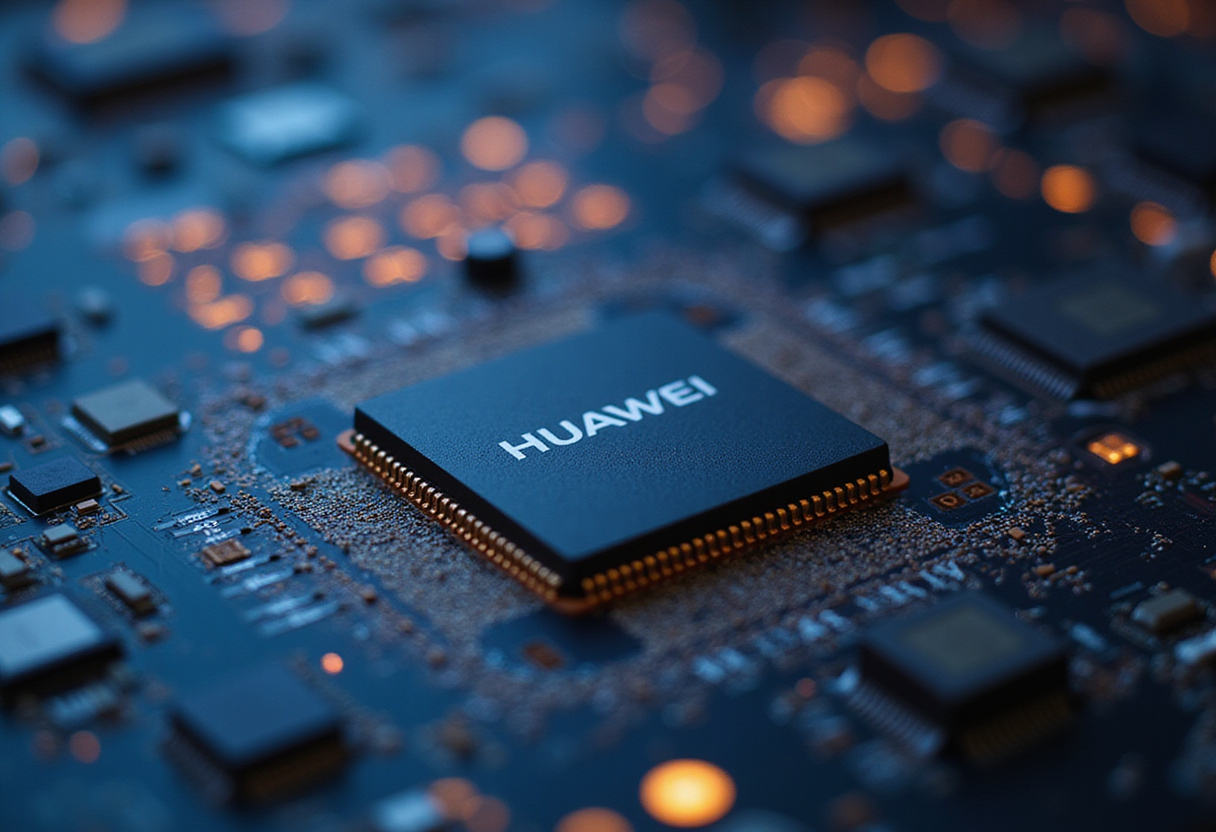
DeepSeek and Huawei will jointly develop open-source software for AI accelerators, Yahoo Tech reported. The Chinese AI lab and the chipmaker plan to release compute libraries, kernel code and toolchain components under an open licence, according to the report. The report provides no licence name, repository, supported chip list or release schedule.
What does each party contribute?
DeepSeek, headquartered in Hangzhou, has released its frontier models as open-weight artefacts. The lab's December 2024 DeepSeek-V3 mixture-of-experts release and its January 2025 reasoning model R1 carry permissive licences that allow downstream redistribution and fine-tuning.
Huawei designs the Ascend family of neural-network accelerators and the proprietary CANN (Compute Architecture for Neural Networks) software stack that supports them. The Ascend line ships primarily into Chinese hyperscale buyers and serves as a domestic alternative to Nvidia hardware.
Why focus on software rather than silicon?
Raw floating-point throughput tells only part of an accelerator's story. Production deployments depend on a software stack — compilers, kernel libraries, communication primitives — that vendors typically keep closed. Nvidia's CUDA ecosystem, developed over more than fifteen years, demonstrates how software, not silicon alone, determines effective throughput on a given model architecture.
Training cost on constrained silicon rises sharply when kernels run below theoretical peak FLOPS, so software quality multiplies the value of every shipped accelerator.
CANN's third-party documentation, kernel breadth and community tooling have historically lagged CUDA. Open-sourcing core components would let independent developers contribute optimisations, port new model operators, and audit compiler internals. The model mirrors the open-source compiler projects — GCC, LLVM — that surround general-purpose CPUs.
What does the open-source scope likely cover?
A complete open-source accelerator toolchain typically contains:
- A compiler that lowers framework graphs (PyTorch, JAX, MindSpore) to chip-specific instructions.
- A kernel library providing the matmul, attention and convolution primitives.
- Communication libraries for collective operations across accelerator clusters.
- Profiling and debugging tools.
- Reference model implementations for benchmarking.
The Yahoo Tech report does not specify which layers the DeepSeek-Huawei collaboration will release, nor whether existing CANN components will be relicensed or whether new components will join the existing closed stack.
What strategic pressures converge here?
Three factors shape the timing:
- US export controls on advanced AI accelerators to China, tightened in October 2023 and updated in December 2024, restricting Nvidia H100, H200 and H20 shipments.
- DeepSeek's open-weight strategy, which reduces lock-in to any single vendor's closed software stack.
- Huawei's installed Ascend base, which needs better third-party software to compete with Nvidia's CUDA-attached workloads.
The collaboration positions both firms to capture training and inference jobs that would otherwise queue behind constrained Nvidia supply.
What is not yet confirmed?
The Yahoo Tech report contains no executive quotation, no licence text, no project name, and no engineering contact. Die Signal has requested comment from DeepSeek and Huawei.
via Google News: AI chip (Source)
More from Amara Osei
Same lot · LOT-C1C6
- DSG-613365nmDeepSeek Releases Huawei AI Chip Tooling, Targets Nvidia Replacement
- DSG-87837nmDeepSeek Teams With Huawei on AI Chip Programming Tools
- DSG-975245nmDeepSeek, Huawei Align on AI Chip Software Stack
- DSG-66815nmHuawei and DeepSeek Join Forces on AI Chip Software
- DSG-19855nmDeepSeek and Huawei team up on AI chip software stack