Test report DSG-4948 · Rev E · tested November 15, 2026
AI Devices & SystemsDevice under test
Tesla Starts Optimus Early Production at Fremont: 1M Robots a Year
Tesla begins early Optimus production at Fremont, sized for 1M robots a year. Musk expects a year-plus ramp and external deliveries near end of 2027. Most circulating numbers remain unconfirmed.
- Read
- 6 min
- Words
- 1,244
- Node
- 14nm
- Operator
- Marcus Bennett
Spec summary
- Tesla has started early Optimus production at Fremont, with the line planned for about 1 million robots per year.
- Musk said reaching full rate could take 'a year, maybe longer'; external deliveries are expected around end of 2027.
- The 20,000 robots-per-week target and $30,000 build cost are unconfirmed figures, not Tesla statements.
- Musk said 'I think probably rent them,' but no rental prices or contract terms have been announced.
- A claimed Giga Texas line with 10 million units per year capacity remains unconfirmed.
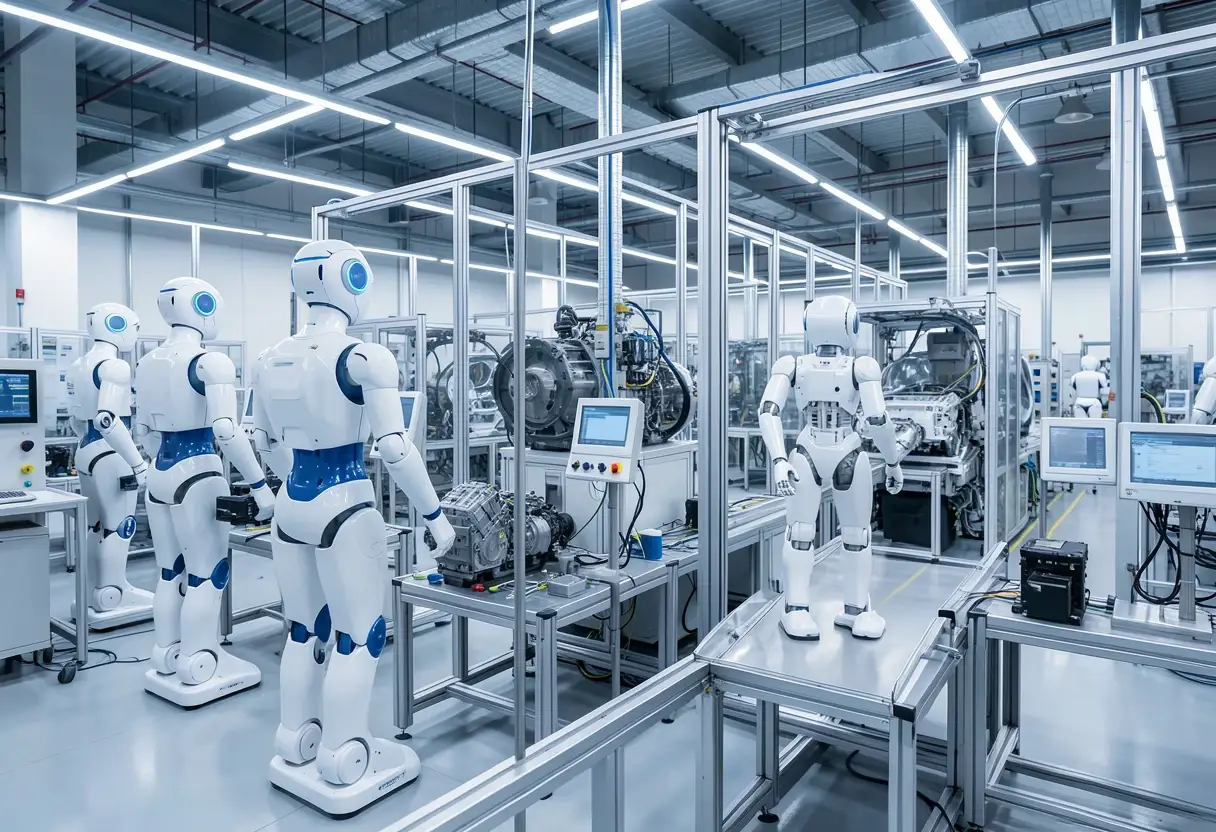
Tesla has started early production of its Optimus humanoid robot at its Fremont, California facility, with the line sized for roughly 1 million robots per year. The company's shareholder materials describe the first units as "the first production-quality bots that we have manufactured." The capacity figure places Optimus among the boldest hardware bets in consumer-adjacent robotics, though nothing in the record shows actual volume yet.
The timeline deserves a careful read. Elon Musk said reaching the planned rate could take "a year, maybe longer," because Tesla is still working through different production-design configurations. He also said Optimus deliveries to companies outside Tesla are expected around the end of 2027.
What has Tesla actually confirmed?
The confirmed set is narrow. Tesla has begun early production at Fremont. The line is planned for about 1 million units per year. Musk stated the ramp timeline and the end-of-2027 delivery window. That is the full list.
Several widely circulated numbers do not appear in official records:
- 20,000 robots per week — unconfirmed target, not an achieved rate
- $30,000 initial build cost, falling toward $20,000 — discussed, unconfirmed
- Rental model — Musk said "I think probably rent them"; no prices or terms exist
- Second-generation Giga Texas line — claimed summer 2027 start, 10 million units per year, unconfirmed
- Optimus V3 specs, AI5 chip details, ~1,000 Gen 3 units, April 2027 AI5 timetable — unconfirmed
"Early production" is a careful phrase. It means the line runs but is not stable. Engineers are still adjusting stations, suppliers are still qualifying parts, and designers are still revising the robot for manufacturability. "Production-quality" tells investors the bots come from production tooling rather than hand assembly, without promising any volume.
What does the 1 million target change?
Capacity and output are different things. A 1 million-unit line describes the factory's ceiling, not yield, uptime, or weekly quality passes. Most commercial humanoid programs still talk about pilot batches and small fleets; a car-scale robot line would move Optimus into a different category. Musk's own "a year, maybe longer" comment signals Tesla expects a long ramp, with the production design still under test in several configurations.
The 20,000-per-week target is at least arithmetically consistent with the headline capacity: 20,000 weekly over 52 weeks equals 1.04 million per year. That is our calculation, not a Tesla statement. It suggests both figures describe the same ambition from two angles. It does not prove Tesla can build that many, and delivering 20,000 humanoids weekly would demand actuators, sensors, batteries and compute at volumes few robotics suppliers have ever shipped.
The sequence implied by Musk's remarks matters for buyers. Tesla builds early units, refines the design, then ships to outside companies late in 2027 while the line still ramps. Early customers would get limited allocations first, wider availability later.
The cost question: $30,000 falling toward $20,000
A $30,000 initial manufacturing cost, falling toward $20,000, was discussed in connection with the program. This is build cost, not customer price. Margins, service, software and financing would sit on top. No customer price or rental terms have been announced.
The capital math shows why unit cost dominates. At 1 million units per year:
- 1,000 units: $30M at $30,000 each versus $20M at $20,000
- 100,000 units: $3B versus $2B
- 520,000 units (half a year at 20,000/week): $15.6B versus $10.4B
- 1,000,000 units: $30B versus $20B
A full year at the planned rate would mean tens of billions of dollars in build cost alone. That is one reason a rental or lease model would shape cash flow so heavily: Tesla would carry the hardware cost while revenue arrives over time.
Rent or sell?
Musk said "I think probably rent them" — a voiced preference, not an announced model. The logic is straightforward. Renting lets Tesla keep control of the fleet, collect operating data and swap failed units. It also lowers the upfront barrier for a factory owner testing a humanoid. The tradeoff lands on Tesla's balance sheet. Any monthly-fee figure circulating now is speculation.
What jobs come first?
The initially intended work is dangerous, repetitive, or round-the-clock industrial work. That is a sensible beachhead. Factories have jobs people dislike, jobs that injure, and jobs running through the night. Industrial settings are also structured — fixed layouts, known parts, trained supervisors — which lowers the technical bar compared with a home kitchen. Tesla has not claimed household use as a near-term goal.
Tesla also holds an advantage no pure robotics startup can match: its own factories provide a built-in test customer. Robots can work in Tesla plants first, generate failure data, then ship to outside buyers once the design settles. Whether internal deployment is already happening at scale is not confirmed.
Hardware, memory and competition
A humanoid is a dense hardware package: onboard AI compute, memory, batteries, sensors and dozens of actuator-driven joints. Each carries its own supply chain, and each can become a bottleneck at hundreds of thousands of units. Memory is the most visible pressure point; SK hynix has locked up more than 50% of 2027-28 HBM4 capacity, and a robot maker competing with data center buyers faces higher prices.
The competitive field is well funded. Agile Robots raised $500M at an $8.5B valuation with SoftBank leading. Apple's HALO software hit 91% across 360 trials on a Unitree G1, showing the hardware and software races are separating. Tesla's pitch is that it can do both at car-factory scale. Its risk is that humanoids demand hand dexterity and safe human interaction, which differ from road driving in important ways — the exact gap rivals with tactile-sensing research, such as Robbyant's open-source LingBot-Touch model trained on 5,000 hours, are attacking.
What does this change for investors?
Optimus now has a physical anchor. Shareholders can demand evidence — units built, cost per unit, customer commitments — instead of demos. The financial test is demanding: layering a capital-hungry robot program on top of Tesla's existing bets raises the stakes. If Optimus reaches volume, it opens a new revenue line; if it stalls, it becomes one more promise competing for capital.
Suppliers stand to gain first. Makers of motors, gearboxes, sensors, batteries and memory would see new demand if the plan holds, and that effect should appear in supplier guidance before Tesla's deliveries — making component makers a useful early indicator through 2027.
What to watch next
Humanoid robotics has a long record of impressive demos and slow commercial rollouts. Tesla scaled EV production to a very large size, and it has also reset production targets before. Real production tooling is a step beyond a stage demo; the 1 million-unit ambition has yet to face a real ramp.
Five signals will show whether the plan is on track:
- A shareholder update stating units built, not just capacity
- A named outside customer — the first real proof of demand
- Rental pricing or contract language from Tesla itself
- Robotics-related orders in supplier earnings filings
- Any redesign of the configurations Musk mentioned, which could push the ramp further out
None of these events has a confirmed date. Until then, the 10 million-per-year Giga Texas figure and the V3/AI5 specifications remain rumor-grade numbers, ten times and several steps beyond what the record supports.
via shattered.io (Source)
More from Marcus Bennett
Show full bio
News editor covering regulation, policy and their impact on hardware layer of artificial intelligence at Die Signal.
591 articles
Same lot · LOT-362B
- DSG-43535nmTesla Robotaxi 24/7: What Is Confirmed and What Is Not
- DSG-61133nmTesla Opens Cybercab Orders at $29,990 — With No Steering Wheel
- DSG-670010nmTesla Cuts AI5 Memory to 72 GB, AI6 to 144 GB
- DSG-789620nmBloomberg Lifts 2030 AI Accelerator Forecast to $1.4 Trillion
- DSG-77475nmHumanoid Robots to Drive 20-Fold DRAM Demand Jump by 2030