Test report DSG-8792 · Rev C · tested November 16, 2026
AI Devices & SystemsDevice under test
Scentronic Wearable Sends Smells Over the Internet at 96% Accuracy
Ohio State and Zhejiang Lab's Scentronic classifies five odors at 96%+ accuracy and releases them remotely. Humans identified delivered scents 73% of the time. Commercial use: years away.
- Read
- 4 min
- Words
- 726
- Node
- 3nm
- Operator
- Grace Kim
Spec summary
- Scentronic paper published in Science Advances on October 21, 2026
- Electronic nose classified 5 odors (coffee, beer, red wine, orange, cake) with over 96% accuracy
- Human participants identified delivered single odors ~73% and paired scents ~71%; handheld test had 14 volunteers
- Form factors: wristband with 2 odor channels, necklace with 5, plus a handheld version
- Researcher Yang calls it a laboratory prototype; commercial availability expected in several years, potentially longer
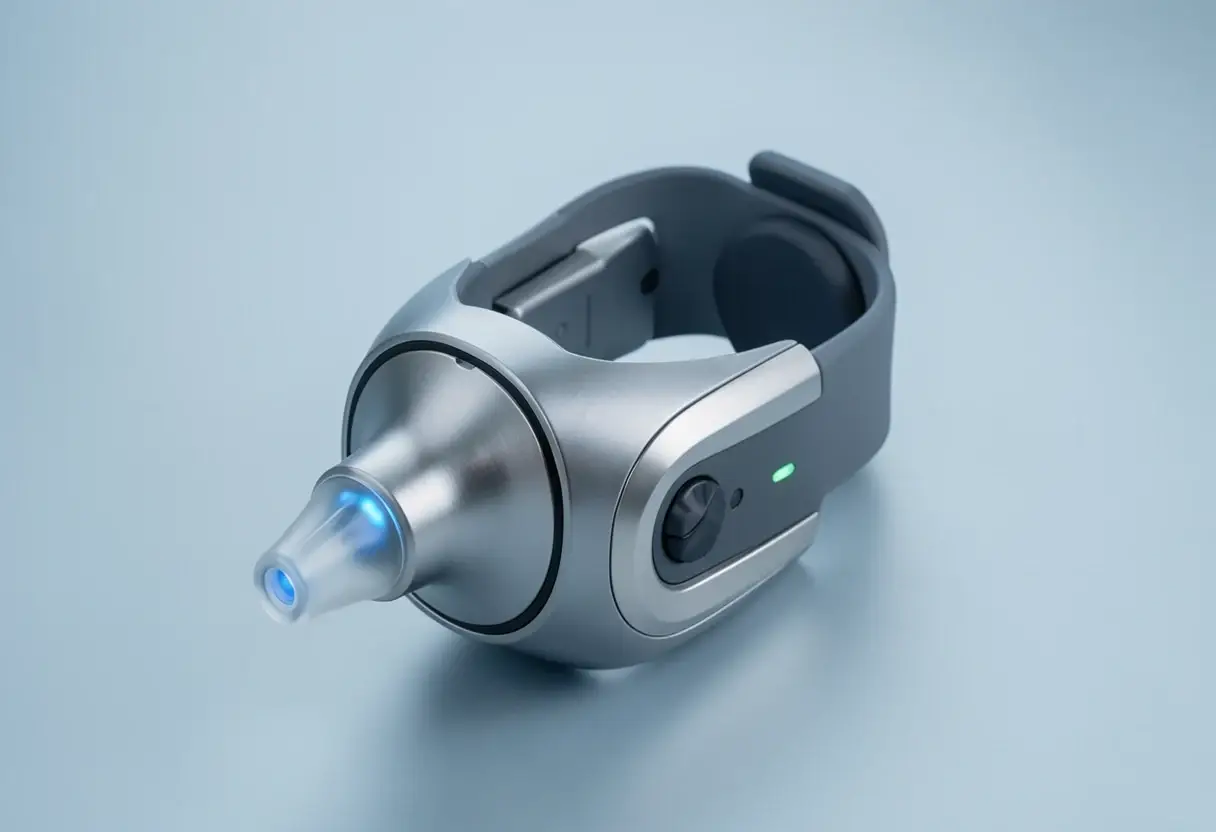
An electronic nose that classifies five odors with over 96% accuracy sits at the core of Scentronic, a wearable system from The Ohio State University and Zhejiang Laboratory that captures a smell in one location and releases it at another. The paper landed in Science Advances on October 21, 2026, and coverage has kept building through November.
The system has three parts. A sensing unit — an electronic nose that records electrical responses of sensors exposed to airborne chemicals — produces a fingerprint-like pattern. An AI model sorts that pattern into known categories: coffee, beer, red wine, orange and cake. A release device then sprays scented liquid as fine droplets through miniature atomizers near the wearer's nose. Data crosses the internet, not molecules.
What do the numbers actually say?
The published figures split into machine and human results, and conflating them overstates the work.
- Electronic nose accuracy across 5 odors: over 96%
- Participants identifying single odors: about 73%
- Participants identifying paired scents: about 71%
- Volunteers in the handheld-device test: 14
- Wristband odor channels: 2; necklace: 5
The pipeline loses roughly 23 points between sensor and nose. The sources don't break that loss down. Candidates include imperfect droplet delivery, air movement, individual smell differences, and the difficulty of naming an unseen odor. Context matters: random guessing among five scents lands near 20%, so 73% shows the delivered scent carries real information — but mislabeling one scent in four would frustrate users and disqualifies safety-adjacent uses entirely. The two-point drop for paired scents is encouraging, though 14 volunteers is too small a sample for firm conclusions.
The receiver doesn't synthesize smells from scratch. It picks from pre-loaded liquids, so sender and receiver must share a scent vocabulary. You can send "coffee," not this specific roast at this moment. The classifier behaves like emoji for the nose, not a recording.
Why the library stops at five
Each new aroma requires new sensor data, labeling and validation. Five scents is a lab chore; five hundred is a logistics problem. There's no smoke, no gas warning, no flowers in the test set. Whether the 96% holds as categories multiply — citrus and floral notes share volatile compounds — is the single most useful follow-up measurement, and nobody has reported it.
The team built three form factors. The wristband carries 2 channels; the necklace carries 5, covering all tested scents but sitting at fixed distance from the nose. The handheld version, used in the 14-volunteer test, isn't hands-free. Placement decides use: a necklace suits long video calls, a wristband suits deliberate moments.
Networked-hardware veterans will recognize the pattern instantly. Scent data is tiny compared with video, survives travel, and can be stored or attached to messages. Latency isn't the bottleneck — droplet physics and scent lingering in a room are. Ordinary broadband handles the data part.
What does the researcher say?
Researcher Yang framed the goal plainly: "Scentronic has the potential to allow people to share smells with others over long distances, much like we currently share images, sounds, and videos." Yang's hook example: "someone could share the aroma of their coffee with a friend in another city."
On readiness, Yang was equally direct. "Scentronic is currently a laboratory prototype," with commercial availability expected to take "several years, potentially longer." That's the most important sentence in the coverage cycle, and most of the excitement skips it.
What changes for whom?
Reports list telepresence, VR and AR, online shopping, accessibility and human-machine interaction as potential uses. No product, price or release date exists. No company beyond the two institutions has been identified as a developer. No battery life, weight or refill cost has been published. Treat any preorder claim with suspicion.
Historically, this closes old gaps. Smell-O-Vision failed in mid-century cinemas; later scent gadgets for games gathered dust. Nobody could measure smell cheaply, describe it digitally, or deliver it without bulky cartridges. Scentronic attacks all three with an e-nose, machine learning and wearable atomizers — the AI step being the genuine change from earlier decades.
The takeaway: the science is real, the product is not, and the distance between them is measured in years. Watch for larger scent libraries, larger human trials, and any commercial partner. Until then, sharing your morning coffee cross-country stays a lab demo.
via shattered.io (Source)
More from Grace Kim
Show full bio
Market editor covering regulation, policy and their impact on hardware layer of artificial intelligence at Die Signal.
665 articles
Same lot · LOT-362C
- DSG-517710nmMicrosoft Links Wisconsin and Atlanta Sites Into First AI 'Superfactory'
- DSG-305965nm403 US Data Centers Draw as Much Power as Austria
- DSG-639714nmGoogle Unveils Edge AI Chip That Cuts Power Use 40% for Wearables
- DSG-46123nmBlackwell Fingerprints Found in Kimi K3 and DeepSeek V4 Weights
- DSG-545314nmStretchable Diode Cuts Robot Skin Sensor Crosstalk to 0.3%