Test report DSG-8985 · Rev B · tested October 10, 2026
Foundries & ManufacturingDevice under test
Samsung Electronics Wins $200B Broadcom AI Chip Partnership
Samsung Electronics has secured a $200 billion AI chip manufacturing partnership with Broadcom, Reuters reports, marking the Korean group's largest foundry commitment as it seeks share from TSMC.
- Read
- 3 min
- Words
- 567
- Node
- 28nm
- Operator
- Marcus Bennett
Spec summary
- Samsung Electronics secured an AI chip manufacturing partnership with Broadcom valued at $200 billion, per a Tuesday Reuters report
- The deal ranks as Samsung's largest publicly disclosed foundry agreement, supporting its foundry segment's expansion against market leader TSMC
- Process node, contract duration and volume schedule remain undisclosed in the Reuters report
- Broadcom designs custom AI accelerators for hyperscalers including Alphabet's Google and Meta Platforms
- Samsung's foundry segment has historically lagged TSMC and remains smaller than the conglomerate's memory business
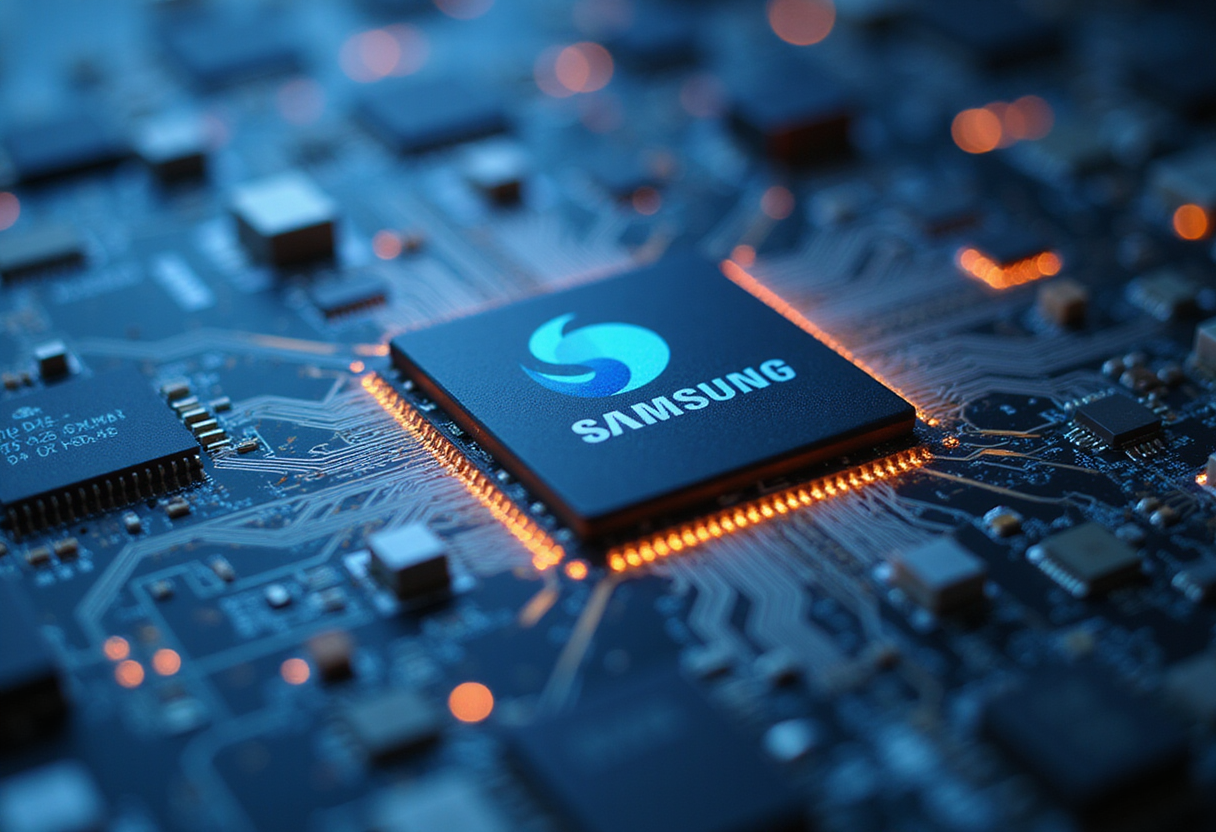
Samsung Electronics has secured a manufacturing partnership with Broadcom to produce AI chips, valued at approximately $200 billion, according to a Reuters report Tuesday. The agreement ranks among the largest foundry contracts publicly disclosed and is a significant contract for Samsung's foundry business as it competes with Taiwan Semiconductor Manufacturing Company (TSMC).
The deal centers on Samsung's fabrication of Broadcom-designed AI accelerators. While Reuters did not specify the contract term, process node, or volume schedule, the $200 billion cumulative value positions the partnership as a step-change for Samsung's foundry scale.
What does the deal signal for Samsung?
For Samsung, the Broadcom commitment provides anchor volume for foundry capacity that has tracked well below TSMC's share of the global market. Samsung's foundry segment generates substantially less revenue than the conglomerate's memory business, which remains the larger profit contributor.
The partnership gives Samsung a second marquee AI chip customer alongside its existing advanced-node work, reducing customer concentration risk in the foundry order book. Foundry revenue at Samsung has, per recent corporate disclosures, lagged the memory segment by a wide margin; a multi-billion-dollar annual run-rate from Broadcom volumes would shift the segment's contribution to group earnings.
How does this affect the supply chain?
For Broadcom, qualifying Samsung as a high-volume manufacturer provides an alternate supplier for the AI accelerators it designs for hyperscaler customers including Alphabet's Google and Meta Platforms. Single-foundry dependency has become a procurement concern for cloud providers, which have diversified orders across TSMC, Samsung, and Intel Foundry Services for non-leading-edge parts.
Multi-foundry qualification also lets Broadcom negotiate wafer pricing and capacity allocation more aggressively during periods of tight supply, a recurring condition across 3nm and 4nm process nodes since 2023.
What production details remain undisclosed?
The Reuters report does not state:
- The specific process node (3nm, 4nm, 5nm, or forthcoming 2nm) Samsung will use
- The contract duration; whether $200 billion represents roughly $20 billion per year across a decade or a different run-rate
- The expected start date for high-volume manufacturing
- Whether the agreement includes co-investment in Samsung's planned Taylor, Texas fabrication facility
Samsung's next quarterly earnings disclosure should provide initial guidance on revenue contribution and capacity utilization tied to the Broadcom engagement.
How does this fit into industry context?
The custom AI accelerator market — chips designed for specific hyperscaler workloads and manufactured by third-party foundries — has scaled rapidly since 2023, when large-language-model-driven GPU demand exposed bottlenecks in Nvidia's general-purpose supply chain. Broadcom has emerged as a leading merchant supplier in this segment, alongside Marvell Technology, with custom-silicon revenue tied closely to accelerator orders at major cloud customers.
A $200 billion foundry agreement signals that AI accelerator wafer demand will continue to outpace supply through the late 2020s, supporting the capacity build-out that Samsung and TSMC have prioritized in their capital expenditure plans. TSMC controls the majority of advanced-node foundry volume; Samsung's Broadcom commitment is its largest single anchor order on record.
Samsung's share price climbed on the Reuters report, extending gains tied to its broader AI hardware exposure, which includes high-bandwidth memory used in Nvidia's data-center GPUs. The deal positions Samsung to compete for additional custom-AI design wins as hyperscalers continue to expand their in-house silicon programs.
via Google News: Semiconductor foundry (Source)
More from Marcus Bennett
Show full bio
News editor covering marketplaces and e-commerce at Die Signal.
274 articles
Same lot · LOT-C1C6
- DSG-40697nmSamsung and Broadcom Expand Collaboration on Memory and Foundry
- DSG-41423nmBroadcom Locks Samsung Memory Pricing at Nvidia Parity
- DSG-701410nmSamsung Projects Foundry Customer Base to Quadruple by 2029
- DSG-491445nmSamsung Foundry Revenue Rose in Q2 2026 but Trailed TSMC
- DSG-852220nmSamsung Posts 783% Profit Jump to Record $80 Billion on AI Demand