Test report DSG-2895 · Rev D · tested September 29, 2026
Edge AI SiliconDevice under test
NVIDIA Unveils RTX Spark AI Superchip
NVIDIA launches the RTX Spark AI superchip, extending its battle with Apple and Intel into local inference hardware for desktops and developer workstations.
- Read
- 4 min
- Words
- 806
- Node
- 3nm
- Operator
- Priya Raman
Spec summary
- NVIDIA has launched the RTX Spark, a superchip aimed at local AI processing workloads.
- The launch intensifies competition with Apple and Intel in the on-device AI silicon market.
- The outcome will hinge on software ecosystems, memory bandwidth, and price and availability.
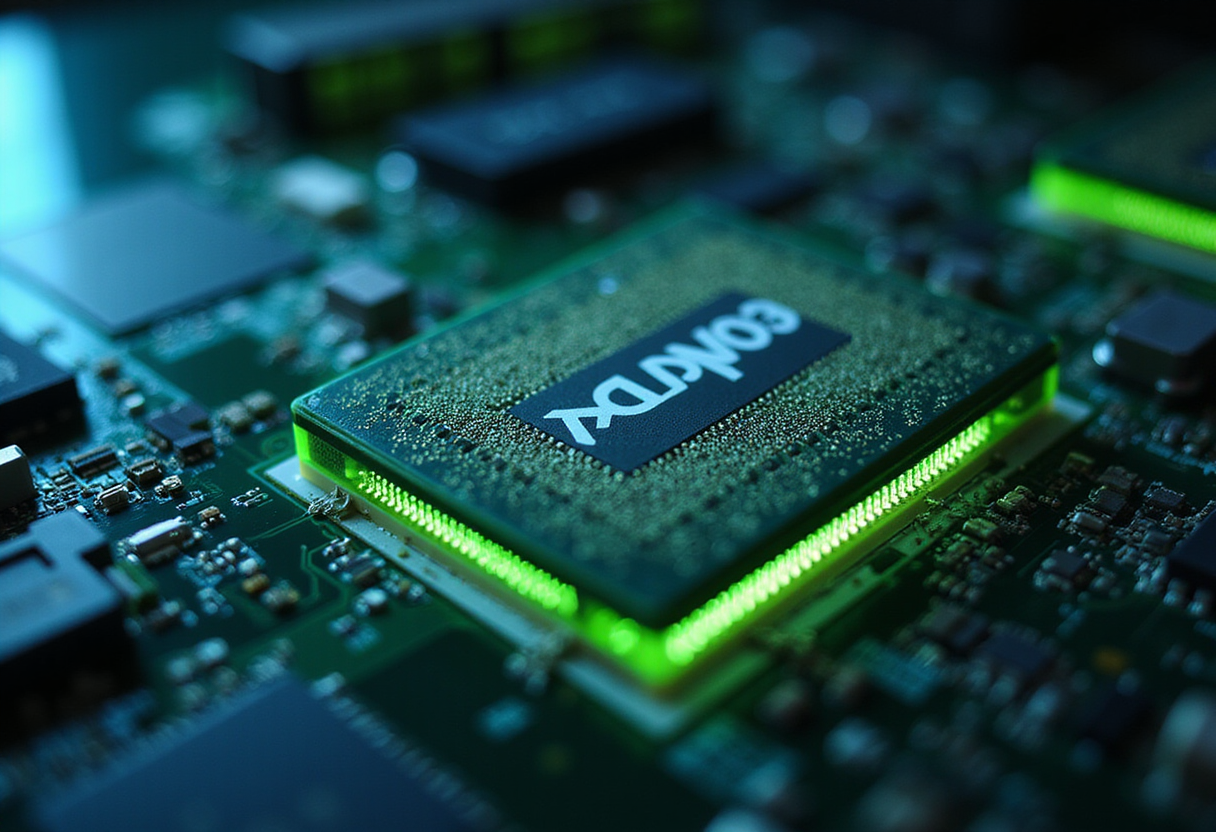
NVIDIA has officially launched the RTX Spark, a superchip the company positions at the center of the next generation of local artificial intelligence processing. The announcement escalates the three-way competition between NVIDIA, Apple, and Intel for workloads that increasingly run on-device rather than in the cloud.
The launch confirms what industry observers have tracked for the past several quarters: the market for high-throughput AI inference hardware is no longer a cloud-datacenter story alone. Chipmakers now compete for desktop machines, workstations, and developer desks, where large language models, image generators, and other neural workloads must execute without round-trips to remote servers.
NVIDIA's move carries weight because of the company's current position. Its accelerators dominate the training segment of the AI hardware market, and the CUDA software stack remains the default development environment for most machine learning engineers. With the RTX Spark, NVIDIA extends that installed base advantage into a product class where Apple and Intel have each staked their own claims.
Apple's approach rests on integrated silicon. Its in-house processors pair unified memory architectures with dedicated neural engines, delivering inference performance inside consumer devices while keeping power budgets tight. The company has marketed this capability heavily to developers building AI features into macOS and iOS applications. Intel, for its part, has embedded AI acceleration into its mainstream CPU lines and dedicated add-in products, targeting the enormous installed base of x86 systems across consumer and enterprise segments.
The RTX Spark enters that contest directly. By branding the product a "superchip," NVIDIA signals a tightly integrated design rather than a conventional discrete graphics card — a packaging strategy intended to deliver maximum AI throughput per unit of power and physical volume. That framing places the product alongside the integrated architectures favored by its rivals rather than above them in a separate category.
Three factors will determine how the competitive dynamics play out.
First, software. NVIDIA's CUDA ecosystem gives the company a formidable moat. Developers who have built tooling, training pipelines, and inference stacks on NVIDIA hardware face switching costs when evaluating alternatives. Apple counters with its own development frameworks, while Intel has invested heavily in open software stacks to lower adoption barriers for its silicon. The RTX Spark's success depends in part on how much of the existing NVIDIA software stack carries over without modification.
Second, memory bandwidth. Local inference of large models is frequently constrained not by raw compute but by how quickly a chip can feed weights to its processing units. Integrated designs with high-bandwidth memory access can outperform nominally faster chips that starve for data. Apple's unified memory architecture was designed with exactly this constraint in mind. NVIDIA's engineers understand the problem well from the datacenter side; the question is how the RTX Spark's memory subsystem translates that expertise into a desktop-class product.
Third, price and availability. NVIDIA has historically commanded premium pricing for its top-tier silicon, sustained by demand that has repeatedly outstripped supply. Rivals have used those price levels as an opening, offering adequate performance at lower cost. If the RTX Spark ships in volume at a price point accessible to individual developers and small teams, it could compress the space competitors have targeted. If supply is constrained at launch, as NVIDIA products have been in recent cycles, Apple and Intel gain time to solidify their positions.
The broader context matters as well. Enterprises are actively evaluating hybrid AI architectures that split workloads between cloud and local hardware. Privacy requirements, latency budgets, and the recurring cost of API calls all push a portion of inference onto local silicon. Every percentage point of that workload migration represents addressable market for all three companies, which explains the intensity of the current product race.
For buyers, the immediate practical questions are concrete: how many tokens per second does the RTX Spark deliver on widely used open models, what is the thermal envelope, and what does the total cost of ownership look like against incumbent options. NVIDIA has not yet published full benchmark data for all these dimensions. Independent testing will follow availability.
What is clear is the strategic direction. NVIDIA refuses to concede any segment of the AI hardware market, from hundred-thousand-GPU training clusters down to the chip inside a developer's desktop machine. The RTX Spark makes that ambition explicit, and it puts Apple and Intel on notice that the competition for local AI silicon will be fought product cycle by product cycle.
The winners in this contest will not be decided by press releases. They will be decided by benchmark results, developer adoption, and delivery volumes over the coming quarters. NVIDIA has opened its next front; the response from Cupertino and Santa Clara will define the shape of the local AI hardware market for years ahead.
via Google News: AI PC chip (Source)
More from Priya Raman
Same lot · LOT-C1BA
- DSG-69337nmNvidia Launches 'RTX Spark' AI PC Chip, Targeting Intel and AMD
- DSG-369465nmNVIDIA Ships DGX Spark 64GB at $4,999 for Local AI
- DSG-275614nmDeepSeek and Huawei Partner on Chip Programming Tools
- DSG-71947nmCerebras stock slides on report Nvidia powers OpenAI 'Ultrafast'
- DSG-82995nmCoreWeave Puts NVIDIA Vera Rubin NVL72 Into Production