Test report DSG-7931 · Rev B · tested October 10, 2026
Edge AI SiliconDevice under test
Nvidia enters PC AI chip market, targets Apple and Intel directly
Nvidia has introduced an AI chip for personal computers, placing the company in direct competition with Apple's Neural Engine silicon and Intel's NPU-equipped Core processors in the on-device AI category.
- Read
- 3 min
- Words
- 529
- Node
- 65nm
- Operator
- Marcus Bennett
Spec summary
- Nvidia has introduced an AI chip designed for personal computers, its first dedicated push into client-side AI silicon.
- The product places Nvidia in direct competition with Apple's Neural Engine and Intel's NPU-equipped Core processors.
- The PC AI chip category had been a two-company contest between Apple's integrated NPU silicon and Intel's NPUs in recent Core generations.
- Specifications including chip name, TOPS rating, fabrication process, pricing and OEM partners were not disclosed in the source.
- Software support via CUDA, TensorRT or an equivalent AI deployment stack will determine real-world performance against Apple's frameworks and Intel's OpenVINO toolkit.
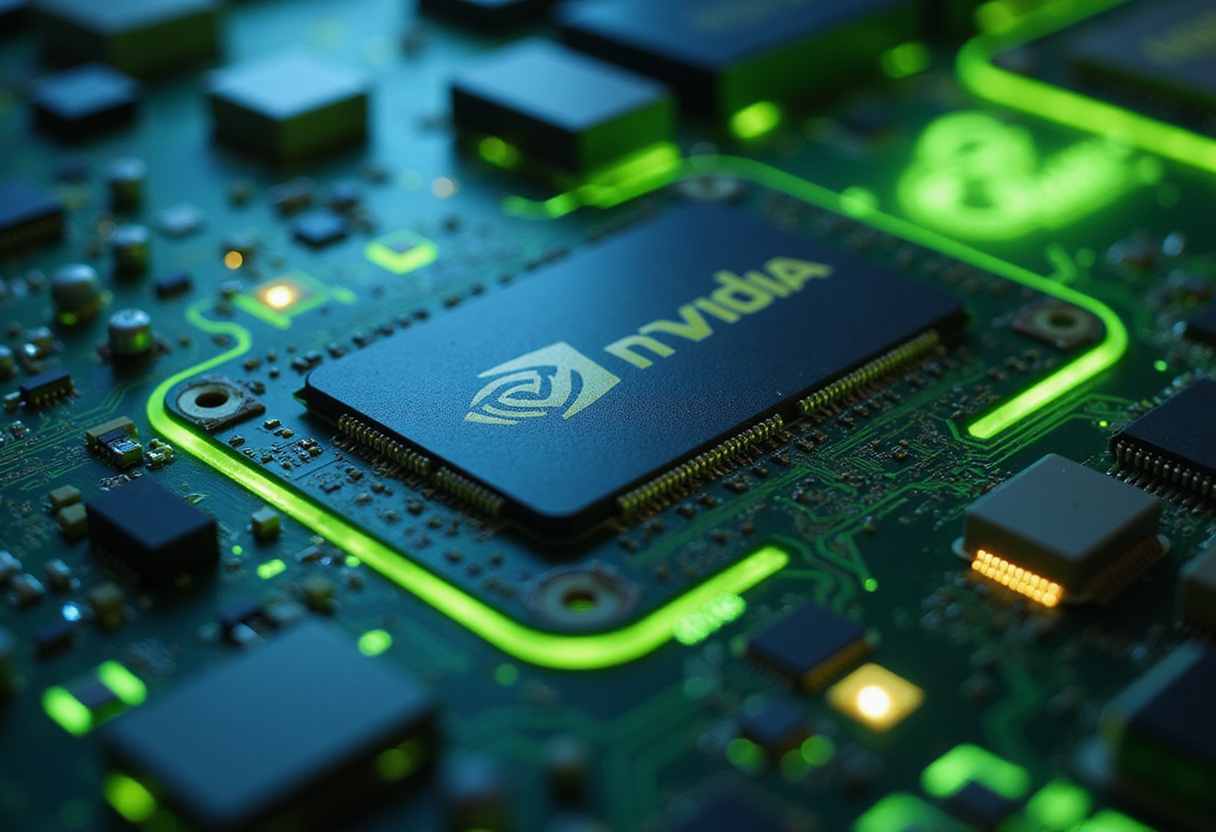
Nvidia has introduced an AI chip built for personal computers, placing the company in direct competition with Apple and Intel in the on-device AI silicon category.
The product marks Nvidia's first dedicated push into client-side AI hardware. Until now, Nvidia's AI silicon has centered on data center accelerators for training and inference workloads. Personal computer AI workloads have been handled by integrated accelerators built into competing architectures, not by discrete Nvidia parts.
What does the move change?
The PC AI chip category has so far been a two-company contest. Apple has built dedicated neural processing silicon into its Mac systems on chip. Intel has integrated NPUs into recent Core generations to meet Microsoft's AI PC specification. Nvidia's chip adds a GPU-rooted architecture into the same design slot.
Why is this framed as a direct challenge to Apple and Intel?
The reporting casts the product as a confrontation rather than a complementary offering. Nvidia's GPU heritage positions the chip against integrated NPUs on throughput, software stack maturity and AI framework support. Apple's vertical integration of hardware and macOS leaves little room for third-party AI silicon in its Mac lineup. Intel's x86 dominance in Windows PCs means any competing AI accelerator must displace NPU silicon or sit alongside it as a discrete companion.
The challenge cuts differently against each rival. Against Apple, Nvidia would compete for the attention of developers and pro users who currently rely on the Neural Engine. Against Intel, Nvidia would compete for OEM design wins in the AI PC category.
What questions remain unanswered?
The available reporting does not specify the chip name, fabrication process, TOPS rating, memory subsystem, power envelope, OEM partners, pricing or release window. Without those details, head-to-head comparisons to Apple's Neural Engine and Intel's NPU generations remain claims rather than benchmarked results.
Software support will shape real-world performance. Apple's Neural Engine runs against frameworks optimized for the M-series SoC. Intel's NPU ships with the OpenVINO toolkit and the broader Windows Copilot runtime. Nvidia's PC chip would need CUDA, TensorRT or an equivalent AI deployment stack to reach rated throughput on consumer hardware.
What is the market impact?
A third major AI accelerator architecture in the PC market fragments the AI PC category but also expands design options for OEMs. PC makers have so far balanced between Apple's ARM-based macOS ecosystem and Intel's x86 Windows base, with AMD Ryzen AI as a third x86 option. Nvidia's silicon introduces a fourth hardware path, with software tooling drawn from its existing GPU and data center ecosystem.
Distribution is a separate question. Nvidia's existing PC presence runs through GeForce RTX discrete GPUs sold as add-in cards or inside laptops. A chip positioned as the primary AI accelerator in a system rather than a companion GPU would require deeper OEM integration than the GeForce channel provides today.
The chip's pricing, OEM uptake and software support will determine whether Nvidia's challenge to Apple and Intel remains a headline claim or translates into measurable share gains in the AI PC market.
via Google News: AI PC chip (Source)
More from Marcus Bennett
Show full bio
News editor covering marketplaces and e-commerce at Die Signal.
278 articles
Same lot · LOT-C1C6
- DSG-710314nmMicrosoft Claims Nvidia-Powered Laptop Beats MacBooks on AI Tasks
- DSG-28953nmNVIDIA Unveils RTX Spark AI Superchip
- DSG-605228nmNvidia pitches RTX Spark 'superchip' as the personal AI computer
- DSG-27287nmNvidia Bets Its AI PC Push on Demand That Has Yet to Materialize
- DSG-15747nmNvidia-backed Upscale AI launches platform to link rival chips