Test report DSG-8900 · Rev E · tested October 13, 2026
Processors & AcceleratorsDevice under test
Nvidia's China AI Chip Share Falls to 34% as Huawei Closes In
Nvidia's China AI chip share has slipped to 34% as Huawei captures the ground opened by US export controls — a structural shift for global AI compute buyers.
- Read
- 3 min
- Words
- 509
- Node
- 28nm
- Operator
- Elena Vasquez
Spec summary
- Nvidia's share of China's AI chip market has fallen to 34%.
- Huawei is the primary competitor closing the gap with Nvidia in China.
- US export restrictions created the opening for Huawei's domestic AI chips.
- Roughly one in three AI chips sold in China is now Nvidia's.
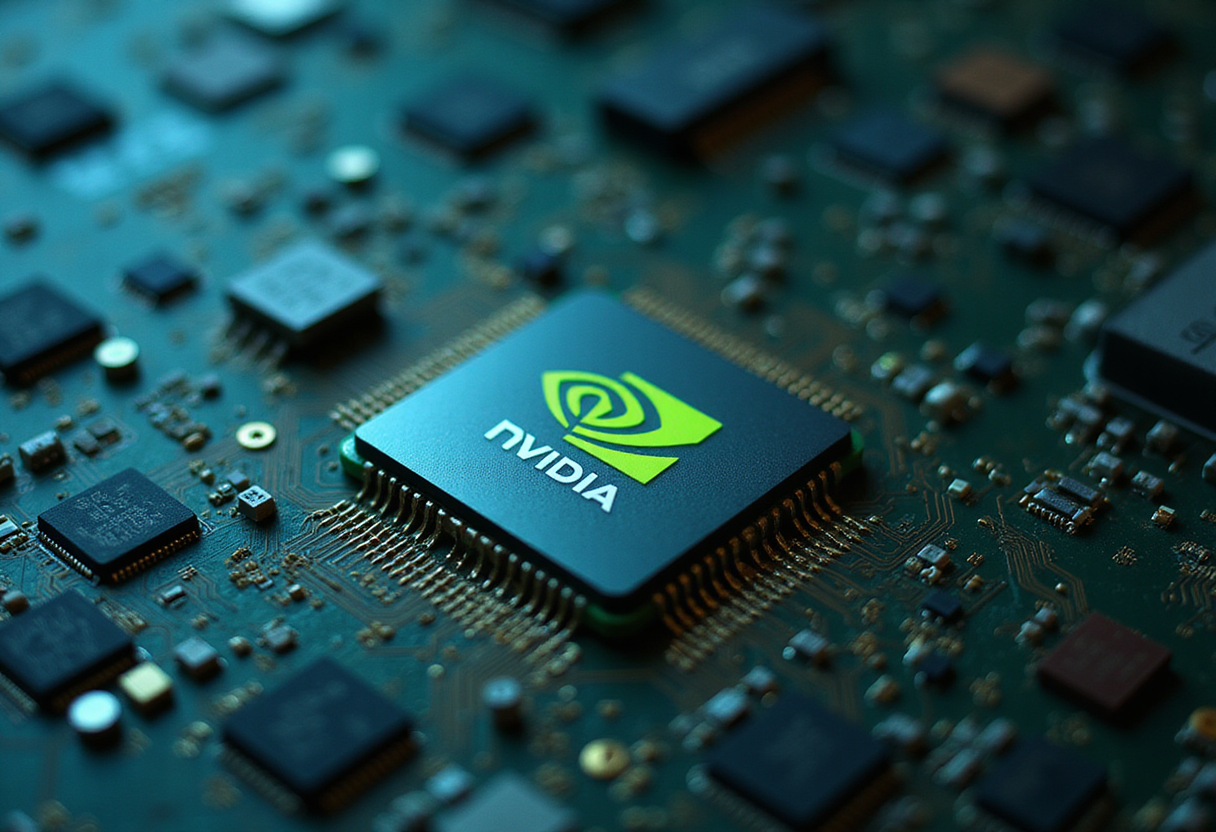
Nvidia's share of China's AI chip market has slipped to 34%, and Huawei is the competitor doing the catching up, according to a BigGo Finance report. For a company that not long ago treated China as a near-captive market, that number marks a genuine inflection point — roughly a third of the market is now all Nvidia has left to defend there.
Why does 34% matter?
It's the clearest quantitative signal yet that US export controls have done what they were designed to do: open space for a domestic rival. Nvidia can't sell its top-tier data center GPUs in China, and Huawei has moved into the gap with its own Ascend-series accelerators.
For practitioners, the read is straightforward. If you're building AI infrastructure in China, your procurement math now includes a serious domestic option. If you're building anywhere else, your supply chain assumptions about Nvidia's global pricing power just got a bit shakier — every point of share Nvidia loses in China is share captured by a competitor that doesn't compete in your market.
How did Huawei close the gap?
The mechanism is Washington's own export restriction regime. Each round of curbs pushed Nvidia's most capable silicon out of Chinese buyers' reach, and Chinese buyers responded the way any rational customer would: they qualified the alternative. Huawei's share is rising as that qualification cycle matures.
That dynamic matters beyond the two companies involved. A chip market that fragments along regulatory lines behaves differently from a unified one — pricing, availability timelines, and software ecosystems all start to diverge. CUDA lock-in remains Nvidia's strongest card outside China, but inside China its ecosystem advantage erodes a little with every deployment Huawei lands.
What changes for the market?
Three practical consequences follow from the 34% figure:
- Chinese AI builders face a real architecture choice for the first time in years, not just a single-vendor procurement exercise.
- Nvidia's China revenue ceiling is now structurally lower than it was before the export-control era, regardless of demand strength in the region.
- Huawei gains reference deployments and scale, which feeds back into its ability to compete on performance and software maturity over time.
The trend line matters as much as the snapshot. A slide to 34% implies momentum, and momentum in chip markets tends to compound — design wins this year become installed bases next year, and installed bases shape developer ecosystems the year after that.
What should you watch next?
The next data points that will confirm or complicate this picture are follow-up share readings over the coming quarters. If Nvidia's number stabilizes around a third, we're looking at a durable duopoly inside China. If the slide continues, Huawei becomes the default rather than the alternative — a very different market structure with very different implications for anyone sourcing AI compute globally.
One in every three AI chips sold in China is now Nvidia's. Two years ago, that framing would have sounded absurd. It doesn't anymore.
via Google News: AI chip (Source)
More from Elena Vasquez
Show full bio
Senior reporter covering people, launches and day-to-day practice in hardware layer of artificial intelligence at Die Signal.
295 articles
Same lot · LOT-C1C9
- DSG-148228nmNvidia Loses Ground in China as Huawei Closes AI Chip Gap
- DSG-152245nmNvidia's China AI-Chip Share Slides as Huawei Closes Gap
- DSG-439910nmNvidia loses AI chip share in China as Huawei closes the gap
- DSG-81705nmHuawei says AI chip demand outstrips supply as Nvidia challenge grows
- DSG-49517nmHuawei chairman: Ascend has passed Nvidia in China AI chip market