Test report DSG-1072 · Rev C · tested October 13, 2026
Processors & AcceleratorsDevice under test
Microsoft Ships Maia 300 AI Chip, Targets One Million Units in 2025
Microsoft launches the Maia 300 AI chip and plans to deploy over one million units in 2025, scaling in-house silicon to fleet level.
- Read
- 3 min
- Words
- 602
- Node
- 5nm
- Operator
- Amara Osei
Spec summary
- Microsoft has launched the Maia 300 AI chip.
- Microsoft plans to deploy over one million Maia 300 units in 2025.
- Deployment is internal to Microsoft's own datacenters, not merchant sales.
- Full specifications, pricing and fab partners have not been disclosed.
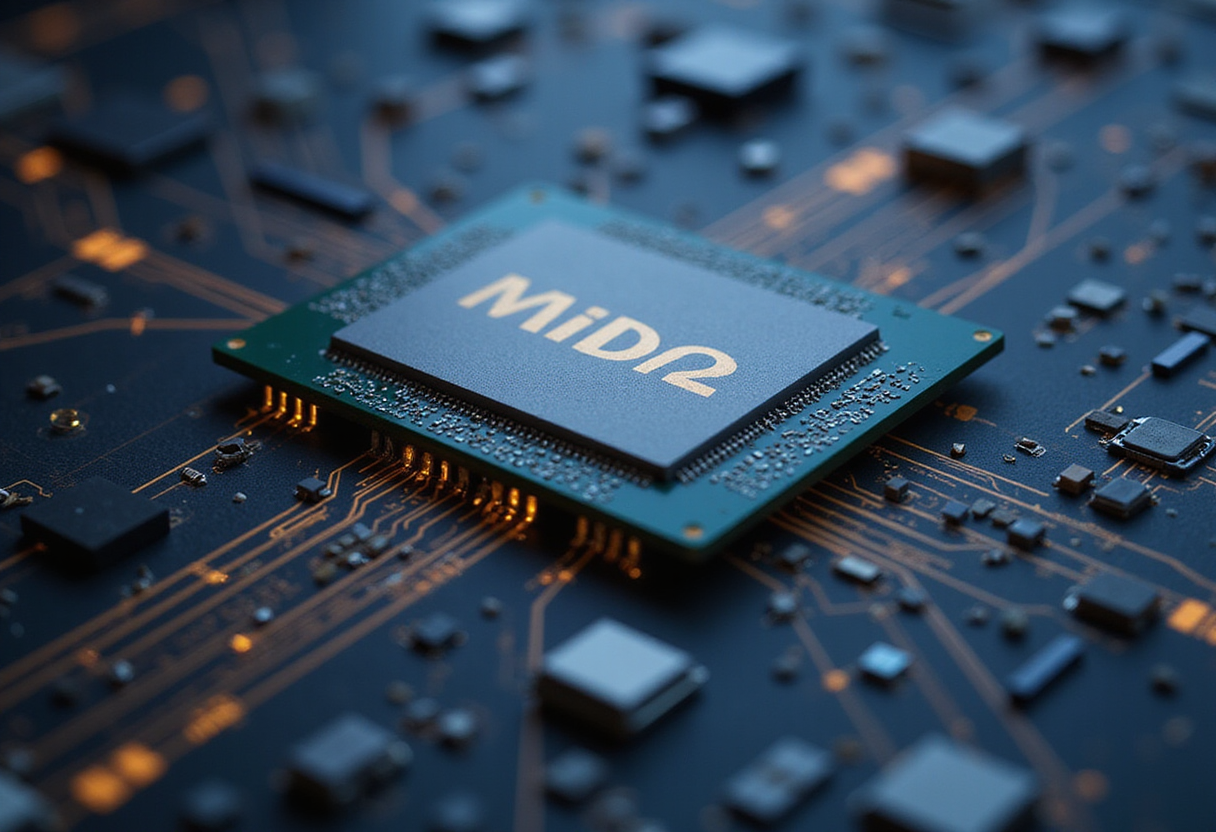
Microsoft has launched the Maia 300, its AI accelerator chip, and plans to deploy more than one million units during 2025, according to a report carried by KuCoin.
The figure anchors the company's most aggressive hardware commitment to date in the generative-computing segment. A one-million-unit deployment in a single calendar year places Microsoft among the largest-volume operators of custom AI silicon, a market it entered as a buyer of Nvidia GPUs and now addresses with in-house designs.
What is Microsoft actually shipping?
The Maia 300 is an AI inference and training accelerator built under Microsoft's custom-silicon program. The company first signaled that program's direction with its initial Maia-generation parts; the 300 marks the follow-on generation now moving into production deployment.
Microsoft has not yet published full specifications for the Maia 300, including memory capacity, interconnect bandwidth or power envelope. What is confirmed is the scale of the rollout: over one million units slated for 2025, deployed inside Microsoft's own datacenter estate rather than sold as a merchant product.
In plain words: Microsoft is building its own AI chips by the million and installing them in its own servers.
Why does the one-million figure matter?
Volume is the binding constraint in AI compute. Model builders and cloud operators have spent the past two years competing for limited accelerator supply, and hyperscalers that design their own silicon gain two levers: cost control and supply independence.
A deployment above one million units in 2025 lets Microsoft:
- reduce its exposure to third-party GPU procurement cycles;
- tune silicon directly to its own inference workloads, including the services behind its Copilot product line;
- spread engineering costs across an installed base measured in seven figures.
Microsoft has not disclosed the unit cost of the Maia 300, the share of its AI fleet the chip will serve, or which specific services will run on it first. The company has also not said whether 2026 volumes will rise or hold.
Where does this leave the GPU incumbents?
The Maia 300 does not eliminate Microsoft's dependence on merchant GPUs. The company continues to buy Nvidia hardware at scale and has repeatedly described third-party and first-party silicon as complementary layers of its infrastructure stack.
What the 2025 deployment does change is the ratio. Each Maia 300 unit installed is capacity Microsoft no longer has to bid for on the open market. At volumes above one million, that substitution becomes measurable in procurement terms rather than symbolic.
The competitive read is straightforward:
- custom silicon moves from pilot program to fleet-scale production;
- Microsoft joins the small set of operators — alongside Google's TPU program and Amazon's Trainium line — running proprietary AI accelerators at million-unit scale;
- pressure increases on merchant suppliers to defend volume with each annual product cycle.
What remains unconfirmed?
KuCoin's report, relayed via Google News, confirms the launch and the 2025 deployment target. It does not attach performance benchmarks, power figures or per-chip cost data to the Maia 300, and this report does not add them. Microsoft has not announced a public ship date beyond the 2025 window, nor has it named the fab partners producing the part at volume.
Any benchmark comparison against current-generation Nvidia or AMD accelerators would require figures Microsoft has not released.
In plain words: the number is confirmed; the silicon's measured performance is not.
The takeaway
Microsoft has committed to installing more than one million Maia 300 AI chips in 2025 — a volume that turns its custom-silicon program from an experiment into infrastructure.
via Google News: AI chip (Source)
More from Amara Osei
Show full bio
Staff writer covering money, funding and market shifts around hardware layer of artificial intelligence at Die Signal.
296 articles
Same lot · LOT-C1C9
- DSG-55767nmMicrosoft Targets 2027 Launch for Maia 300 AI Chip
- DSG-670828nmMicrosoft sets one million deployment target for Maia 300 AI chip
- DSG-187665nmMicrosoft Unveils Maia 300 to Cut AI Chip Dependence on Nvidia and AMD
- DSG-965628nmMicrosoft Unveils Maia 300 AI Chip, Expanded Rollout From 2027
- DSG-405610nmMicrosoft Unveils Maia 300 AI Chip to Reduce Reliance on Nvidia