Test report DSG-5155 · Rev F · tested October 10, 2026
Edge AI SiliconDevice under test
Microchip Technology Acquires Hailo to Expand Edge AI Portfolio
Microchip Technology has acquired Hailo, the Tel Aviv-based designer of Hailo-8 and Hailo-15 NPUs, according to Embedded Computing Design. Deal terms, closing date, and executive statements were not disclosed.
- Read
- 3 min
- Words
- 587
- Node
- 65nm
- Operator
- Amara Osei
Spec summary
- Microchip Technology acquired Hailo, the Tel Aviv-based designer of the Hailo-8 and Hailo-15 NPU families.
- Hailo was founded in 2017 and targets edge inference at typical power budgets under 2.5 W.
- Microchip trades on Nasdaq as MCHP and is headquartered in Chandler, Arizona, with cores spanning Arm Cortex-M, PIC, AVR, and dsPIC.
- Embedded Computing Design reported the deal without disclosing closing date, purchase price, or executive statements.
- The Hailo-8 NPU delivers up to 26 TOPS and ships in M.2, mPCIe, and module form factors.
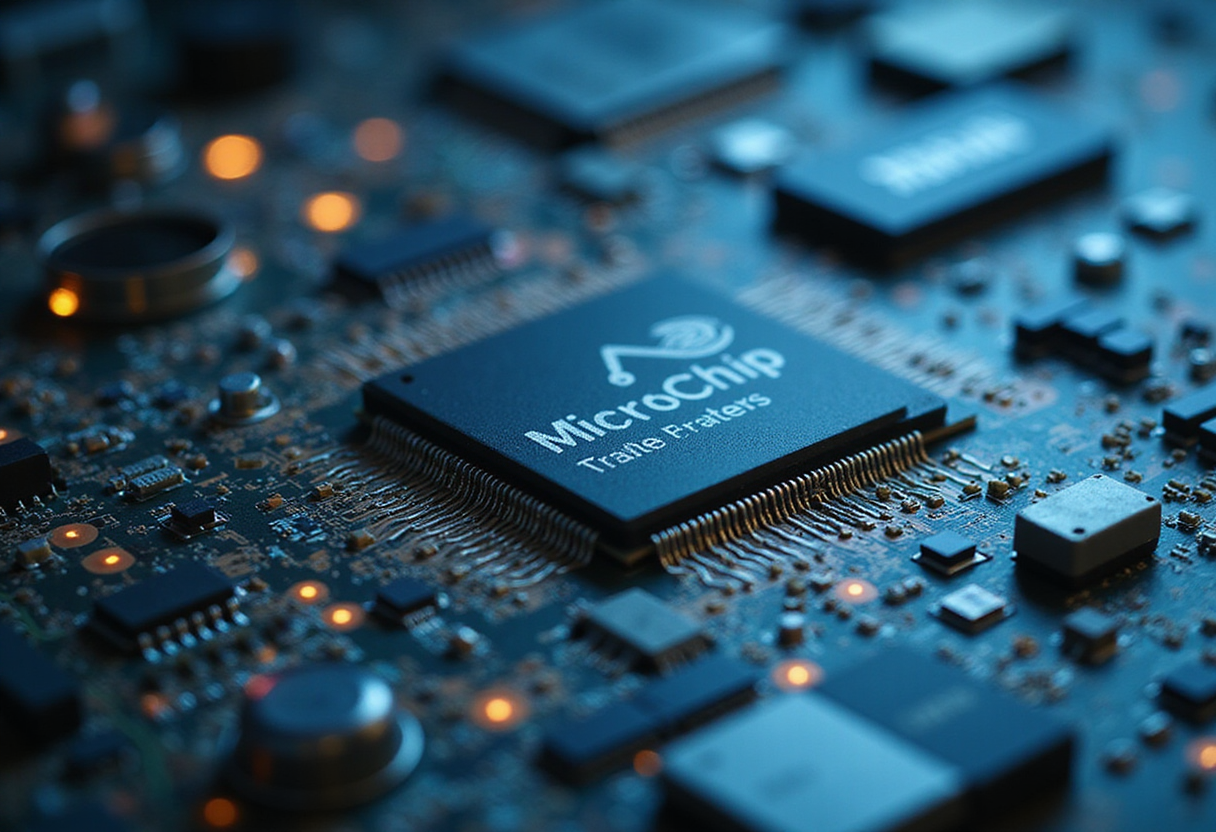
Microchip Technology has acquired Hailo, the Tel Aviv-based designer of low-power neural-network accelerators, according to Embedded Computing Design. The deal extends Microchip's edge AI solutions portfolio beyond its existing microcontroller and FPGA product lines.
Microchip (Nasdaq: MCHP), headquartered in Chandler, Arizona, supplies 8-, 16-, and 32-bit microcontrollers, DSPs, mixed-signal analog ICs, FPGAs, and connectivity silicon to industrial, automotive, aerospace, and consumer customers. The company's portfolio spans Arm Cortex-M, PIC, AVR, and dsPIC architectures, with development tools including MPLAB X IDE, MPLAB Harmony, and the SmartHLS toolchain. Microchip's PolarFire and Igloo families cover low-power FPGA inference paths, and the SAM family of Cortex-M microcontrollers targets deterministic real-time control.
Hailo, founded in 2017, designs the Hailo-8 and Hailo-15 NPU families. Hailo-8 delivers up to 26 TOPS at typical power budgets under 2.5 W and ships in M.2, mPCIe, and module form factors. The newer Hailo-15 extends the architecture with an integrated image signal processor for camera-class applications. Until the acquisition, Hailo sold chips, modules, and PCIe cards to OEMs in smart cities, retail analytics, industrial machine vision, and surveillance.
What does the deal change?
The acquisition moves purpose-built neural-network inference silicon into Microchip's distribution and developer ecosystem. Customers currently prototyping on PolarFire FPGAs or SAM family microcontrollers can integrate Hailo accelerator IP without sourcing a separate vendor's toolchain or qualification cycle.
Microchip has framed the combination as part of a broader push into edge AI, the umbrella term for on-premises inference workloads that bypass cloud round-trips. Typical targets include latency budgets under 50 ms, network-isolated industrial sites, and cost-sensitive imaging applications where continuous video streaming to a public cloud is uneconomic. Microcontrollers handle orchestration and pre/post-processing; the NPU executes the convolutional or transformer model.
Where does the embedded AI accelerator segment stand?
The Hailo product line competes with embedded-NPU offerings from Syntiant, Kneron, and the AI cores now embedded in newer parts from STMicroelectronics, NXP, and Texas Instruments. FPGA-based inference from Lattice Semiconductor and Microchip's own PolarFire SoC family is the closest competing programmable alternative, though programmable logic carries a higher power and price penalty per inference.
Edge AI chipset revenue has grown as OEMs replace rule-based machine vision with convolutional and transformer models. Industrial machine vision and automotive ADAS are the two fastest-growing end segments, with retail analytics, surveillance, and robotics contributing meaningful secondary demand.
What details remain undisclosed?
The Embedded Computing Design headline carried no closing date, purchase price, retention terms for Hailo's engineering staff, or executive statements. Die Signal has not received confirmation of the deal value from either party or Microchip's investor relations office.
Without financial terms, the strategic weight of the transaction cannot be measured against Microchip's recent capital allocation. The company has historically pursued bolt-on acquisitions in mixed-signal and connectivity silicon rather than AI accelerator IP, making this deal a notable departure in scope if not size.
What regulatory and integration steps remain?
Regulators in jurisdictions where both firms hold subsidiaries or R&D sites will need to clear the deal. Microchip operates design facilities across the United States, India, and the Philippines. Hailo maintains offices in Tel Aviv and Munich. Integration of developer environments, sales channels, and roadmap alignment typically takes 12 to 18 months for semiconductor acquisitions of this profile, with channel conflicts and product-line rationalization the most common friction points.
via Google News: Edge AI processor (Source)
More from Amara Osei
Same lot · LOT-C1C6
- DSG-14647nmMicrochip Technology Moves to Acquire AI Chipmaker Hailo
- DSG-74807nmMicrochip Technology Signs Definitive Agreement to Acquire Hailo
- DSG-131814nmMicrochip Acquires Edge AI Chip Maker Hailo
- DSG-234628nmMicrochip Technology Acquires On-Device AI Processor Maker Hailo
- DSG-62443nmMicrochip to Acquire Edge AI Processor Maker Hailo