Test report DSG-1318 · Rev C · tested October 10, 2026
Edge AI SiliconDevice under test
Microchip Acquires Edge AI Chip Maker Hailo
Microchip Technology has acquired Hailo, the Israel-based edge AI inference chip developer, adding dedicated neural network accelerators to its embedded silicon portfolio.
- Read
- 3 min
- Words
- 655
- Node
- 14nm
- Operator
- Marcus Bennett
Spec summary
- Microchip Technology has acquired edge AI accelerator developer Hailo.
- The deal was surfaced via Jon Peddie Research's news coverage.
- Transaction terms, including purchase price, were not disclosed.
- Hailo specializes in neural network inference processors for embedded hardware.
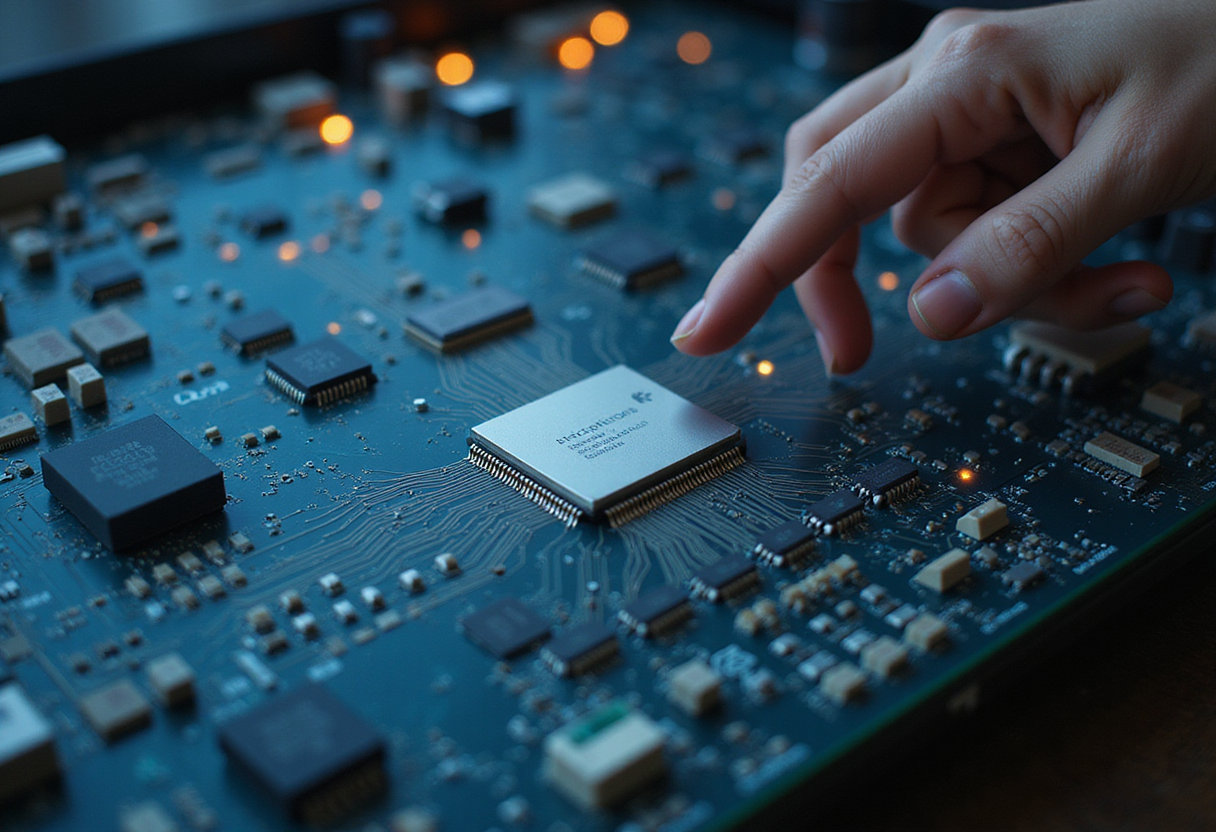
Microchip Technology has acquired Hailo, the Israel-based developer of edge AI inference processors, according to an announcement surfaced via Jon Peddie Research. The deal places a dedicated edge AI accelerator supplier inside one of the largest embedded-control semiconductor vendors and signals how quickly inference-at-the-edge has moved from specialist niche to core portfolio requirement.
What does the acquisition cover?
Hailo builds purpose-built processors that run neural network inference directly on embedded hardware, rather than sending data to cloud datacenters. The company positioned itself as a leader in this segment, targeting applications where latency, power budgets and data privacy rule out round trips to remote compute.
The acquisition therefore hands Microchip:
- Edge AI inference accelerators as a product line alongside its microcontrollers, MPUs and FPGAs
- A technology stack aimed at vision and sensor-processing workloads in embedded systems
- A footprint in a market segment where customers increasingly demand on-device machine learning
For Microchip's customer base — industrial, automotive and embedded OEMs — the appeal is integration. Instead of combining a general-purpose MCU with a third-party AI accelerator, designers can in principle source both silicon and software support from a single vendor.
Why does edge AI matter to Microchip's market?
Embedded developers have shifted workloads toward on-device inference over the past several years. Camera-based inspection on production lines, driver-assistance perception, voice detection in consumer devices and anomaly detection in industrial sensors all rely on running trained models locally.
That shift creates a problem for vendors whose portfolios centre on control-oriented silicon. Microcontrollers excel at deterministic, real-time control tasks, but neural network inference demands a different processing profile: high-throughput matrix arithmetic running under strict power and thermal limits. Dedicated accelerators such as Hailo's address that gap directly.
How does this fit the broader consolidation pattern?
The move follows a recognizable pattern across the semiconductor industry: large diversified vendors acquiring specialist AI-silicon teams rather than developing inference architectures in-house. Buying an established accelerator vendor buys working silicon, an existing customer base and engineering teams already steeped in neural network compiler and runtime software — assets that take years to build organically.
For the edge AI startup sector, the acquisition is another data point in a consolidation phase. Early-stage accelerator companies that carved out niches in computer vision and industrial inference are increasingly being absorbed into larger platforms, as standalone edge AI silicon proves difficult to sell profitably against broad-line vendors bundling compute, control and connectivity.
What happens next?
Details of the transaction — purchase price, closing conditions and integration timeline — were not disclosed in the announcement as reported. Key open questions for customers of both companies include:
- Product roadmap continuity for existing Hailo accelerator families
- How Microchip will package Hailo silicon with its MCU, MPU and FPGA lines
- Long-term support commitments for designs already in production using Hailo parts
Microchip has a long track record of acquiring semiconductor firms and continuing their product lines for extended lifecycles, an approach valued by industrial and automotive customers who ship products for a decade or more. Buyers of Hailo-based designs will likely watch for confirmation that this policy extends to the acquired portfolio.
What does the deal signal for the market?
The acquisition confirms that edge inference has become table stakes for embedded semiconductor vendors. Control processing alone no longer defines a competitive embedded platform; customers expect a path to running trained models on the same board, often within existing power envelopes.
For system designers, vendor consolidation cuts both ways. Single-vendor sourcing simplifies procurement, tooling and support chains. It also reduces the number of independent accelerator suppliers in the market, concentrating roadmap decisions in fewer hands.
Jon Peddie Research, which tracks graphics and compute hardware markets, flagged the deal — a further indication that edge AI silicon now sits squarely within the mainstream processor industry's coverage map, rather than at its margins.
via Google News: Edge AI processor (Source)
More from Marcus Bennett
Show full bio
News editor covering marketplaces and e-commerce at Die Signal.
278 articles
Same lot · LOT-C1C6
- DSG-234628nmMicrochip Technology Acquires On-Device AI Processor Maker Hailo
- DSG-62443nmMicrochip to Acquire Edge AI Processor Maker Hailo
- DSG-74807nmMicrochip Technology Signs Definitive Agreement to Acquire Hailo
- DSG-14647nmMicrochip Technology Moves to Acquire AI Chipmaker Hailo
- DSG-515565nmMicrochip Technology Acquires Hailo to Expand Edge AI Portfolio