Test report DSG-5094 · Rev A · tested October 10, 2026
Memory & StorageDevice under test
KB Securities Sees Samsung Returning ₩600 Trillion to Shareholders
KB Securities projects Samsung Electronics could return ₩600 trillion to shareholders over three years, four times the prior cycle. Operating profit could reach ₩555 trillion in 2027, with HBM4 revenue share doubling.
- Read
- 3 min
- Words
- 560
- Node
- 3nm
- Operator
- Grace Kim
Spec summary
- KB Securities, 1 October 2026: Samsung could return ₩600 trillion (~$441.8 billion) to shareholders over the next three years, versus ₩140 trillion in 2023–2025.
- Operating profit estimated at ₩368 trillion in 2026 and ₩555 trillion in 2027, under a policy of returning 50% of free cash flow.
- HBM4 revenue share projected to double from 40% in 2026 to 80% in 2027, with HBM ASPs forecast to rise more than 100% year-over-year in 2027.
- Conventional DRAM wafer share (ex-HBM) projected to fall from 73% (2025) to 65% (2026) to 59% (2027) as HBM consumes over three times the wafer volume per bit.
- Q3 2026 cash dividends estimated at ₩30 trillion (~$22.1 billion) and Q4 2026 dividends at ₩40 trillion, alongside ₩40 trillion in buybacks and cancellations.
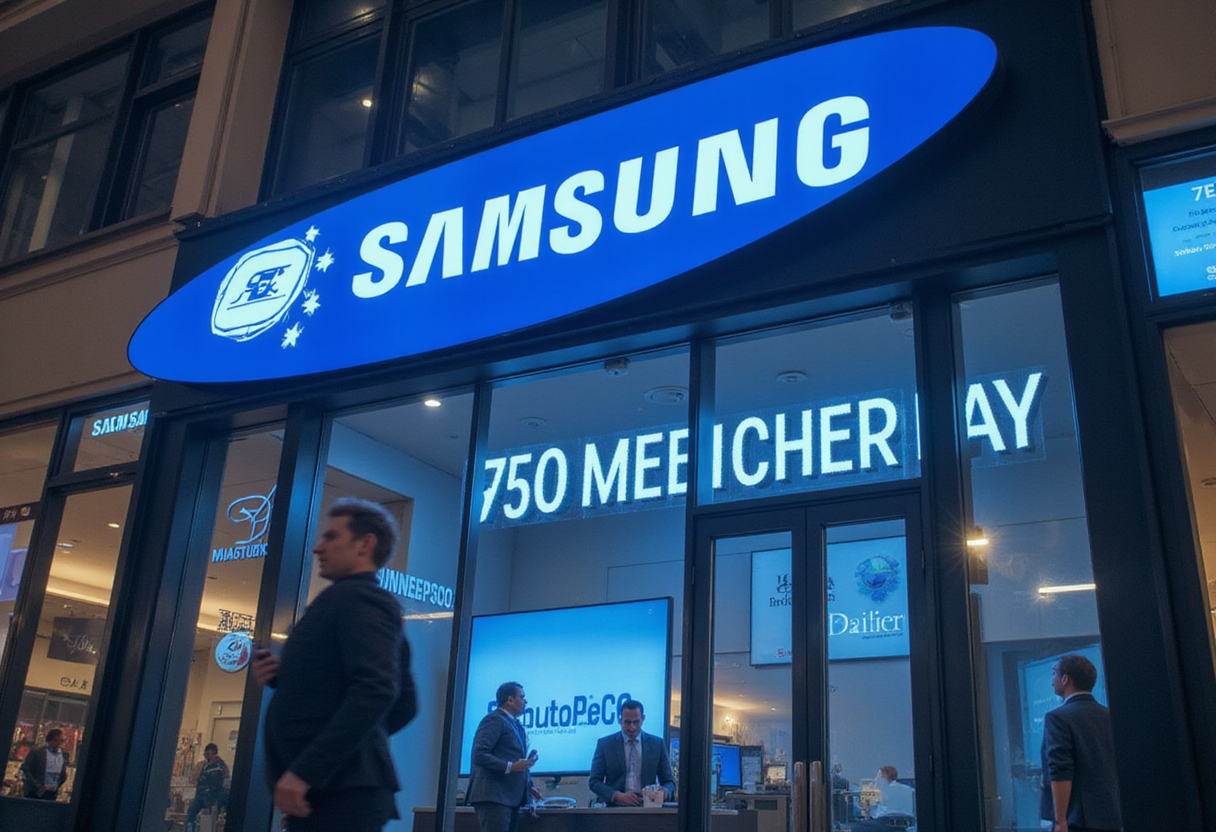
Samsung Electronics could return ₩600 trillion (approximately $441.8 billion) to shareholders over the next three years, more than four times the ₩140 trillion returned during 2023–2025, according to a 1 October brokerage report from KB Securities.
What drives the ₩600 trillion forecast?
Kim Dong-won, head of research at KB Securities, derived the figure from residual shareholder return resources of ₩110 trillion ($81.0 billion) earmarked for the 2024–2026 cycle. The breakdown:
- Cash dividends: ₩70 trillion (~$51.5 billion)
- Share buybacks and cancellations: ₩40 trillion (~$29.5 billion)
Subject to the 25% payout requirement and the separate-taxation regime on dividend income, KB estimates Q3 2026 dividends of ₩30 trillion (~$22.1 billion) and Q4 2026 dividends of ₩40 trillion. Kim judged remaining resources sufficient to fund the buyback component without additional capital allocation.
"Samsung Electronics' shareholder return scale is expected to expand more than fourfold, from ₩140 trillion over the past three years to ₩600 trillion over the next three years," he wrote.
The forecast assumes Samsung continues returning 50% of free cash flow to shareholders, the same ratio embedded in the existing program.
How does HBM reshape DRAM supply?
The returns thesis rests on a memory earnings cycle. KB projects Samsung's annual operating profit at ₩368 trillion ($271.0 billion) in 2026 and ₩555 trillion ($408.7 billion) in 2027.
Samsung told the Korea Premium Week 2026 audience that high-bandwidth memory would account for more than one-third of total global DRAM wafer production by 2027. Conventional DRAM's wafer share — excluding HBM — falls from 73% in 2025 to 65% in 2026 and 59% in 2027.
Because HBM consumes more than three times the wafer volume of conventional DRAM, the mix shift mechanically withdraws capacity from legacy output. The translation is direct: a higher HBM share in DRAM bit terms requires disproportionately more wafers per gigabyte.
Kim framed the supply arithmetic bluntly: "With a new product category consuming 30% of total DRAM wafer production capacity emerging in just two to three years, it would actually be strange if conventional DRAM supply shortages did not occur under the current supply structure."
What does the HBM4 ramp mean for pricing?
KB expects Samsung's HBM4 revenue share to double from 40% in 2026 to 80% in 2027. Pricing follows product mix.
"HBM selling prices in 2027 are estimated to rise more than 100% year-over-year," Kim said.
Even with the three major DRAM suppliers lifting HBM wafer input to 30% of their combined totals by year-end 2027, HBM captures only about 13% of total DRAM storage bits. The wafer-density gap consumes most of the headline supply gain, and conventional DRAM remains the larger revenue pool by bit volume.
How durable is the cycle?
KB's framework routes the cash engine back to memory pricing. HBM tightness and conventional DRAM shortages compound into blended average selling price strength. Higher earnings feed the 50%-of-FCF return policy, and the report projects the mechanism continues "for the foreseeable future."
The step-up from ₩140 trillion to ₩600 trillion — a 4.3x increase — reflects an earnings multiple expansion rather than a capital structure reset. FCF assumptions, the payout ratio, and buyback intensity remain anchored to current policy parameters. The variable that matters, KB argues, is the depth and length of the HBM-led memory upcycle.
via img.biggo.com (Original)
More from Grace Kim
Same lot · LOT-C1C6
- DSG-50777nmSamsung Targets 100 Trillion Won Q3 Profit as Won Strength Looms
- DSG-998920nmSamsung, SK hynix Set for Record Q3 on AI Memory Shortage
- DSG-748714nmSamsung Q3 Preliminary: Operating Profit Passes 100 Trillion Won
- DSG-756610nmSamsung Posts Record Operating Profit of 107 Trillion Won
- DSG-689820nmSamsung Forecasts Record $80B Q3 Profit on AI Chip Demand