Test report · tested November 28, 2026
Foundries & ManufacturingDevice under test
Intel Rises 5.38% to $57.40 on Two Foundry Deals With No Disclosed Terms
Intel closed at $57.40 on November 27, 2026, after Microsoft became the first EMIB customer and 18A-P gained an unnamed buyer. Foundry revenue rose 58% to $6.7 billion; losses continue.
- Read
- 7 min
- Words
- 1,490
- Segment
- Foundries & Manufacturing
- Operator
- Priya Raman
Spec summary
- Intel shares rose 5.38% to $57.40 in the shortened U.S. session on November 27, 2026.
- Microsoft is the first disclosed customer for Intel Foundry's EMIB advanced packaging, targeting Azure silicon.
- Intel disclosed its first external 18A-P customer on November 18, 2026; the name remains unconfirmed.
- Intel Foundry posted $6.7 billion in Q3 2026 revenue, up 58% year over year, while still reporting operating losses.
- A 70% 18A-P yield figure is circulating but unconfirmed.
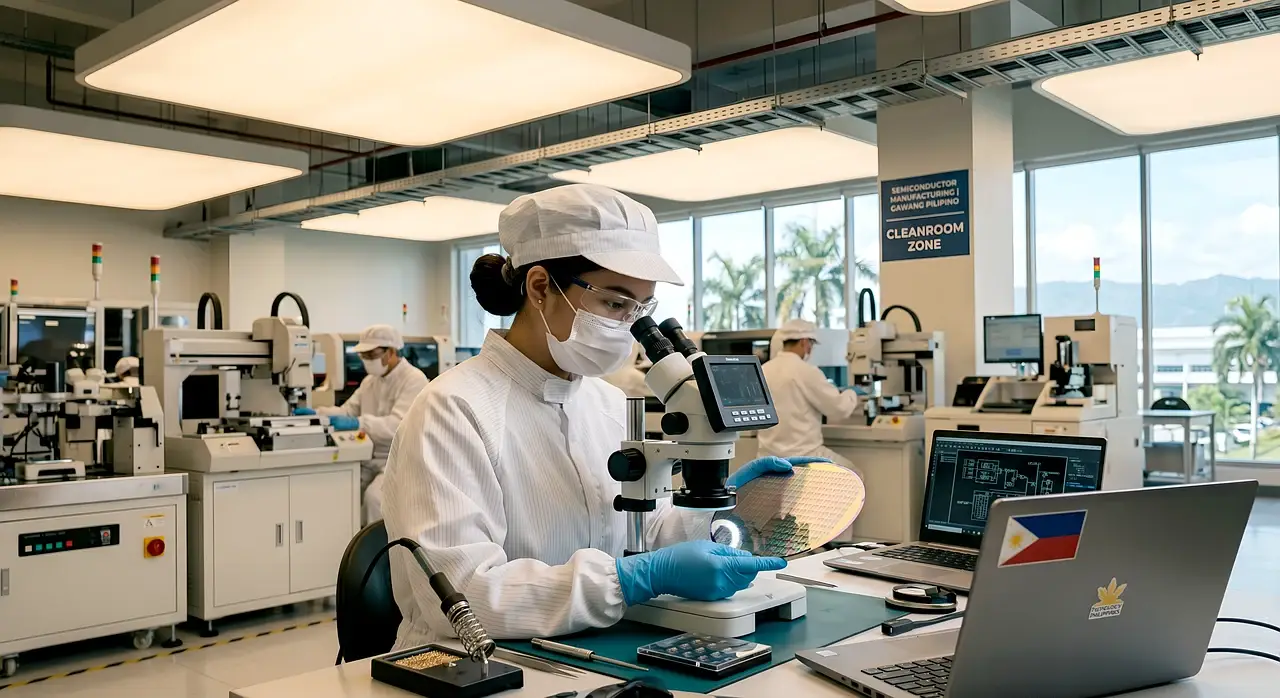
Intel shares rose 5.38% to $57.40 in the shortened U.S. trading session on November 27, 2026, leading a wider rebound in chip stocks after two foundry disclosures in ten days. The gains rest on real announcements. The contract details behind them are almost entirely absent.
The stock move followed Intel's disclosure, on November 18, 2026, of its first external customer for the 18A-P node (a variant of Intel's 18A process family), plus Microsoft's emergence as the first disclosed customer for Intel Foundry's EMIB advanced-packaging service. TokenPost tied the lift directly to the foundry updates. Working backward from the close, the prior session ended near $54.47, a gain of roughly $2.93 per share; this is our own arithmetic, not a published figure.
Caveats apply before the numbers carry weight. Half-day sessions after Thanksgiving trade on thin volume, which exaggerates moves in both directions. MarketBeat's intraday alert carried a 4.9% climb, a snapshot taken before the close. A 5% gain on a quiet Friday does not carry the same signal as a 5% gain on a heavy Tuesday.
What is confirmed, and what is not?
The verified record for this story supports the following items:
- Share move: +5.38% to $57.40 on November 27, 2026, in a shortened session.
- 18A-P external customer: first one disclosed November 18, 2026; customer name not confirmed.
- Microsoft and EMIB: first disclosed customer for Intel Foundry's EMIB packaging; no specs, dates, value, or volume released.
- Intel 14A design kit: 0.9 PDK (process design kit, the toolbox of design rules, device models, and libraries a chip designer needs for a given node) released in October 2026, per reports.
- Intel Foundry Q3 2026 revenue: $6.7 billion, up 58% year over year, per Intel's earnings release filed with the SEC.
- Intel Foundry profitability: operating losses continue; the unit was not profitable in the quarter.
- 18A-P yield: a 70% figure has circulated; it is unconfirmed.
For years the central question around Intel has been whether it can sell its factories to companies that do not carry the Intel badge. An outside customer on 18A-P and a hyperscaler on EMIB give the stock rebound something concrete to stand on, even though investors are pricing a promise rather than a purchase order they can inspect.
What did Intel's CEO say about the 18A-P deal?
Intel CEO Lip-Bu Tan raised the milestone at the TomorrowX Summit. TrendForce recorded his remarks, in which Tan said: "And then 18A, I'm involved in production and we just signed the first customer." His wording refers to 18A generally; outlets covering the event tied the customer to 18A-P.
The reports reviewed do not confirm who the customer is. They also give no wafer volumes, no contract size, and no product category. That silence is normal for early foundry deals, since customers often stay private until a product nears launch. It also means the distinction between a signed customer and a shipping customer matters. Ramping volume on a new node, qualifying it, and holding yields steady take quarters.
Why does Microsoft's EMIB commitment matter?
EMIB stands for embedded multi-die interconnect bridge, Intel's method of linking separate chiplets inside one package. Instead of building one enormous die, a designer splits a processor into smaller pieces and stitches them together, mixing chiplets built on different nodes or at different foundries.
Microsoft is the first company disclosed as a customer for the EMIB service, and the packaging work targets silicon for Azure, Microsoft's cloud platform. No product specification, delivery date, contract value, or production volume has been disclosed, so any number attached to the deal should be treated as speculation.
Two executives commented on record. Naga Chandrasekaran, Intel's chief technology and operations officer and general manager of Intel Foundry, said: "Through use of our advanced packaging capabilities with EMIB to scale future generations of Azure infrastructure, Intel and Microsoft can combine the flexibility of heterogeneous integration with the manufacturing scale required for the AI era." Saurabh Dighe, corporate vice president of Azure System and Architecture at Microsoft, told DatacenterDynamics: "Our longstanding collaboration with Intel brings together advanced packaging, custom compute, memory and security capabilities to support Azure compute and continued innovation across Azure."
Both statements stay at the strategy level. Neither names a product, a ship date, or a dollar amount. Chandrasekaran's phrasing signals multi-year intent without committing to a schedule, while Dighe leans on the length of the existing relationship.
How does the TSMC comparison look?
TSMC remains the benchmark for leading-edge manufacturing, and its packaging services anchor many AI accelerator supply chains. Its 2nm node reached 8% of wafer revenue in Q3, indicating how tight leading-edge capacity is across the industry.
Intel's route into that market runs through two entry points: a competitive node and a packaging service customers can buy separately. On the current record:
- Newest node: Intel has 18A-P with a first external customer, and 14A at 0.9 PDK; TSMC's 2nm is already generating wafer revenue.
- Packaging: Intel has Microsoft on EMIB; TSMC's packaging services dominate AI accelerator builds.
- Customers: Intel has one external 18A-P customer, unnamed; TSMC has a long roster of named leading-edge customers.
- Revenue: Intel Foundry posted $6.7 billion in Q3 2026, up 58%; TSMC's base is considerably larger.
Samsung's foundry arm is the other name buyers weigh, but the verified sources contain no new data on it. A buyer who cannot get enough capacity from one supplier has every reason to qualify a second source, and that is the opening Intel is trying to widen.
What is the 14A design kit worth?
Reports say Intel released the 0.9 process design kit for Intel 14A in October 2026. Version 0.9 sits close to the finish line, since a 1.0 kit usually signals that the process is ready for customers to commit real designs.
The timing helps explain the market reaction. Investors saw three layers of the foundry story move at once: 18A-P gained a customer, EMIB gained a hyperscaler, and 14A gained a mature design kit. Each layer sits at a different stage of maturity, spreading risk across multiple products rather than one bet. Foundry customers choose a partner for a decade, and a near-final 14A kit tells them Intel has a next step ready.
Can the $6.7 billion quarter answer the profit question?
Intel Foundry reported $6.7 billion in third-quarter 2026 revenue, a 58% jump from a year earlier. The unit still loses money. Both facts sit side by side without contradiction: building new fabs and ramping new nodes costs enormous sums up front, so a fast-growing foundry can lose money for years before the economics flip.
Skeptics will point to the gap between revenue and profit as the main reason to stay cautious. Supporters will point to the growth rate as proof the investment is paying off. The more important question for 2027 is whether new customers move the unit toward breakeven or simply add costs, since wins that demand heavy custom engineering can hurt margins before they help.
Is the 70% yield figure real?
A figure of 70% for 18A-P yield has circulated alongside the customer news, notably in a Tom's Hardware headline. Yield measures the share of chips on a wafer that work. The number is unconfirmed, and three reasons argue for caution: yield depends on die size, so a figure for a small test chip says little about a large AI processor; companies rarely publish yield on the record because it hands competitors negotiating leverage; and a reported number can describe a point in time during risk production rather than a steady state. Until Intel publishes a defect-density figure or yield range at an investor event, treat 70% as a rumor with a plausible ring.
What historical context does the 2024 launch add?
Intel formally recast its manufacturing arm as a systems foundry in 2024, at a launch event that included Microsoft CEO Satya Nadella. He said at the time: "That's why we are so excited to work with Intel Foundry, and why we have chosen a chip design that we plan to produce on Intel 18A process." That endorsement raised expectations Microsoft would anchor 18A volume. The November 2026 news reads differently: Microsoft's first disclosed commitment is to EMIB packaging, a related but separate service, and whether it overlaps with the 2024 announcement is not established.
The path since has not been smooth, including a shareholder suit over the Commerce Department's 9.9% stake in Intel. Two customer disclosures in two weeks count as real progress. They do not erase the delays or the losses. The next disclosures will decide whether the hope priced into $57.40 was justified.
via shattered.io (Source)
More from Priya Raman
Show full bio
Correspondent covering money, funding and market shifts around hardware layer of artificial intelligence at Die Signal.
787 articles
Same lot
- Intel posts 70% 18A yield, Microsoft details first EMIB plan
- Intel Trades at $62.50 as Server Growth Meets 2027 Risk
- Intel Shares Plunge 25% as AI-Driven Memory Shortage Squeezes PC Business
- Intel, Microsoft expand Azure deal; Intel shares fall 39% in month
- Intel’s $15B-$16B Q4 2026 Guide Puts 2027 Cash Flow at Risk