Test report DSG-6740 · Rev C · tested October 10, 2026
AI Datacenter InfrastructureDevice under test
Dell Forecasts 75% of Datacenter Demand Will Come from AI by 2030
Dell projects AI will drive 75% of datacenter demand by 2030, with a $1 trillion opportunity. Q2 F2027 revenue hit $46.97B, AI backlog reached $95B, and 6,500 customers now run PowerEdge AI systems.
- Read
- 3 min
- Words
- 683
- Node
- 14nm
- Operator
- Elena Vasquez
Spec summary
- Dell expects AI to account for 75% of datacenter demand and add 200 GW of power consumption by 2030
- Q2 F2027 revenue reached $46.97B, up 57.7% year on year; net income rose 3.55X to $4.13B
- AI systems backlog stands at $95B, 8.1X the year-ago figure, with $60.9B added in the quarter
- 6,500 unique customers now run AI workloads on PowerEdge hardware, with 1.2M legacy 14G-or-older servers awaiting refresh
- Dell shipped $16.4B in AI systems in Q2 and forecasts $74B in AI revenue for fiscal 2027
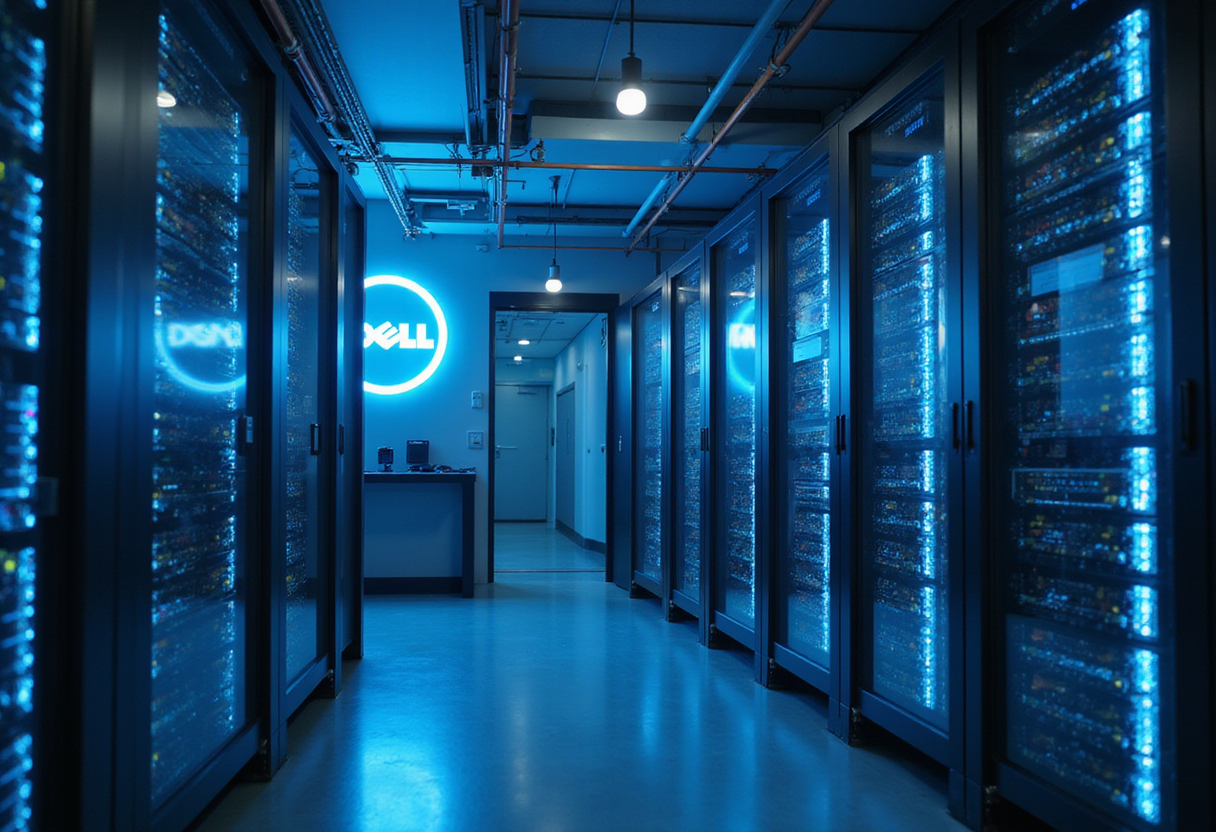
Dell COO and vice chairman Jeff Clarke told analysts that AI will account for 75% of all datacenter demand by 2030, on the company's Q2 fiscal 2027 earnings call covering the quarter ended July 31. The company now counts 6,500 unique organizations running AI workloads on PowerEdge hardware.
Combined revenue reached $46.97 billion for the quarter, up 57.7% year on year. Product revenue alone hit $41.11 billion, up 71.8%. Net income climbed 3.55X to $4.13 billion, equal to 8.8% of revenue. Services revenue stayed flat at $5.86 billion.
What does Dell see driving demand?
Clarke framed the next decade in concrete terms:
- Inference tokens: 87X growth to 3,600 quadrillion tokens by 2030
- Training compute: 5X growth to 850 zettaflops by 2030
- Enterprise agentic: expected to be the single largest workload by 2028
- Power demand: +200 GW added through 2030
- Total opportunity: >$1 trillion
"As we see it, agentic demand is reshaping the datacenter in underlying infrastructure," Clarke said. "Inference is past training, and it is pure demand in our industry." Roughly half of the 200 GW addition, he argued, sits within Dell's traditional buyer base: neoclouds, sovereigns, and large enterprises.
How large is the AI backlog?
Dell ended the quarter with $95 billion in cumulative AI system bookings, 8.1X the year-ago total. $60.9 billion of that backlog booked during the quarter. The company shipped $16.4 billion in AI systems in Q2, double the year-ago period and roughly flat sequentially.
Forward guidance projects $19 billion in Q3 AI revenue and $22.5 billion in Q4, for a full-year AI total of $74 billion.
What's behind the legacy server surge?
The non-AI server line is itself hitting records. Server and networking sales rose 2.1X to $26.93 billion, up 9.1% sequentially. Traditional servers plus networking alone hit $10.53 billion, up 2.2X year on year, the highest quarterly figure in Dell's history by the company's own framing.
Two forces drive the line. First, the installed base contains more than 1.2 million PowerEdge 14G (2017-vintage) or older machines. Clarke pegs consolidation at 6-to-8 legacy servers per single 17G system, or 12-to-14 per 18G machine. Second, rising DRAM, flash, and CPU component prices are inflating average selling prices on heavily configured refresh orders.
Dell expects traditional server revenue to surpass AI server revenue in Q4, coinciding with the ramp of Nvidia's "Vera Rubin" systems.
Where does Project Lightning stand?
The parallel file system aimed at high-end AI workloads remains in beta and competitive runoffs. "Lightning, our parallel file system designed for native AI use cases, we continue to have the product out in the field," Clarke said. "It is still a relatively new product. It is in beta at several customers. We are in runoffs against other competitors with the product."
Lightning targets workloads with high small-IO block patterns on flash and competes against Lustre (DataDirect Networks), VAST Data, WEKA, and Everpure. It sits separate from PowerScale's OneFS foundation.
What about margins and the balance sheet?
- ISG: $31.78 billion revenue (+89.2%), $4.78 billion operating income (+3.25X)
- Storage: $4.85 billion (+25.8%)
- Client Solutions Group: $15.0 billion (+20.2%), $1.14 billion operating income (+42.2%)
Dell generated $2.2 billion in free cash flow during the quarter and holds $14.25 billion in cash and investments. Debt and cash are rising at similar rates, leaving net debt roughly stable despite heavy AI build-outs.
Who competes in the same lane?
Dell's deployment-scale claim puts it in direct contention with ODMs, including Quanta, Foxconn, Sanmina (which inherited ZT Systems from AMD), and IEIT Systems (the rebranded Inspur that dominates China). OEM rivals include Hewlett Packard Enterprise, Lenovo, and Supermicro.
GPU allocation appears to be the gating constraint. Dell's supply-chain readiness lets it convert Nvidia and AMD allocations into shipped systems faster than ODM peers, reducing Nvidia's dependence on hyperscaler in-house XPUs.
via The Next Platform (Source)
More from Elena Vasquez
Show full bio
Senior reporter covering industry trends and analytics at Die Signal.
253 articles
Same lot · LOT-C1C6
- DSG-470120nmTSMC Q3 revenue hits T$1.49 trillion, beating estimates
- DSG-663365nmBroadcom Posts $16.7B AI Chip Revenue, Up 221% YoY in Q3 FY2026
- DSG-20647nmTSMC Lifts 2026 Chip Revenue Forecast to $1.7T, Anchored by AI
- DSG-980065nmSamsung Posts Record $80 bn Quarterly Profit on AI Chip Demand
- DSG-686765nmTSMC AI Chips Drive One-Third of Record $40.2B Q2 Revenue