Test report DSG-8261 · Rev F · tested November 12, 2026
Processors & AcceleratorsDevice under test
Alibaba's T-Head Files for Hong Kong IPO as AI Chip Race Heats Up
T-Head, Alibaba's chip unit, filed for a Hong Kong IPO on Sept. 11 after unveiling its Zhenwu V900 accelerator, as Hong Kong listing proceeds hit $51.9 billion this year.
- Read
- 3 min
- Words
- 619
- Node
- 3nm
- Operator
- Elena Vasquez
Spec summary
- T-Head filed its Hong Kong listing application on Sept. 11; Alibaba disclosed the move on Oct. 10
- Zhenwu V900 performance tripled from the previous model; up to 500,000 units can be linked in a cluster
- T-Head has shipped 560,000 Zhenwu units to more than 400 external customers
- Hong Kong IPO proceeds hit $51.9 billion this year, the highest in six years
- Kunlunxin, Baidu's AI chip unit, has filed a confidential IPO application and could list next year
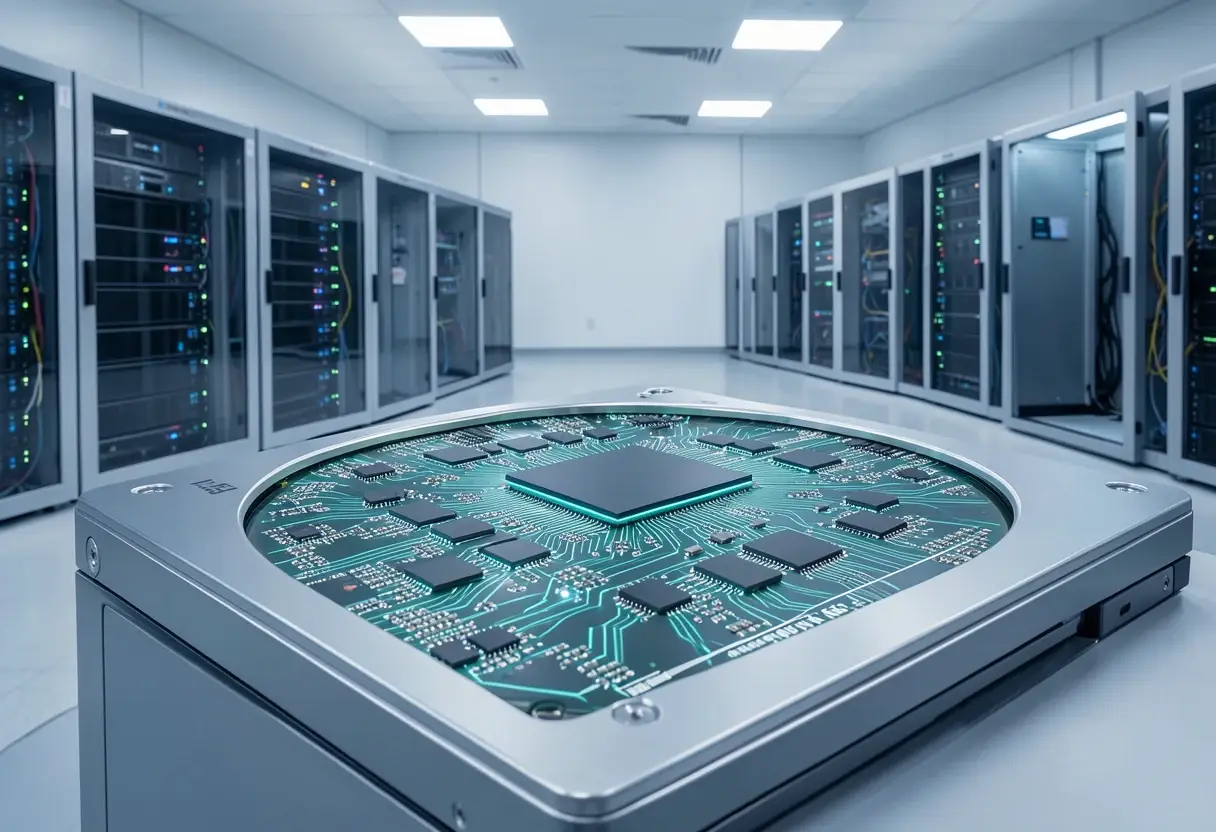
T-Head, Alibaba's chip design subsidiary, filed for an initial public offering on the Hong Kong stock exchange on Sept. 11, with Alibaba confirming the move in a disclosure on Oct. 10. The size and structure of the offering remain undisclosed.
The filing lands amid Beijing's broader push for technological self-reliance. T-Head now sits alongside Huawei Technologies and Hygon Information Technology in the effort to narrow the gap with leading overseas chipmakers — a race that's increasingly playing out on the Hong Kong exchange itself.
What does the listing change for T-Head?
T-Head is a wholly owned subsidiary that supplies chips to data centers in China, and it will stay an Alibaba subsidiary after the listing. So this isn't a full breakup. It's a valuation and financing play.
Alibaba spelled out three concrete effects in its disclosure:
- Investors can value T-Head separately from the group's other businesses
- Investors seeking pure exposure to the chip business get a direct vehicle
- T-Head gains direct access to equity and debt capital markets, which should also strengthen its hand in securing bank loans
For practitioners, that last point matters most. Chip development is capital-intensive, and independent access to debt markets gives T-Head funding options that don't run through Alibaba's balance sheet.
What hardware is T-Head bringing to market?
In September, T-Head unveiled the Zhenwu V900 accelerator — a hardware package spanning chips, servers and racks — which the company bills as the most powerful AI chip in China. It targets the large-scale capacity expansion expected at data centers over the next several years.
The numbers behind the claim are specific. Performance has tripled from the previous model, and up to 500,000 units can be linked in a single cluster to train advanced AI models. Alibaba has said T-Head has already shipped 560,000 units of its Zhenwu product line, with the processors adopted by more than 400 external customers.
That installed base gives T-Head something many IPO candidates lack: proven external demand rather than captive group sales alone.
How hot is Hong Kong's IPO market?
Very — by recent historical standards. Companies raised $51.9 billion through Hong Kong listings this year, Bloomberg reported on Oct. 10. That edges past the $51.6 billion raised in 2020, previously the second-highest annual total on record, and marks the highest level in six years. The all-time record stands at $57.8 billion, set in 2010.
Ten companies each raised more than $1 billion through IPOs this year. Innolight pulled in $7.8 billion, and Luxshare Precision Industry secured $3.2 billion. Chinese companies in the AI supply chain led the charge — a cohort T-Head is about to join.
Local bankers say the market has slowed somewhat, but several large deals were merely postponed and could come to market next year. Kunlunxin, Baidu's AI chip unit, has already filed a confidential IPO application and could list next year, according to sources.
Is investor demand the real bottleneck?
"The constraint is not the number of companies lined up to list, but investor demand and offer pricing," said Bush Chu, head of Chinese equities at Aberdeen Investments. "We don't expect the pipeline of listing candidates to shrink next year."
Chu added that many companies are still waiting in the queue and that some large deals postponed this year could be completed next year.
For anyone tracking the AI chip sector, the takeaway is straightforward: the supply of listing candidates isn't the question. Pricing and demand will decide how much of this pipeline — T-Head and Kunlunxin included — actually clears in the coming year.
via en.sedaily.com (Source)
More from Elena Vasquez
Show full bio
Senior reporter covering people, launches and day-to-day practice in hardware layer of artificial intelligence at Die Signal.
589 articles
Same lot · LOT-3628
- DSG-11565nmTSMC to list TWD14.8bn green bonds in Taiwan on November 12
- DSG-619165nmIntel Terafab deal holds as TSMC takeover rumours persist
- DSG-15017nmWall Street: Musk's Terafab Talks With TSMC Could Hurt Intel
- DSG-39007nmTaiwan Reportedly Weighs Tighter AI Chip Export Curbs on China
- DSG-768165nmSK hynix Reportedly Seeks U.S. Tool Approval for China Expansion