Test report · tested November 22, 2026
Edge AI SiliconDevice under test
Abaco SBC3618 Puts Intel Core Ultra 3 on Rugged 3U VPX at 15–65 W
Abaco's SBC3618 pairs Intel Core Ultra Series 3 with a 15–65 W envelope, 64 GB LPDDR5 and 100G Ethernet. Production targets early 2027; no price or benchmarks yet.
- Read
- 4 min
- Words
- 780
- Segment
- Edge AI Silicon
- Operator
- Priya Raman
Spec summary
- SBC3618 uses Intel Core Ultra Series 3 (formerly Panther Lake) with integrated CPU, GPU and NPU.
- Power envelope is configurable from 15 W to 65 W; performance per setting is unpublished.
- Up to 64 GB LPDDR5 with ECC and 1 TB NVMe storage; 100G Ethernet with RDMA and optional TSN.
- Production is targeted for the first part of 2027; no price or benchmarks disclosed.
- Board is aligned with the SOSA compute-intensive profile; formal conformance certification is unconfirmed.
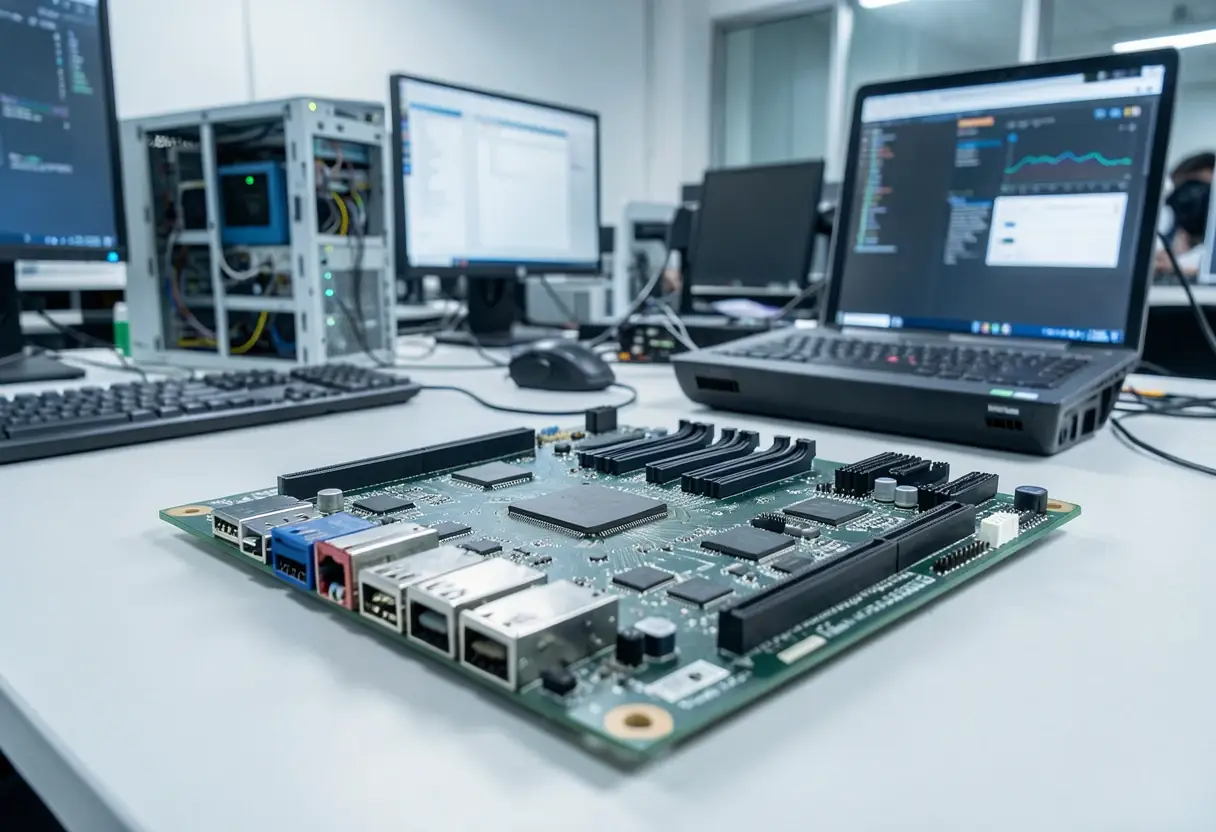
Abaco Systems has announced the SBC3618, a rugged 3U VPX single-board computer (the small-format defense standard for mission computers) built on Intel Core Ultra Series 3 processors, with a configurable power envelope of 15 W to 65 W. Production is targeted for the first part of 2027. No price has been disclosed.
Dan Taylor, Technology Editor at Military Embedded Systems, opened his report: "Abaco Systems introduced the SBC3618, a rugged 3U VPX single-board computer (SBC) built on Intel Core Ultra Series 3 processors for artificial intelligence (AI) processing at the tactical edge, the company announced in a statement." Taylor also wrote: "The SBC3618 is aligned with the Sensor Open Systems Architecture, or SOSA, Technical Standard."
Abaco's own product page says the board "features the new high performance, highly integrated Intel® Core Ultra Series 3 processor (formerly known as 'Panther Lake')" and describes it as "16th Generation Intel Core Technology."
What are the confirmed specifications?
- Processor: Intel Core Ultra Series 3, integrating CPU, GPU and NPU (neural processing unit, the on-chip block for AI inference) on one die
- Power envelope: configurable from 15 W to 65 W
- Memory: up to 64 GB LPDDR5 with error-correction support
- Storage: up to 1 TB NVMe
- Networking: 100G Ethernet with RDMA (remote direct memory access, which moves data between cards without CPU involvement), optional time-sensitive networking (TSN) for bounded-latency traffic
- Expansion: PCI Express Gen4
- Architecture: aligned to the SOSA compute-intensive profile
- Production: first part of 2027
The power range spans a factor of more than four. That lets one board design serve both sealed low-airflow chassis and roomier platforms through firmware settings rather than a hardware respin. For program managers, fewer part numbers means less to qualify and stock.
But the envelope describes what the board can be set to, not what it delivers. No benchmark, inference throughput figure or thermal derating curve has been published. Any claimed AI performance number for this board should be treated as unverified.
Why does the integrated SoC matter?
Rugged boards typically lag commercial silicon by years because of qualification cycles, thermal validation and long supply commitments. The SBC3618 narrows that gap by using a current client generation at launch.
Integration is the practical gain. Earlier edge AI designs paired an x86 board with a discrete GPU or accelerator, which added connectors, power rails, heat and failure points. A single die with CPU, GPU and NPU simplifies the bill of materials, the cooling plan and the number of software stacks a team must certify.
Software remains the weak point buyers should test hardest. An NPU only pays off when the inference framework, drivers and operating system actually route work to it, and teams porting models trained for other accelerators should budget that effort against a 2027 schedule.
What does SOSA alignment actually mean?
The Sensor Open Systems Architecture (SOSA) is a standard that lets defense electronics customers swap processor, radio or sensor cards from different vendors without redesigning the chassis. Alignment is not the same as formal conformance certification, and no conformance statement appears in the available material. Procurement teams that need certification for a contract should request documentation rather than infer it from marketing language.
For buyers, SOSA's commercial value is competition: boards from several vendors fitting the same slot profiles let a program re-compete a card or add a second source. The 3U VPX market already includes Mercury Systems, Curtiss-Wright, Aitech Systems and Kontron, plus EIZO Rugged Solutions with an NVIDIA-module-based 3U VPX computer in market listings.
The integrated approach wins where power, space and qualification time are tight. Discrete-GPU designs keep the lead for very large models or very high throughput. The 64 GB ceiling pushes teams toward small, quantized or purpose-built networks — sensor fusion and electronic warfare classification rely on specialized models, not chatbots.
What remains unconfirmed?
- Price: not confirmed; rugged boards are usually quoted per program
- Named executive quote: none found in verifiable coverage
- Benchmarks or AI throughput: none published
- Customer or program wins: none named
- Model confusion: a Defense and Munitions listing uses SBC3518, apparently a separate Abaco product; Abaco's page names the Core Ultra Series 3 compute-intensive board as SBC3618
Emergen Research publishes a VPX SBC market report with a forecast horizon to 2035, but its figures were not reviewed and are not cited here.
The takeaway: a credible, well-specified SOSA-class entry on current Intel silicon with a flexible power envelope. Its real value will only show once price, performance data and delivery dates arrive. Until then, treat it as a promising spec sheet and evaluate against numbers you can test.
via shattered.io (Source)
More from Priya Raman
Show full bio
Correspondent covering money, funding and market shifts around hardware layer of artificial intelligence at Die Signal.
731 articles
Same lot
- Intel unveils Xeon 6+ CPUs for telecom, cloud, Edge AI
- Naver Cloud Runs 35,000 AMD EPYC Units as AMD Pushes Hybrid AI
- Intel Reallocates 18A Capacity to Xeon as Server Demand Outruns Supply
- Supermicro to Buy 10,000 SambaNova SN50 Chips for AI Systems
- Microsoft puts Maia 300 on 2027 clock, calls it primary inference system