Test report DSG-6715 · Rev B · tested September 30, 2026
Foundries & ManufacturingDevice under test
TSMC's Next Strategic Move Could Reshape Chip Industry Supply Chains
TheStreet reports that TSMC's upcoming strategic decision would have consequences extending beyond Apple and Nvidia, rippling through the global semiconductor supply chain and rival chipmakers.
- Read
- 4 min
- Words
- 739
- Node
- 65nm
- Operator
- Elena Vasquez
Spec summary
- TheStreet reports that TSMC's next strategic move would have ripple effects beyond its major customers Apple and Nvidia.
- TSMC is the world's largest contract chipmaker, and Apple and Nvidia depend on its advanced process nodes.
- The report does not specify the nature or timing of the decision, but frames it as consequential for the broader semiconductor industry.
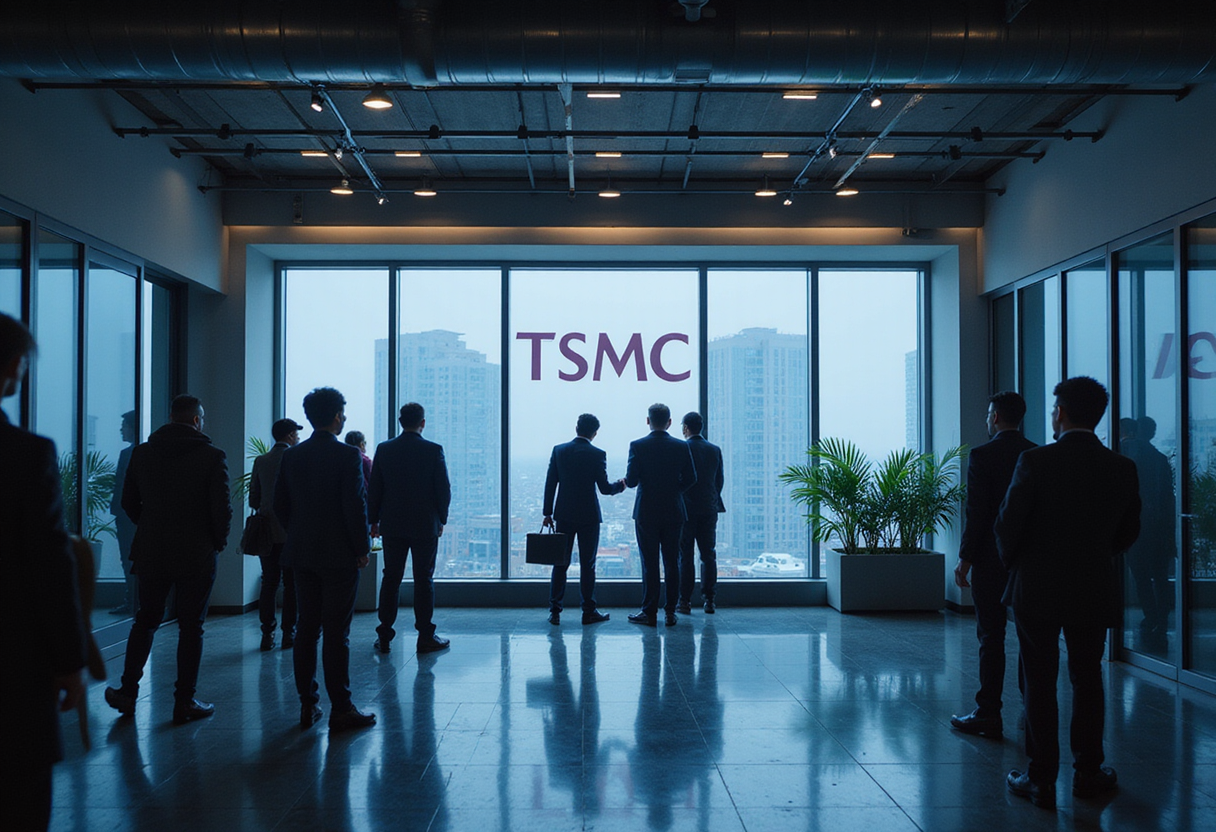
A report from TheStreet draws attention to an upcoming decision by Taiwan Semiconductor Manufacturing Company, arguing that the consequences of the foundry's next move would extend well beyond its two most prominent customers, Apple and Nvidia.
The headline claim is narrow but consequential. TSMC sits at the center of the global semiconductor supply chain, and Apple and Nvidia both depend on the company to fabricate their most advanced processors. Any significant shift in TSMC's strategy — whether in pricing, capacity allocation, process roadmap timing, or geographic footprint — would transmit directly into the product plans, cost structures, and release schedules of both firms.
The report's framing, however, is that the ripple effects would not stop there. TSMC manufactures for a wide range of fabless chip designers and electronics companies, and its decisions shape conditions for the industry as a whole: which customers secure leading-edge capacity, at what price, and on what timeline.
Why TSMC's decisions carry industry-wide weight
TSMC is the world's largest contract chipmaker. Companies that design chips but do not own fabrication facilities — including Apple for its custom silicon and Nvidia for its data center and gaming GPUs — rely on TSMC's advanced process nodes to build their products.
This concentration means a single supplier's strategic choices function as industry-wide signals. When TSMC adjusts capital expenditure, changes wafer pricing, reprioritizes capacity between customer segments, or modifies its technology rollout plans, the effects propagate through the entire electronics supply chain.
For Apple, TSMC's manufacturing decisions influence the production ramp of iPhone and Mac processors. For Nvidia, they affect the availability of the GPUs that power artificial intelligence data centers, where demand has strained supply chains.
The ripple effect beyond the two largest customers
The core of TheStreet's report is the word "beyond." Apple and Nvidia are the customers most visibly tied to TSMC, but they are not the only ones. A move by the foundry would reach:
- Other fabless semiconductor companies that compete for the same advanced-node capacity.
- Device makers whose components are fabricated by TSMC.
- Rival foundries, whose pricing and positioning decisions respond to TSMC's actions.
- Investors assessing the semiconductor sector, where TSMC's guidance often functions as a proxy for broader industry health.
The dynamics of capacity allocation matter here. Leading-edge fabrication capacity is finite. If TSMC tilts its allocation or investment toward one class of customers — for example, AI accelerators — other product categories face longer lead times or higher costs.
What remains unknown
The report's headline does not specify which move TSMC is considering. The publication signals that a decision is coming and that its impact will be broad, but details on timing, scope, and the specific nature of the decision were not included in the available material.
Possible dimensions of a major TSMC move — based solely on the strategic position the company occupies — include changes to its overseas fab expansion, adjustments to advanced-node pricing, shifts in capacity allocation among customer segments, or revisions to its process technology roadmap. TheStreet's report does not confirm which of these, if any, is at issue.
The stakes for the supply chain
TSMC's centrality is structural rather than incidental. Decades of capital investment and process development concentrated the most advanced logic fabrication capability in a small number of facilities, most of them in Taiwan. Apple and Nvidia designed their product strategies around that capability.
This is why a single company's "next move," as TheStreet frames it, functions as an industry event rather than a corporate one. Chip designers plan product generations years in advance, and fabrication capacity, yields, and pricing determined by TSMC feed directly into those plans.
The investment angle follows the same logic. TSMC's quarterly results and capital spending announcements are watched as bellwethers for semiconductor demand. A strategic shift by the foundry would inform expectations not only for Apple's and Nvidia's margins but for the broader cohort of chip designers and electronics manufacturers that share the same supply base.
Bottom line
TheStreet's report points to an impending TSMC decision with consequences that would reach past Apple and Nvidia into the wider semiconductor and electronics markets. The specific move, its timing, and its mechanics remain unspecified in the available report. What is clear from the framing is the asymmetry of the situation: one foundry, two flagship customers, and an industry arranged around the decisions that follow.
via Google News: TSMC (Source)
More from Elena Vasquez
Show full bio
Senior reporter covering industry trends and analytics at Die Signal.
53 articles
Same lot · LOT-C1D0
- DSG-35237nmTSMC Secures Approval for Sub-1.4 nm Manufacturing Plants
- DSG-746720nmTSMC Crosses $2 Trillion Market Cap on AI Foundry Demand
- DSG-467345nmTSMC Reports 45% Sales Surge Driven by AI Chip Demand
- DSG-977165nmTSMC Prepared to Commit $265 Billion to U.S. Operations
- DSG-483214nmTSMC Confirms It Is Evaluating Potential New Investment in Texas