Test report DSG-4673 · Rev F · tested September 29, 2026
Foundries & ManufacturingDevice under test
TSMC Reports 45% Sales Surge Driven by AI Chip Demand
TSMC posted a 45% sales surge as AI chip demand drives orders for its leading-edge nodes, tightening supply of advanced silicon across the market.
- Read
- 4 min
- Words
- 716
- Node
- 45nm
- Operator
- Grace Kim
Spec summary
- TSMC, the world's biggest chipmaker, reported a 45% surge in sales.
- CNBC attributed the growth to buoyant demand for AI chips.
- The result makes TSMC the primary beneficiary of the datacenter AI buildout.
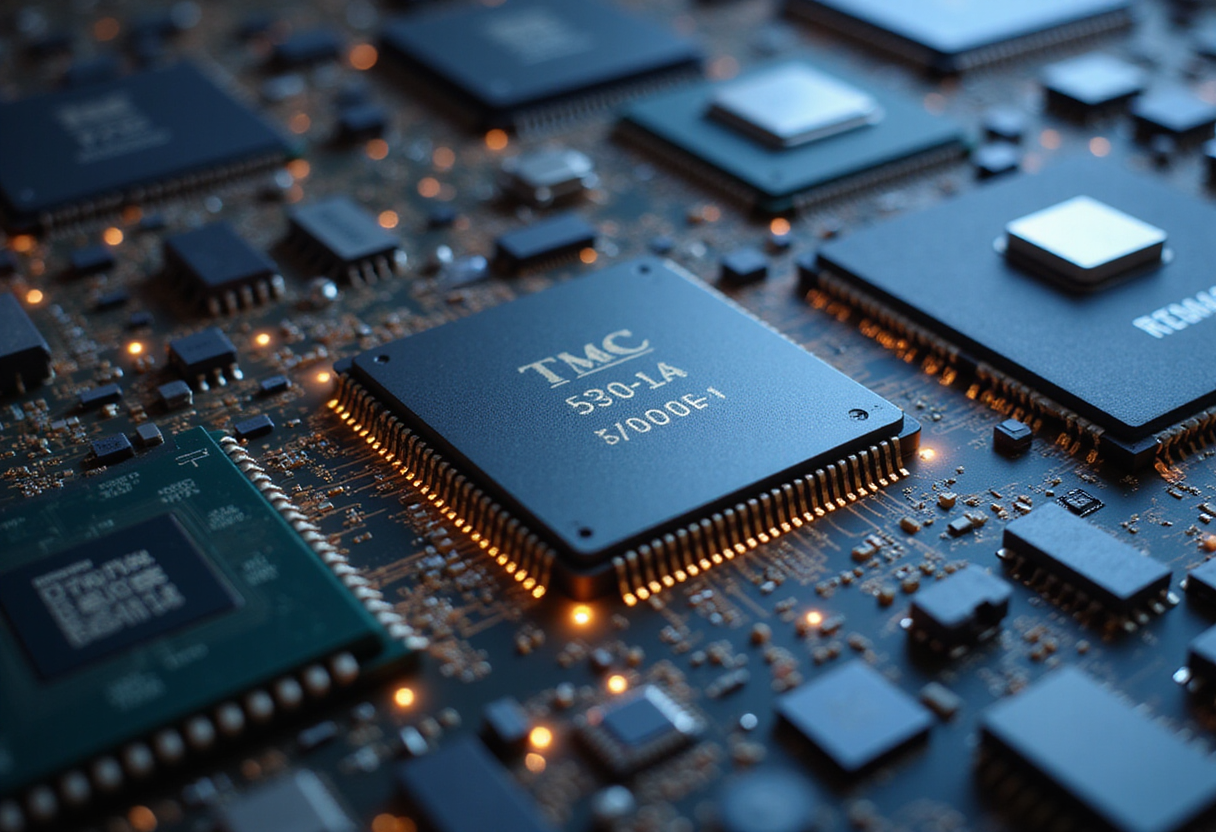
TSMC, the world's biggest chipmaker, posted a 45% surge in sales, according to a CNBC report, as demand for artificial intelligence hardware continues to drive orders across its advanced manufacturing lines.
The figure marks one of the sharpest expansions in the company's recent operating history and confirms that spending on AI accelerators, high-performance computing processors and related silicon remains the dominant growth engine in the global semiconductor market. Contract manufacturers of TSMC's scale rarely sustain growth at this pace; the 45% jump signals that hyperscalers and chip designers are continuing to place volume orders despite broader caution in consumer electronics segments.
The result positions TSMC as the clearest beneficiary of the AI buildout now underway across datacenters worldwide. Companies designing AI chips depend on the Taiwanese foundry's leading-edge process nodes to fabricate their most advanced products. As AI model training and inference workloads scale, those customers have expanded their order books, pulling TSMC's revenue sharply upward.
The 45% growth rate stands out against the historical rhythm of the foundry business. Mature-node producers and memory suppliers have faced uneven demand over the past two years, while companies exposed to AI silicon have seen outsized gains. TSMC's latest numbers place it firmly in the second camp. Its role as the primary manufacturer for the most advanced logic chips means AI demand translates almost directly into wafer shipments and revenue.
Investors have tracked this dynamic closely. Foundry leadership at the leading edge gives TSMC pricing power and capacity allocation leverage that smaller competitors cannot match. Each new generation of AI processors requires tighter transistor densities and higher packaging complexity, which concentrates orders at the few facilities capable of yields at that level. TSMC operates the largest share of those facilities.
The sales surge also carries implications for the wider supply chain. Equipment makers, substrate suppliers and packaging partners typically see order momentum follow TSMC's utilization rates with a lag. A 45% revenue expansion at the top of the chain suggests upstream suppliers will face rising volume requirements in coming quarters, and downstream system builders will compete for allocation of advanced chips.
Geopolitically, the numbers reinforce Taiwan's centrality to global AI infrastructure. Nearly every major AI chip design, regardless of the vendor selling it, passes through TSMC's fabs. That concentration has prompted governments and customers in the United States, Europe and Japan to push for diversified manufacturing capacity, an effort that will take years to affect the current demand picture.
For TSMC itself, the challenge shifts from demand generation to capacity execution. Sustaining growth near the 45% mark requires continued capital expenditure on new fabs, advanced packaging lines and equipment. The company has historically managed this balance by matching capacity additions to committed customer orders rather than speculative buildout, a discipline that has kept utilization high through prior demand cycles.
The AI demand wave now driving results differs from the smartphone-driven cycles that previously defined TSMC's growth. Datacenter chips carry higher average selling prices and larger die sizes, which lifts revenue per wafer. Even if unit volumes grew modestly, the shift in product mix toward AI silicon would push sales figures upward. The reported 45% surge indicates both effects are at work: more wafers, at higher value.
Competitors face a widening gap. Samsung Foundry and Intel Foundry Services both aim to win advanced-node business, but neither has matched TSMC's combination of yields, capacity and customer breadth at the leading edge. As long as AI chip designers prioritize manufacturing certainty over supplier diversification, TSMC's share of the most valuable orders remains difficult to displace.
The 45% sales growth reported by CNBC underscores a broader market reality: AI hardware spending has moved from speculative investment to sustained, volume-based procurement. TSMC sits at the choke point of that procurement. Its results now function as a real-time indicator of AI infrastructure investment, watched by chip designers, cloud providers and semiconductor investors alike.
Looking ahead, the key question is durability. AI capex forecasts from major cloud operators remain elevated, and new chip generations are scheduled for release on annual cadences. Each generation ramps through TSMC's fabs. Unless AI infrastructure spending contracts sharply, the demand base supporting the current surge appears intact for the near term.
via Google News: TSMC (Source)
More from Grace Kim
Same lot · LOT-C1BA
- DSG-563714nmTSMC Foundry Share Hits 72.5% as AI, Smartphone Demand Fill Advanced Nodes
- DSG-35237nmTSMC Secures Approval for Sub-1.4 nm Manufacturing Plants
- DSG-746720nmTSMC Crosses $2 Trillion Market Cap on AI Foundry Demand
- DSG-163210nmTSMC Raises 2nm Output Target 20% to 120,000 Wafers Monthly
- DSG-608565nmTSMC to Raise Wafer Foundry Prices 3%–6% From January