Test report DSG-7723 · Rev D · tested November 17, 2026
Processors & AcceleratorsDevice under test
Optical Computing Market Hits $2.22 Billion as AI Power Bills Bite
Optical computing's market value grew from $0.4 billion in 2022 to $2.22 billion, as startups target a 10-80x energy-efficiency edge over GPUs for AI inference.
- Read
- 5 min
- Words
- 979
- Node
- 7nm
- Operator
- Elena Vasquez
Spec summary
- Optical computing market valuation rose from $0.4 billion in 2022 to $2.22 billion.
- Companies in the sector target a 10- to 80-fold energy-efficiency improvement over today's GPUs.
- Neurophos claims 50x the speed and 35x the energy efficiency of Nvidia's Blackwell B200, with rack deliveries planned for 2028.
- LightSolver emulation showed its laser processing unit solving differential equations 40 to 80,000 times as fast as a GPU.
- Lumai's Iris Nova optical server became available for evaluation in April 2026.
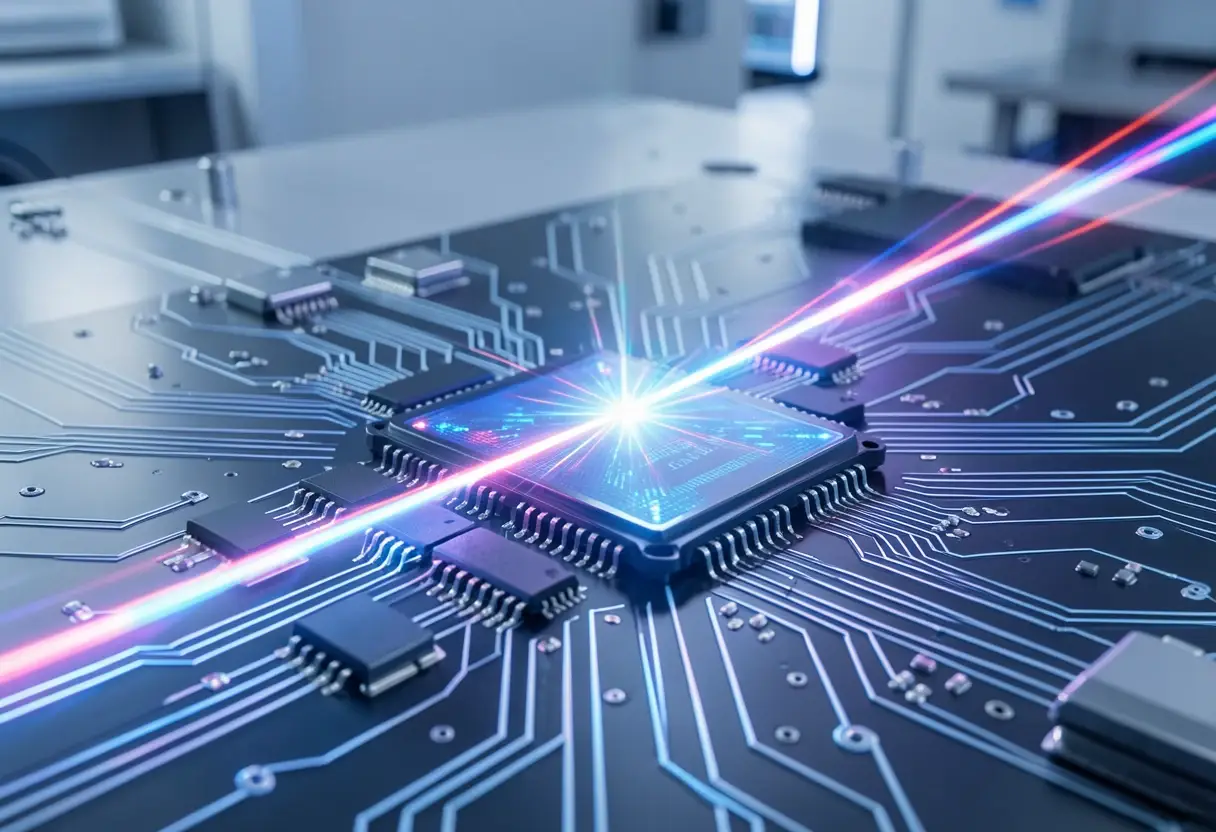
The optical computing sector's combined market valuation has jumped from $0.4 billion in 2022 to $2.22 billion, and the reason is simple: AI inference has run into a power wall. "Most of the interest in [photonics] is driven by the fact that AI inference has literally become limited by power, and in a rather striking manner," says Peter McMahon, associate professor of applied and engineering physics at Cornell University, who has researched optical computing for over a decade.
The underlying idea is 70 years old, but the physics argument is concrete. Inference is dominated by one operation — matrix-vector multiplication — and Joseph W. Goodman proposed an optical method for it back in 1978. Multiply an N-by-N matrix by a vector of length N, and electronics burns energy scaling with N², because each of the N² multiplications costs power. In optics, the multiplication is passive: passing light through an attenuator costs almost nothing, so energy scales with N instead of N².
How big is the energy win, really?
In 2022, McMahon's Cornell team demonstrated an optical neural network that used less than one photon — roughly 2.5 x 10⁻¹⁹ joules — per multiplication. A conventional multiply takes between 10⁻¹⁴ and 10⁻¹² joules, which points to a theoretical factor-of-100,000 improvement.
Don't bank on it. McMahon notes the encoding cost wasn't counted, and the constants matter: if one electronic multiply costs 1 picojoule but encoding one optical vector element costs 1,000 picojoules, electronics wins for vectors shorter than 1,000 elements. "The very rough answer is somewhere between N equals 1,000 and N equals 10,000," he says of the crossover point.
Amdahl's law bites too. If 90 percent of a workload can be accelerated and 10 percent can't, the ceiling is a 10x speedup — and inference includes nonlinear operations optics doesn't handle. Factor in all caveats and today's optical-computing companies are aiming for a 10- to 80-fold energy-efficiency gain over GPUs, with traditional silicon closing in from behind.
Free space versus on-chip: who's building what?
Lumai, in Oxford, England, follows Goodman most directly, replacing his fixed attenuator with a programmable spatial light modulator. "A full vector-matrix multiply completes in a single optical cycle," says head of product Phillip Burr. The company's Iris Nova optical server went out for evaluation in April 2026, and the next-generation Iris Aura is designed to do prefill — the compute-heavy half of inference — on roughly one-tenth of a GPU's energy.
Neurophos, based in Austin, Texas, uses metamaterial modulators just several micrometers per side, fitting a 1,000-by-1,000 array on a 5-mm-square chip. CEO Patrick Bowen says the silicon-photonics equivalent "optical transistor" is about 2 millimeters long — far too big to compete with TSMC's compute density. His modulators switch over 10,000 times faster than liquid-crystal spatial light modulators, and he claims 50 times the speed and 35 times the energy efficiency of Nvidia's Blackwell B200, with a roadmap to 250x speed and roughly 90x efficiency. The chips are CMOS-compatible, and Neurophos is picking a fab site ahead of rack deliveries in 2028.
The on-chip camp trades free space's 3D advantage for manufacturability. "There is a good reason that free-space optics are usually limited to 1,000 units a year," says Michael Förtsch, CEO and founder of Q.ANT in Stuttgart, citing lens inspection and assembly. Q.ANT's interferometer-based Native Processing Server already runs at the Leibniz Supercomputing Centre in Munich and the Jülich Supercomputing Centre, and the company recently sold a system to cloud provider Ionos. Shanghai-based Lightelligence, meanwhile, described a 2025 paper running vector-matrix multiplication at 1 GHz with 3-nanosecond latency on its PACE2 processor — which handles 128-by-128 matrices — claiming two orders of magnitude lower latency than GPUs.
Förtsch is candid about the catch: analog-to-digital conversion. Without a fast, low-energy converter, "we don't see realistic chances that…a general vector-matrix multiplication machine in optics makes sense," he says.
What about workloads beyond AI inference?
Several startups are skipping the matrix race entirely. LightSolver, based in Israel, puts a spatial light modulator and a laser-like gain medium inside a cavity; light bounces to a steady state that encodes the solution to differential equations. Emulation showed its laser processing unit solving them 40 to 80,000 times as fast as a GPU, depending on workflow, and the team is now benchmarking energy. CEO and cofounder Ruti Ben-Shlomi says a working prototype exists, with a rack-mountable box in development and a custom algorithm for text-to-image generation.
Optalysys, in Leeds, England, moved Fourier transforms on-chip with a passive silicon-plane component that can also pull out other mathematical operations. Founder and chief product officer Nick New targets the network path itself, where data already travels as light — doing GPU-result combination, compression and format conversion essentially for free. "We're effectively adding processing to where there is none right now," he says, focusing on memory-bound decode rather than prefill.
Will photons actually displace GPUs?
Yale's Logan Wright isn't betting on it. "The direction of algorithm development is not going to be a direction that is automatically favorable for optics," he says, since model developers optimize for GPUs. But he draws optimism from Nvidia and TSMC investing in co-packaged silicon photonics for switching and interconnects — a foothold that "opens the door to do a little bit more in the future."
Förtsch frames the endpoint as heterogeneous: "CPUs, GPUs and photonic NPUs each take on the tasks they are best suited for," with each task running on the most efficient hardware to cut energy and operating costs.
via spectrum.ieee.org (Source)
More from Elena Vasquez
Show full bio
Senior reporter covering people, launches and day-to-day practice in hardware layer of artificial intelligence at Die Signal.
675 articles
Same lot · LOT-362D
- DSG-289545nmDeepX's 3W NPU Brings Vision and Small Language Models to Raspberry Pi
- DSG-637828nmDeepX NPU Runs AI Inference on 3 Watts, Gets Raspberry Pi Spotlight
- DSG-90885nmMicrosoft's Maia 300 Claims 40% Efficiency Gain Over Nvidia
- DSG-36157nmTensordyne Tapes Out Napier: Log-Based AI Inference at 300W vs B300's 1,200W
- DSG-667728nmSiMa.ai raises $150m at $1.45bn valuation for physical AI chips