Test report DSG-8392 · Rev E · tested November 17, 2026
AI Datacenter InfrastructureDevice under test
Nvidia Slips to Third as $500 Billion AI Financing Wobbles
Nvidia fell to third in market capitalization at $3.76 trillion as Huang's exit puts $500 billion in AI financing partly at risk; UBS warns of $50 billion in potential outflows.
- Read
- 7 min
- Words
- 1,304
- Node
- 3nm
- Operator
- Grace Kim
Spec summary
- Nvidia fell 4.12% to a $3.7629 trillion valuation on the 16th, dropping to third in market cap for the first time in 18 months.
- A $500 billion AI infrastructure financing memorandum with Apollo, BlackRock, Blackstone, Brookfield, Goldman Sachs and KKR is partly at risk; UBS warns of over $50 billion in outflows.
- Nvidia took part in 129 venture investments this year, 27% of global VC activity, per PitchBook.
- Interim CEO Colette Kress previously cut Nvidia's OpenAI Ohio backstop to about $105 billion from $250 billion.
- Nvidia reports third-quarter results after the close on the 17th; Anthropic lists on Nasdaq on the 19th.
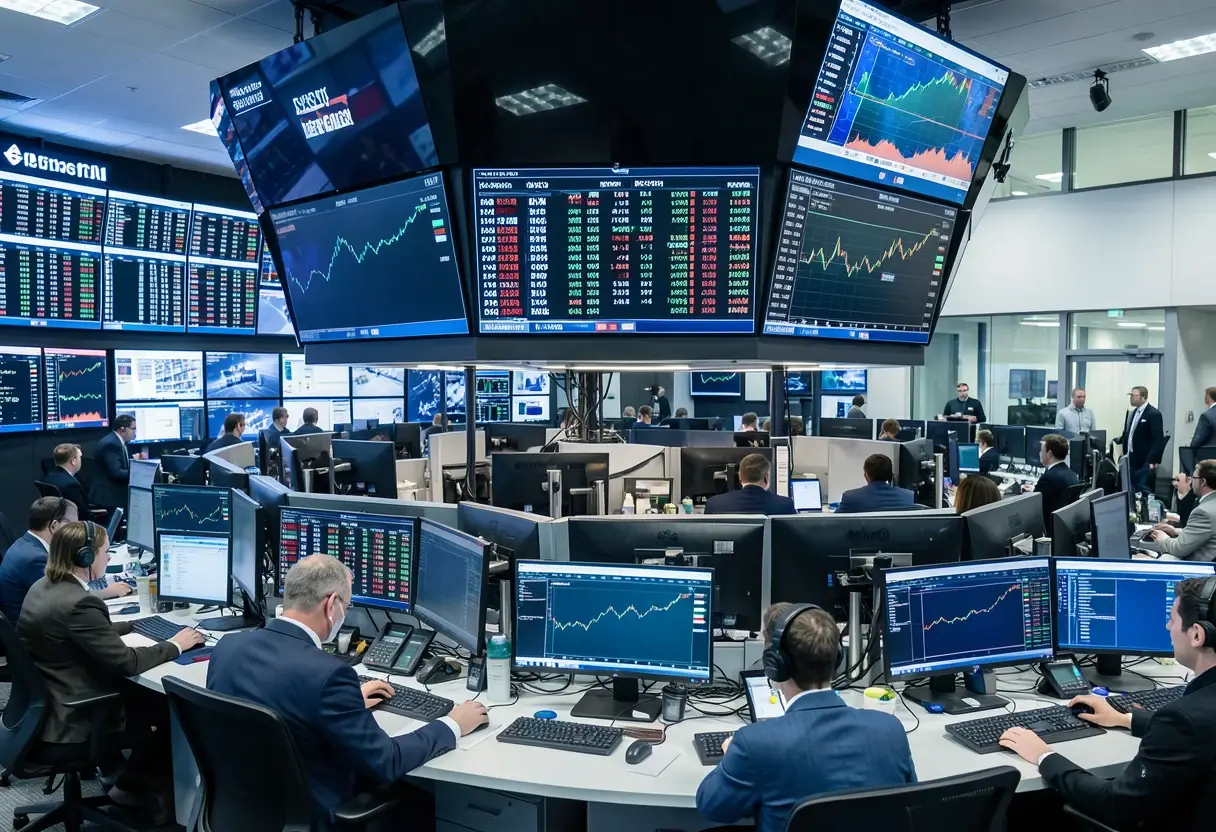
Nvidia's market value has fallen to $3.7629 trillion, dropping the company to third place in market capitalization for the first time in 18 months, as the exit of former chief executive Jensen Huang over an extramarital affair scandal puts a $500 billion AI financing project partly at risk. The stock fell 4.12% on the New York market on the 16th, and the company now trails Apple and Microsoft after a valuation that once topped $5 trillion.
The selloff spread across the sector. On the 16th most technology stocks fell: Apple (-0.98%), Microsoft (-1.12%), Amazon (-3.34%), TSMC (-6.34%), Alphabet (-4.07%), SpaceX (-1.26%), Meta (-2.38%), Broadcom (-3.92%), Tesla (-2.69%), SK hynix (-7.29%), AMD (-5.58%) and Micron (-7.62%). The Dow dropped 1.41%, the S&P 500 fell 1.92% and the Nasdaq Composite lost 2.49%. The Philadelphia Semiconductor Index plunged 5.28%, falling below the 10,000 mark for the first time since the 10th.
Why does Huang's exit threaten AI funding?
Huang stepped down from both the chief executive post and the board on the 12th, after allegations of successive extramarital relationships with Alice Huang — suspected of being a Chinese spy and known in Chinese as Huang Le — and with Kimberly Powell, vice president of the company's healthcare division, among others. Alice Huang is also suspected of using the former CEO to divert at least $7.5 billion worth of Nvidia AI chips to Chinese companies.
Huang had acted as a major funding source for the nascent AI ecosystem despite criticism that the arrangements amounted to "circular transactions" — money from chip sales channeled back into the industry as investment, enabling recipients to buy more Nvidia chips. On Aug. 10, Nvidia signed a memorandum of understanding worth a combined $500 billion with Apollo Global, BlackRock, Blackstone, Brookfield, Goldman Sachs and KKR for AI infrastructure financing.
UBS said in a report that more than $50 billion could flow out of the market if Nvidia pulls back its financing, and that companies would face funding shortages at a time of rising interest rates. PitchBook found that as of the 10th, Nvidia had taken part in 129 venture capital investments this year — 27% of global investment. Should Nvidia withdraw from equity investing, a wave of startups could struggle to stay in business.
Interim chief executive Colette Kress, previously chief financial officer and a finance specialist, has already put the brakes on large deals. She led negotiations that cut Nvidia's financial backstop commitment for an OpenAI data center in Ohio to about $105 billion from an initial $250 billion. The Wall Street Journal projected on the 15th that Nvidia would scale back computing-related transactions and its startup support.
Elon Musk, SpaceX chief executive, wrote on X on the 14th that Huang "led supply chain management brilliantly at Nvidia, but many of the contracts were done on a handshake rather than in writing," adding that "without Jensen, at least some key contracts will be lost."
Who wants Huang back?
Brad Gerstner, chief executive of Altimeter Capital, and Gavin Baker, founder of Atreides Management — both major Nvidia shareholders — said on the 14th they had sent a formal letter to the board calling for Huang's reinstatement, arguing he "deserves a careful process, free of the unnecessary haste of being replaced before all the facts are known." As of June 30, Altimeter held about 9.41 million Nvidia shares and Atreides about 1.25 million.
A petition titled "Stand With Jensen" drew about 160,000 participants, including shareholders and current and former employees. Signatories include Musk, Epic Games chief executive Tim Sweeney, Y Combinator chief executive Garry Tan and Cohere co-founder Aidan Gomez.
OpenAI chief executive Sam Altman, speaking on the 16th at a Semafor event, said Huang "has been my hero for a long time" and that "heroes have flaws, too." He called it "hard to imagine the AI revolution without Huang and the company he built," adding that "Nvidia bet on us early, and we bet on him." Asked whether he wanted Huang back immediately, Altman noted he himself was removed by his board three years ago and felt "deep personal sympathy for the current situation."
The Financial Times reported on the 15th that Huang had discussed returning to the chief executive role with close associates, and that a "war room" of Silicon Valley executives was being assembled to lobby for his return with White House support. CNBC reported on the 16th, however, that Nvidia's board has held no discussions at all about bringing Huang back.
What do the internal revelations show?
Opposition is substantial. The New York Post reported testimony that at a closed February 2024 meeting Huang verbally abused Jay Puri, then vice president overseeing global sales, telling him he hoped Puri "would catch the flu or get even sicker" and wished he "would just die and relieve us all of the pain." At another meeting Huang shouted at a senior executive, "All I see are faces like dead people, so get out," and sources said he threw a water bottle at a senior executive.
Stephen Witt, Huang's biographer, wrote in a New York Times opinion piece on the 15th that Huang "could not tolerate dissent" and "would berate employees for more than an hour, and executives feared him." He recalled Huang "once ate breakfast at Denny's and left a $1,000 tip," but said he came to suspect these were "performances meant to please himself rather than others." Witt concluded that "Nvidia without Huang is like the Chicago Bulls without Michael Jordan."
The New York Times reported on the 16th that more than 10 current and former employees said Huang's eldest daughter, senior director Madison Huang, effectively served as her father's chief of staff, clashing with Kress and with vice presidents Ian Buck and Puri — both seen as candidates for the top job. She also pushed a "Toy Jensen" campaign turning her father into a cartoon character, which some employees feared would make the company look like a cult.
In San Jose, the Denny's restaurant marking Nvidia's 1993 founding — where Huang washed dishes as a young man and where a plaque reads "the booth that birthed a trillion-dollar company" — removed the plaque after his resignation, then said it "will be reinstalled" after controversy.
What happens next?
Treasury Secretary Scott Bessent, at odds with Commerce Secretary Howard Lutnick, said on Fox News on the 15th that Nvidia "needs a sweeping overhaul" and the board "should look outside the company when it searches for a new leader." President Trump, defending Huang on the 16th, said of Alice Huang that "nobody has proven she is a spy" and "she may not be a spy," stressing Huang "should come back." The Washington Post reported Trump's Nvidia holdings stood between $13 million and $62 million as of the end of August.
The New York Times also reported that Bitdeer, a Singapore-based data center operator and client of Lutnick-founded Cantor Fitzgerald, will run an AI data center in southern Malaysia next year fitted with Nvidia's latest servers, with computing capacity supplied to Chinese companies. The Bureau of Industry and Security said on the 16th it would block Chinese remote access to U.S.-made AI chips.
The Federal Reserve estimated in its Financial Stability Report on the 13th that major U.S. banks' AI-related exposure stood at nearly $1 trillion. Investor attention now turns to Nvidia's third-quarter results, due after the close on the 17th, and Anthropic's Nasdaq listing on the 19th — with participants watching the strategy for filling Huang's void more than the earnings themselves, and his status weighing on any year-end "Santa rally."
via en.sedaily.com (Source)
More from Grace Kim
Show full bio
Market editor covering regulation, policy and their impact on hardware layer of artificial intelligence at Die Signal.
665 articles
Same lot · LOT-362D
- DSG-902714nmNvidia Sheds $650 Billion in a Week as Huang Exit Hits AI Sector
- DSG-120410nmAMD Falls 8.75% as Huang Exit Rattles Semiconductor Trade
- DSG-132545nmMicrosoft Overtakes Nvidia in an Intraday Market-Cap Snapshot
- DSG-92305nmNVIDIA slides 27% as Wall Street resets targets after CEO exit
- DSG-18605nmAltman Praises Huang as NVIDIA Falls 4.12% Ahead of Earnings