Test report DSG-7512 · Rev E · tested October 13, 2026
Supply Chain & PolicyDevice under test
Nvidia's China AI Chip Share Falls to 34% as Huawei Gains
Nvidia's share of China's AI chip market has slid to 34%, with Huawei picking up ground as US export controls reshape the world's second-largest AI market.
- Read
- 2 min
- Words
- 492
- Node
- 5nm
- Operator
- Grace Kim
Spec summary
- Nvidia's China AI chip market share has dropped to 34%.
- Huawei is gaining ground at Nvidia's expense in China.
- US export controls restrict Nvidia's highest-end AI chip sales to China.
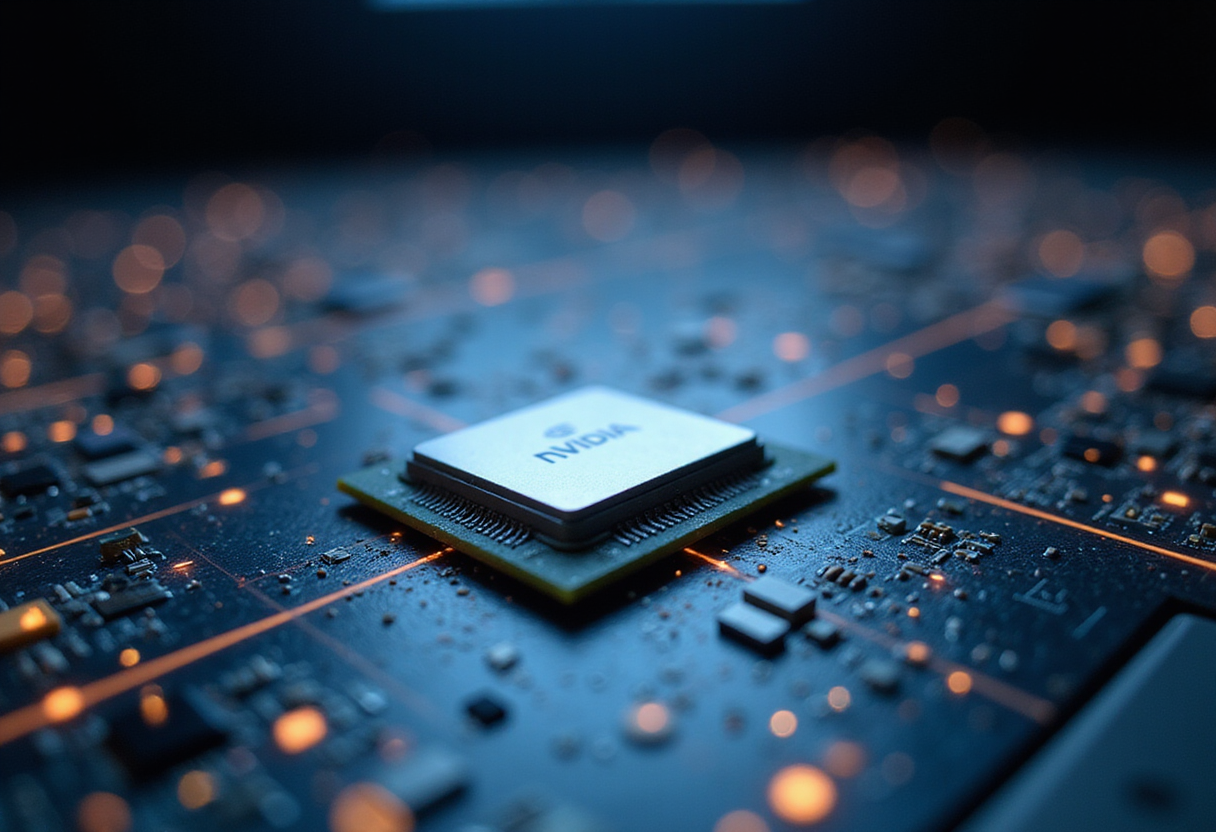
Nvidia now holds 34% of China's AI chip market, a sharp fall for a company that until recently dominated the segment it effectively created for Chinese buyers. Huawei is the beneficiary, gaining ground as domestic suppliers absorb demand the US firm can no longer serve freely.
The figure lands amid a US export-control regime that bars Nvidia from selling its highest-end data-center GPUs (graphics processing units, the accelerator chips that train and run AI models) to Chinese customers without a license. Washington has tightened those rules repeatedly since 2022, and each round has pushed more Chinese spend toward domestic alternatives.
Huawei sits at the front of that queue. Its Ascend line of AI accelerators is the most visible local competitor, and Beijing's procurement preferences increasingly steer state-linked buyers toward it. The result is a market where Nvidia's ceiling is set in Washington and Huawei's floor is set by industrial policy.
What does the 34% share change for buyers?
For Chinese cloud and AI labs, it means fewer fallback options on the US side. Nvidia's approved-for-export parts run slower than its flagship parts, so customers weighing them against Huawei's domestic silicon face a genuine trade-off: proven software ecosystem versus supply security. Every point of share Nvidia cedes makes that calculation less about risk and more about routine.
For Nvidia, China was once a multi-billion-dollar revenue line; the 34% share quantifies how much of that has leaked away. The company does not control the variables — export licensing, Huawei's yield, or Beijing's procurement directives — and each of them currently moves against it.
Why Huawei is gaining now
Three forces are working in the same direction:
- Export controls cap what Nvidia can legally ship, compressing its addressable product range in China.
- State procurement favors domestic accelerators for government-linked AI projects, handing Huawei a baseline of guaranteed demand.
- Ecosystem maturity — Chinese developers are porting training workloads to Huawei's stack (the software layer that makes a chip usable), which was historically the biggest barrier to switching.
None of these reverses quickly. Export policy would need to loosen in Washington, or Huawei would need to stumble on supply, for Nvidia to claw share back.
The read for the rest of the market
Chip analysts will watch two follow-on numbers. First, whether Huawei can convert share gains into volume at scale, since demand for AI compute in China still exceeds what domestic fabs (chip fabrication plants) can produce. Second, whether Nvidia's remaining 34% holds — that residual reflects customers who still need CUDA (Nvidia's proprietary programming platform) and will pay a premium or jump through licensing hoops to get it.
The direction of travel is clear, though. A market Nvidia once treated as a growth engine is now a contested one, and the contest's rules are written in two capitals. Neither has shown any sign of easing up.
via Google News: AI chip (Source)
More from Grace Kim
Show full bio
Market editor covering regulation, policy and their impact on hardware layer of artificial intelligence at Die Signal.
309 articles
Same lot · LOT-C1C9
- DSG-26245nmNvidia Stock Falls as Its China AI-Chip Share Drops to 34%
- DSG-890028nmNvidia's China AI Chip Share Falls to 34% as Huawei Closes In
- DSG-94803nmNvidia's China AI Chip Share Slides to 34%, IDC Data Shows
- DSG-152245nmNvidia's China AI-Chip Share Slides as Huawei Closes Gap
- DSG-679328nmNVIDIA's China AI Chip Share Slides to 34% as Huawei Advances