Test report DSG-2738 · Rev C · tested October 15, 2026
Foundries & ManufacturingDevice under test
Nvidia Expands CUDA-X Toolset for AI-Driven Semiconductor Manufacturing
Nvidia has expanded its CUDA-X tool family for AI semiconductor manufacturing, pushing its GPU software stack from the datacenter onto the fab floor.
- Read
- 2 min
- Words
- 437
- Node
- 28nm
- Operator
- Grace Kim
Spec summary
- Nvidia has expanded its CUDA-X tool family for AI semiconductor manufacturing.
- The tools target compute-heavy fab workflows such as inspection, process control and yield analysis.
- No pricing, release date, customer list or partner names accompanied the announcement.
- CUDA-X is Nvidia's umbrella brand for domain-specific libraries built on its CUDA parallel-computing platform.
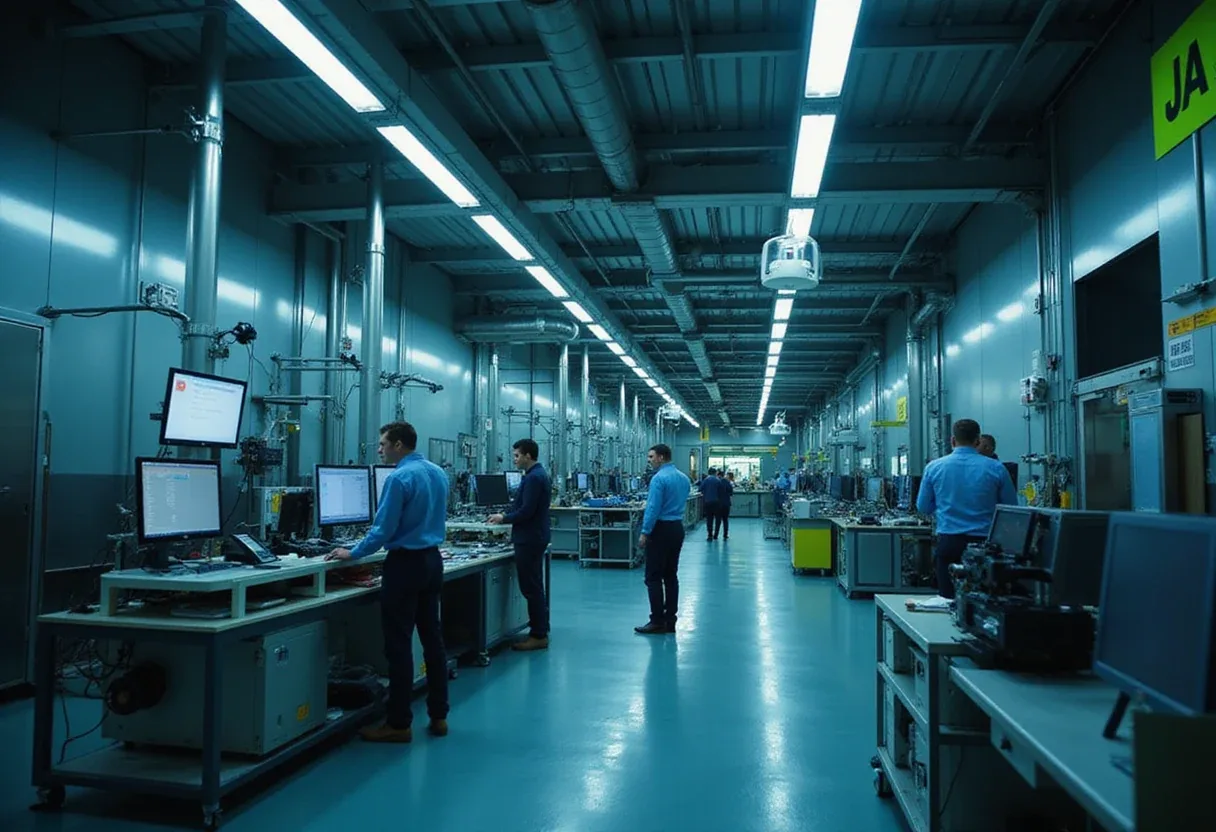
Nvidia has expanded its CUDA-X tool family for AI semiconductor manufacturing, extending the company's software stack from model training into chip production itself.
The announcement, reported by Advanced Manufacturing, names no pricing, no release date, and no customer list. What it does signal is direction: Nvidia wants its graphics processing units (GPUs) and CUDA software libraries (the parallel-computing toolkit that runs on them) embedded deeper in the factory, not just the datacenter.
CUDA-X is Nvidia's umbrella brand for domain-specific libraries built on top of CUDA (Compute Unified Device Architecture), the company's core parallel-computing platform. The manufacturing-focused additions target semiconductor production workflows — the class of compute-heavy tasks found in fabs, where AI models increasingly handle inspection, process control, and yield analysis.
Why does a chip designer sell factory software?
Because that's where the compute is going. Semiconductor manufacturing generates enormous volumes of sensor and inspection data, and AI workloads in that environment need acceleration. Nvidia's pitch is straightforward: run those workloads on its hardware, managed through its libraries, and the factory floor becomes another CUDA customer.
It's a familiar playbook. Nvidia built its datacenter dominance the same way — CUDA libraries first, GPU procurement follows. Applying it to manufacturing extends the moat into a sector that has historically run on proprietary and legacy control systems.
What does this change for manufacturers?
For fabs and equipment makers, the practical question is integration. A CUDA-X library for manufacturing only pays off if it connects to existing inspection tools, metrology systems, and process-control pipelines. The announcement doesn't detail which workflows the expanded tools cover, which partners are involved, or how deployment works.
What buyers get today is a directional commitment, not a product spec sheet. Vendors of manufacturing-execution and quality-control software will need to decide whether to build on Nvidia's stack or keep their platforms hardware-agnostic.
The bigger picture
Nvidia has spent years pushing CUDA-X into verticals — healthcare, climate modeling, robotics, telecom. Semiconductor manufacturing is a logical addition, and arguably a pointed one. The company already sits at the center of AI chip demand; tooling the factories that make those chips tightens the loop further.
For competitors like AMD and Intel, which have their own accelerator software efforts, the move raises the familiar CUDA problem in a new venue: software ecosystems stick, and Nvidia keeps expanding theirs into adjacent territory.
The reporting from Advanced Manufacturing offers no deployment figures, no named fabs, and no availability timeline. Die Signal will follow up as concrete specifications and customer announcements emerge.
By Grace Kim
via Google News: AI chip (Source)
More from Grace Kim
Show full bio
Market editor covering regulation, policy and their impact on hardware layer of artificial intelligence at Die Signal.
396 articles
Same lot · LOT-C1CB
- DSG-891845nmNvidia to Invest in Chip Rival d-Matrix as Its Challengers Choose Partnership
- DSG-28953nmNVIDIA Unveils RTX Spark AI Superchip
- DSG-548565nmJensen Huang Signals NVIDIA's N1 Plans for AI PCs
- DSG-275614nmDeepSeek and Huawei Partner on Chip Programming Tools
- DSG-15747nmNvidia-backed Upscale AI launches platform to link rival chips