Test report DSG-8981 · Rev D · tested October 10, 2026
Processors & AcceleratorsDevice under test
NVIDIA Chip Prices Surge on China's Black Market Under US Export Curbs
Restricted NVIDIA AI accelerators are commanding sharply higher premiums on China's underground secondary market, according to a Chosun Ilbo headline distributed via Google News, framing the price escalation as a direct consequence of US export controls.
- Read
- 3 min
- Words
- 554
- Node
- 14nm
- Operator
- Marcus Bennett
Spec summary
- Chosun Ilbo headline reports price surge for restricted NVIDIA chips on Chinese black market
- US BIS export controls have restricted legal China shipments of NVIDIA silicon since October 2022
- NVIDIA H20 added to controlled list in late 2024, requiring worldwide licensing
- Compliant variants A800, H800, and H20 were engineered below original BIS thresholds
- Domestic substitute Huawei Ascend 910B/910C trails NVIDIA on throughput and software maturity
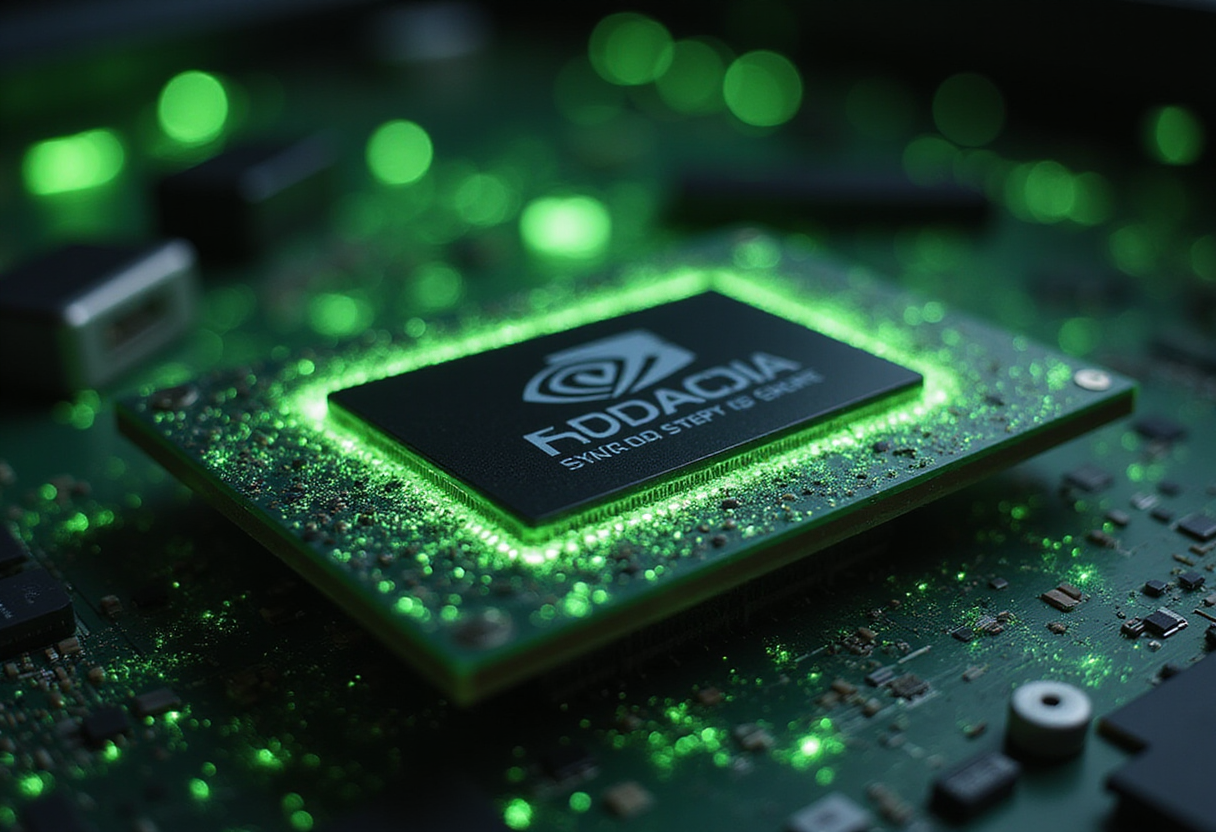
Restricted NVIDIA AI accelerators are commanding sharply higher premiums on China's underground secondary market, according to a headline distributed by the South Korean daily Chosun Ilbo via Google News. The outlet frames the price escalation as a direct consequence of US export controls that have restricted legal shipments of high-end NVIDIA silicon into mainland China.
What controls are in play?
The US Commerce Department's Bureau of Industry and Security administers the export licensing regime covering advanced computing chips. Rules issued in October 2022 established ceilings on compute density and interconnect bandwidth; subsequent revisions have tightened those ceilings and expanded the controlled-item list. NVIDIA's flagship data-center accelerators have consistently fallen within scope.
NVIDIA has responded by engineering compliant variants—the A800, H800, and later H20—designed to operate just below the published thresholds. After further revisions, the H20 was added to the controlled list in late 2024, requiring worldwide licensing for shipment to China. New Blackwell-generation parts face a worldwide licensing requirement rather than country-specific restrictions.
Why does the black market clear at a premium?
A licensing denial creates a price wedge. End-users willing to acquire parts outside official channels pay a premium for guaranteed access; intermediaries willing to circumvent border controls capture the spread. The economics scale with the compute value of the restricted silicon and with enforcement penetration at the destination.
Two structural factors keep the channel active. Chinese demand for training-grade compute has remained elevated across hyperscalers, research institutes, and government-linked entities. Legal supply of restricted parts is now functionally limited to pre-control inventory, gray-channel imports, and lower-tier domestic alternatives.
What domestic substitutes exist?
Huawei's Ascend 910B and 910C are the principal domestic alternatives. Chinese-language trade reports indicate that the Ascend line trails NVIDIA's restricted silicon on per-accelerator throughput and on the maturity of the CUDA-equivalent toolchain. That performance differential keeps demand for genuine NVIDIA parts intact in training workloads, even at black-market prices.
What enforcement actions have occurred?
US authorities have prosecuted smuggling networks through cases filed by the Department of Justice and BIS. Targets have included shell-company structures registered in third countries, with penalties ranging from multi-year prison sentences for individuals to entity-list additions for complicit firms. End-user enforcement inside China remains constrained by sovereign inspection access.
How has NVIDIA disclosed the exposure?
NVIDIA's data-center segment revenue has continued to grow at the company level, but China-region sales have declined following successive waves of restriction. Management has explicitly disclosed that incremental controls on the H20 will reduce addressable China revenue going forward, with executives quantifying the impact during quarterly earnings calls.
What does the trend imply?
The Chosun Ilbo headline indicates that the price wedge has widened rather than narrowed. Continued tightening of US controls, combined with limited domestic substitute performance, points to sustained black-market premiums for restricted NVIDIA accelerators in China. The trajectory remains contingent on the pace of domestic silicon ramp at Huawei and other Chinese vendors, and on any future US licensing adjustments.
The South Korean report adds to a growing body of regional coverage documenting gray-channel activity around controlled NVIDIA silicon. Specific quoted prices, transaction volumes, and named intermediaries were not disclosed in the headline-level summary.
via Google News: Semiconductor export controls (Source)
More from Marcus Bennett
Show full bio
News editor covering marketplaces and e-commerce at Die Signal.
276 articles
Same lot · LOT-C1C6
- DSG-719120nmUS Charges Man With Illegally Shipping Nvidia Chips to China
- DSG-155110nmChip Smuggling Cases Reveal Gaps in Nvidia's China Export Controls
- DSG-49517nmHuawei chairman: Ascend has passed Nvidia in China AI chip market
- DSG-382114nmUS Charges Man With Illegally Shipping Nvidia Chips to China
- DSG-192165nmChinese state funds tied to restricted Nvidia AI chip buys