Test report DSG-4137 · Rev F · tested October 10, 2026
Supply Chain & PolicyDevice under test
Nvidia, Broadcom insulated as AI power strain hits supply chain
Morgan Stanley says power availability, not chip capacity, is now the binding constraint on AI hardware supply — with Nvidia and Broadcom best shielded from the fallout.
- Read
- 4 min
- Words
- 748
- Node
- 14nm
- Operator
- Amara Osei
Spec summary
- Morgan Stanley names Nvidia and Broadcom as best shielded from the AI power crunch
- The analysis identifies power availability, not wafer capacity, as the current binding supply chain constraint
- Power infrastructure constraints take years to resolve, unlike earlier chip component shortages
- Hyperscaler-linked suppliers gain protection because large operators control scarce power capacity
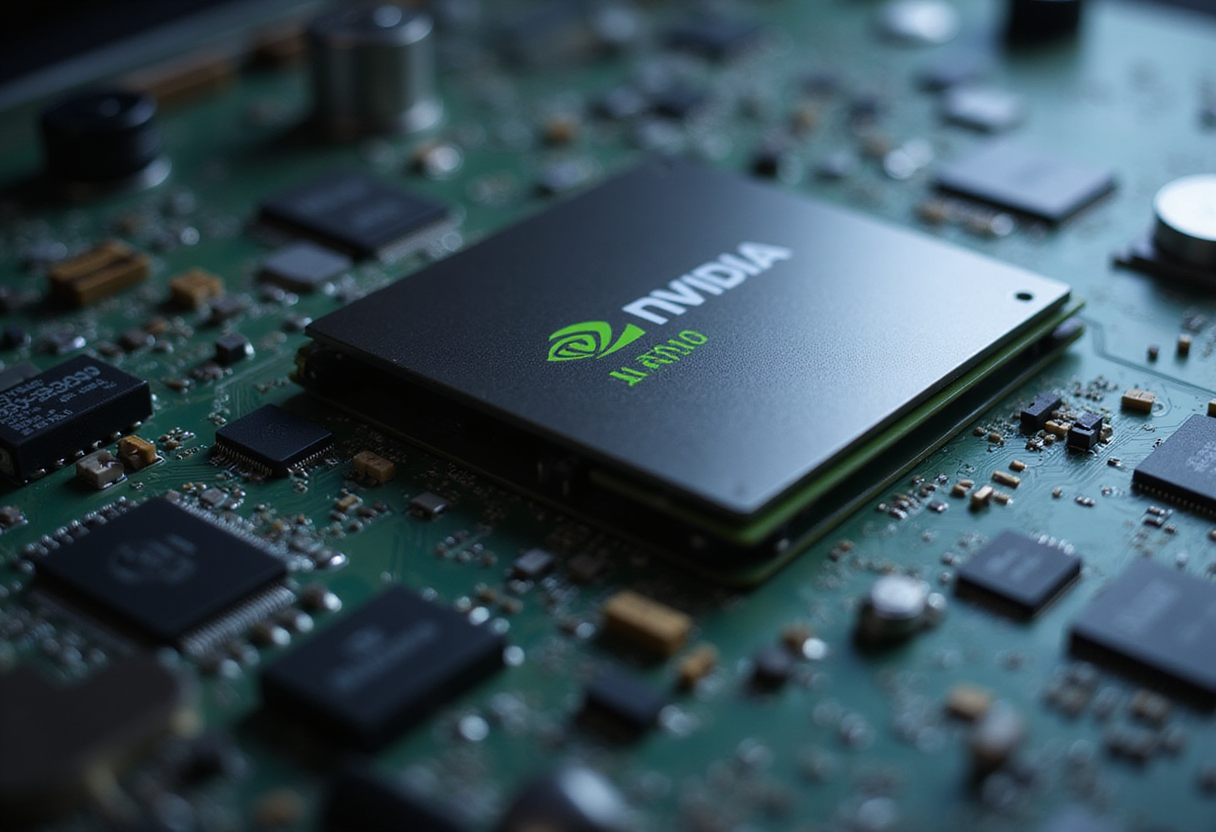
Morgan Stanley has identified power availability, not wafer capacity, as the binding constraint now tightening the AI chip supply chain — and it names Nvidia and Broadcom as the two suppliers best shielded from the disruption.
The bank's analysts frame the situation as a shift in where the AI infrastructure bottleneck sits. For most of the past two years, advanced packaging and high-bandwidth memory limited how many accelerators could ship. That constraint has eased as capacity came online. The next limit, according to the analysis, is electricity: data centers built for the AI buildout are running into walls on grid interconnection, transformer lead times and on-site power generation.
Who is exposed, and who is not?
The report's central distinction is between suppliers whose products sit close to the power problem and those whose demand holds up regardless of it. Nvidia and Broadcom fall into the shielded category, in Morgan Stanley's assessment.
The reasoning, as laid out in the research:
- Nvidia — demand for its accelerators remains the primary driver of AI capital expenditure, so allocation flows to it first when power-constrained operators must prioritize which systems to energize.
- Broadcom — its custom ASIC business ties it directly to hyperscalers that are among the most aggressive builders of new power capacity, giving it visibility into projects already secured electricity.
- Suppliers further down the stack — power delivery components, cooling and adjacent silicon — face more direct exposure to delays and redesigns triggered by the power crunch.
The analysts' verdict, in short: the power shortage reshuffles relative positioning across the supply chain rather than cutting demand at the top of it.
What does the power crunch actually change?
Three practical consequences follow from the analysis.
First, the constraint moves from the fab to the facility. Chipmakers can produce more silicon, but operators cannot energize it on schedule. That shifts risk from component supply to project execution.
Second, differentiation widens. Customers with secured power — largely the largest hyperscalers — continue to place orders at scale. Smaller operators without locked-in electricity defer deployments, concentrating demand on the suppliers serving the biggest spenders.
Third, design priorities change. Power efficiency per unit of compute becomes a purchasing criterion on par with raw performance, since every watt delivered to a rack carries a higher effective cost.
Each of these dynamics, in Morgan Stanley's framing, works in favor of the two shielded names and against suppliers dependent on a broad, evenly distributed buildout.
Why the supply chain, not the chips, is the story
Morgan Stanley's analysis reads the AI hardware market as a sequence of bottlenecks. GPUs were scarce. Then memory and packaging were scarce. Each scarcity concentrated value at whichever node held the constraint, and each resolution pushed the bottleneck downstream.
Power is the next node in that sequence. It differs from the earlier ones in a specific way: capacity cannot ramp in months. Grid upgrades, substations and generation take years to plan and build. That means the power constraint is likely to bind longer than the component shortages that preceded it — and it explains why the bank treats exposure to it as a durable differentiator rather than a transient one.
For Nvidia, the implication is that its order book stays protected even if total industry shipments lag the theoretical capacity of the semiconductor pipeline. For Broadcom, the implication is that its hyperscaler relationships — the same ones driving its custom silicon business — double as insulation, because those customers control the scarce resource.
What should buyers and investors watch?
Morgan Stanley's framework points to a short list of indicators that will confirm or break the thesis:
- Grid interconnection timelines and transformer lead times in major data center markets, which set the pace of new capacity.
- Capital expenditure guidance from the largest hyperscalers, whose spending reveals whether power constraints are biting.
- Order patterns among second-tier AI operators, where deferrals would show up first if the power crunch spreads.
- Any redesign or reprioritization of rack-level power delivery architectures among the major system vendors.
If those indicators move as the bank expects, the divergence it describes — protected leaders, exposed periphery — becomes the defining structure of the AI hardware market through the next procurement cycle.
The report does not claim the power crunch caps AI demand overall. Its argument is narrower and more consequential for positioning: demand holds, but where it can be fulfilled shifts, and that shift concentrates benefit at Nvidia and Broadcom while redistributing risk to the rest of the supply chain.
via Google News: AI chip (Source)
More from Amara Osei
Same lot · LOT-C1C6
- DSG-45545nmMorgan Stanley: AI power crunch strains chip supply chain
- DSG-58583nmMorgan Stanley: AI power crunch strains chip supply chain
- DSG-404920nmMorgan Stanley: Nvidia and Broadcom shielded from AI power crunch
- DSG-503714nmEmerald AI Draws Google, Nvidia, Anthropic for Grid-Flexibility Work
- DSG-977414nmNvidia backs Cloverleaf, a data-center-powered land company