Test report DSG-1509 · Rev B · tested October 10, 2026
Processors & AcceleratorsDevice under test
Nvidia Announces Largest Buyback in Its History Amid AI Chip Competition
Nvidia has authorized the biggest share buyback in its history as competition in AI chips weighs on the stock, a record capital-return signal to investors.
- Read
- 3 min
- Words
- 520
- Node
- 45nm
- Operator
- Priya Raman
Spec summary
- Nvidia has announced the largest share buyback program in its history.
- The record buyback comes as AI chip competition weighs on the company's stock performance.
- Reuters reported the announcement, linking the capital-return move to rising competitive pressure.
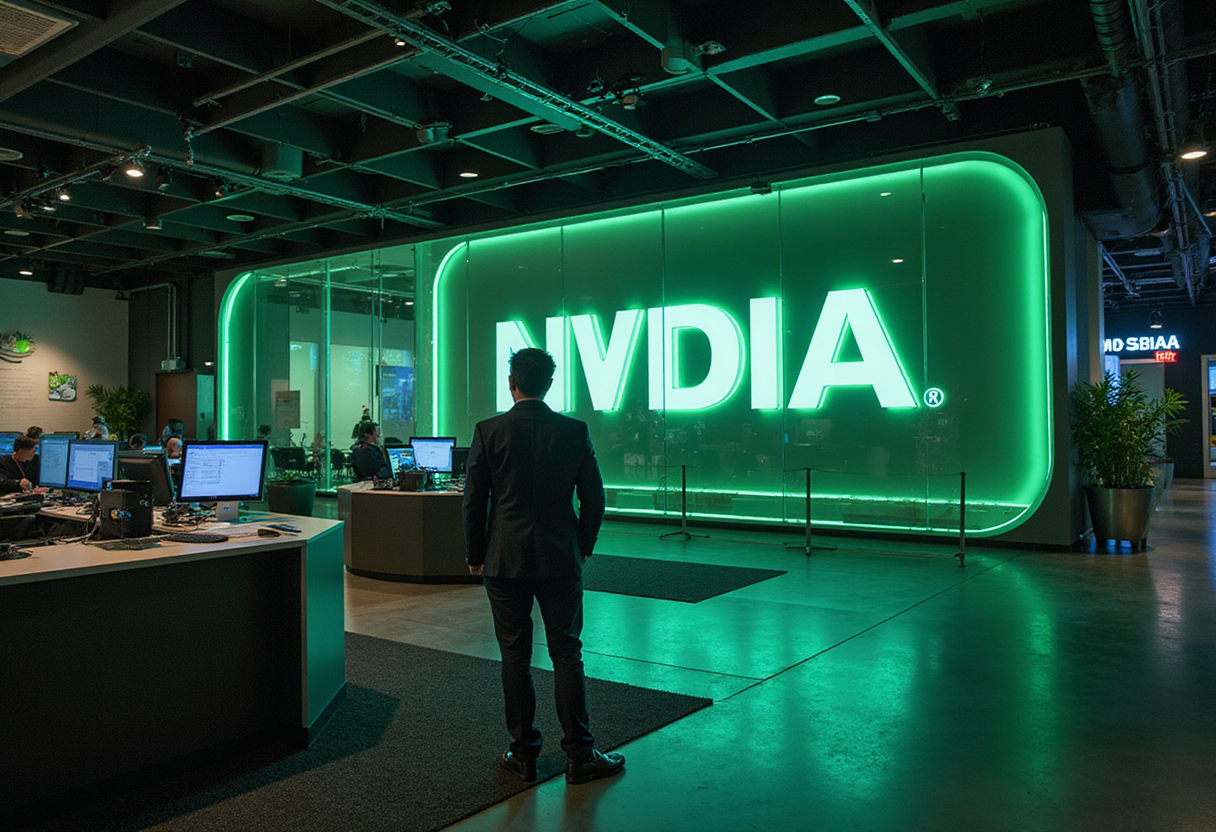
Nvidia has authorized the largest share repurchase program in its history, a move that arrives as competition in the AI accelerator market puts pressure on the company's stock performance, Reuters reports.
The decision signals that the dominant AI chip supplier intends to deploy its balance sheet directly against investor concerns. Buybacks of record scale typically serve two functions: they return capital to shareholders, and they communicate management's conviction that the shares are undervalued relative to the company's own internal outlook.
Why is Nvidia buying back stock now?
The timing is the story. Nvidia's equity has underperformed as rivals intensify their push into the market for AI training and inference chips. Competition in this segment — once effectively a one-vendor market — has broadened, and investors have responded by marking down the premium the stock carried.
A record buyback functions as a counterweight. By retiring shares, the company supports earnings per share mechanically while signaling that management views the current valuation as an opportunity rather than a warning.
What does the plan signal about the competitive landscape?
The announcement tacitly acknowledges what the market has already priced in: Nvidia no longer operates in a vacuum. Several dynamics matter here:
-
Customer concentration risk. The largest cloud operators are designing their own silicon and qualifying alternative suppliers, eroding the single-vendor dynamic that defined the first phase of the AI buildout.
-
Margin defense. As competing accelerators reach volume, pricing power at the top of the market faces its first real test of the AI cycle.
-
Capital allocation discipline. A record repurchase commits future free cash flow to shareholders rather than to acquisitions or capex, a statement about where management sees the best return.
Reuters frames the buyback explicitly against this backdrop, tying the record authorization to the competitive pressure now weighing on the shares.
How should investors read a record repurchase?
Trade history offers a caution: buyback announcements mark the ceiling of authorization, not a spending floor. Companies frequently authorize more than they execute, and the pace of actual repurchases can stretch across quarters or years. The relevant diligence questions are straightforward:
- Over what horizon will the company execute the program?
- Does free cash flow cover the repurchase alongside research, development, and supply commitments?
- Will the buyback pace step up specifically on share weakness, or run on a fixed schedule?
What comes next?
The buyback lands at a decision point for the AI hardware trade. If competition compresses Nvidia's share of AI compute spending, the repurchase cushions per-share results but cannot offset revenue deceleration on its own. If Nvidia's roadmap holds its lead, the record authorization will read in hindsight as management buying its own stock at a discount.
For the semiconductor sector more broadly, the announcement sets a benchmark. The largest vendor in the AI chip market has now committed its balance sheet to defending its valuation — a data point every competitor, customer, and investor in the stack will factor into positioning going forward.
Die Signal will track the execution pace of the program and the competitive responses from rival accelerator suppliers as the cycle develops.
via Google News: AI chip (Source)
More from Priya Raman
Same lot · LOT-C1C6
- DSG-120210nmNvidia Announces Largest Buyback in Its History Amid AI Chip Competition
- DSG-845510nmNvidia Sets Record Buyback Amid AI Chip Competition Pressure
- DSG-735145nmNvidia's Chip-Financed AI Boom Bet Meets a Wall Street Reality Check
- DSG-165528nmNvidia Reportedly Backstops Customer GPUs in Exchange for Cloud Revenue Share
- DSG-891845nmNvidia to Invest in Chip Rival d-Matrix as Its Challengers Choose Partnership