Test report DSG-2148 · Rev E · tested October 13, 2026
Processors & AcceleratorsDevice under test
Microsoft Unveils Maia 300 AI Chip, Targets Multi-Gigawatt Deployment From 2027
Microsoft has unveiled the Maia 300 AI chip and plans multi-gigawatt deployment from 2027, shifting AI compute capacity onto in-house silicon at scale.
- Read
- 2 min
- Words
- 386
- Node
- 28nm
- Operator
- Amara Osei
Spec summary
- Microsoft unveiled the Maia 300 AI chip.
- Deployment is planned to start in 2027.
- Microsoft targets multi-gigawatt deployment capacity.
- The chip extends Microsoft's in-house AI silicon program.
- Performance specs and manufacturing partner were not disclosed.
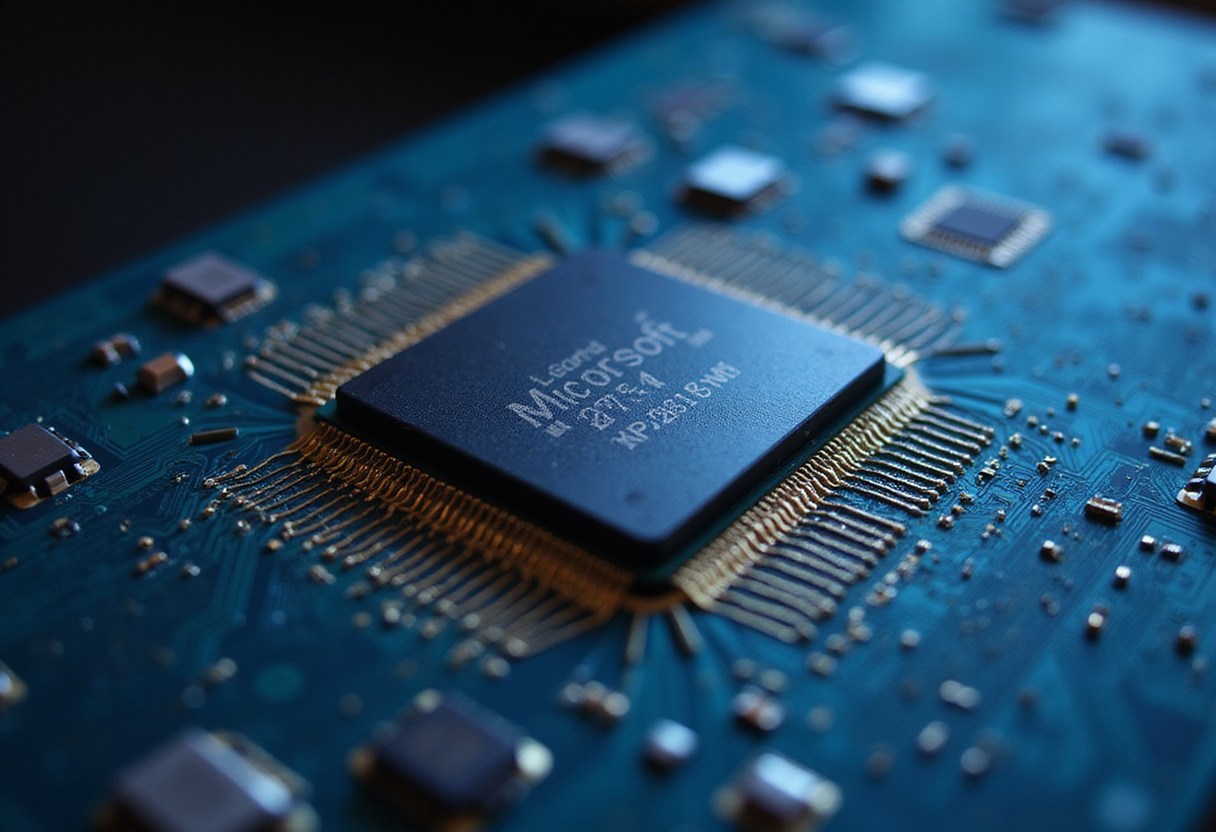
Microsoft has unveiled the Maia 300, its next-generation AI accelerator, and stated it plans a multi-gigawatt deployment starting in 2027. The company disclosed the chip and the deployment timeline in an announcement reported by Yahoo Finance on the day of the unveiling.
The figure at the center of the announcement is scale: multi-gigawatt capacity. That measure matters because AI training and inference clusters are now sized in power draw rather than in server counts. A commitment measured in gigawatts signals Microsoft expects to run the Maia 300 across fleets of data centers, not a limited pilot.
What does the Maia 300 announcement change?
The Maia 300 extends Microsoft's custom silicon program. The company designs the accelerators it intends to deploy in its own infrastructure, which reduces its dependence on third-party GPU suppliers for AI compute capacity.
Three concrete elements define the announcement:
- Product: the Maia 300, an AI chip bearing Microsoft's Maia brand.
- Deployment window: from 2027 onward.
- Scale: multi-gigawatt capacity across Microsoft's infrastructure.
The 2027 start date gives Microsoft roughly two years of lead time before volume deployment. That window covers silicon validation, system integration and data center power provisioning — the stages that typically determine whether a chip ships on schedule.
Why does the multi-gigawatt figure matter?
Power, not chip count, is now the binding constraint on AI capacity expansion. When Microsoft quantifies its deployment in gigawatts, it commits to securing the electricity, cooling and land that capacity requires.
A multi-gigawatt rollout from 2027 also sets a planning horizon for suppliers of power equipment, cooling systems and data center construction. Each gigawatt of AI compute capacity requires years of upstream coordination, and Microsoft has now put a date on when that capacity must be live.
What remains unknown?
The announcement, as reported, did not disclose:
- performance specifications or benchmark figures for the Maia 300;
- the manufacturing partner or process node;
- which Microsoft services will run on the chip first;
- the capital expenditure attached to the deployment.
Those details will determine how the Maia 300 compares with competing accelerators. For now, Microsoft has committed to the two facts it controls: the product name and the deployment scale.
Microsoft plans to switch on multi-gigawatt AI capacity built on its own Maia 300 silicon beginning in 2027.
via Google News: AI chip (Source)
More from Amara Osei
Show full bio
Staff writer covering money, funding and market shifts around hardware layer of artificial intelligence at Die Signal.
321 articles
Same lot · LOT-C1C9
- DSG-965628nmMicrosoft Unveils Maia 300 AI Chip, Expanded Rollout From 2027
- DSG-55767nmMicrosoft Targets 2027 Launch for Maia 300 AI Chip
- DSG-149945nmMicrosoft Targets Gigawatt-Scale Maia AI Chip Deployment by 2027
- DSG-75925nmMicrosoft puts Maia 300 on 2027 clock, calls it primary inference system
- DSG-10725nmMicrosoft Ships Maia 300 AI Chip, Targets One Million Units in 2025