Test report DSG-8017 · Rev F · tested October 10, 2026
AI Datacenter InfrastructureDevice under test
KIT to build €24 million AI data center with waste heat recovery
KIT will spend €24 million on a 2MW AI data center at Campus North, scalable to 10MW, feeding waste heat into district heating by 2030.
- Read
- 3 min
- Words
- 608
- Node
- 14nm
- Operator
- Marcus Bennett
Spec summary
- KIT estimates the AI data center will cost €24 million ($27.2m).
- The facility will draw 2MW initially, with an option to scale to 10MW.
- Construction is due to complete by the end of 2029; the site opens in 2030.
- Waste heat from the servers will feed the district heating network on campus.
- Baden-Württemberg currently hosts 32 data centers, according to DataCenters.com.
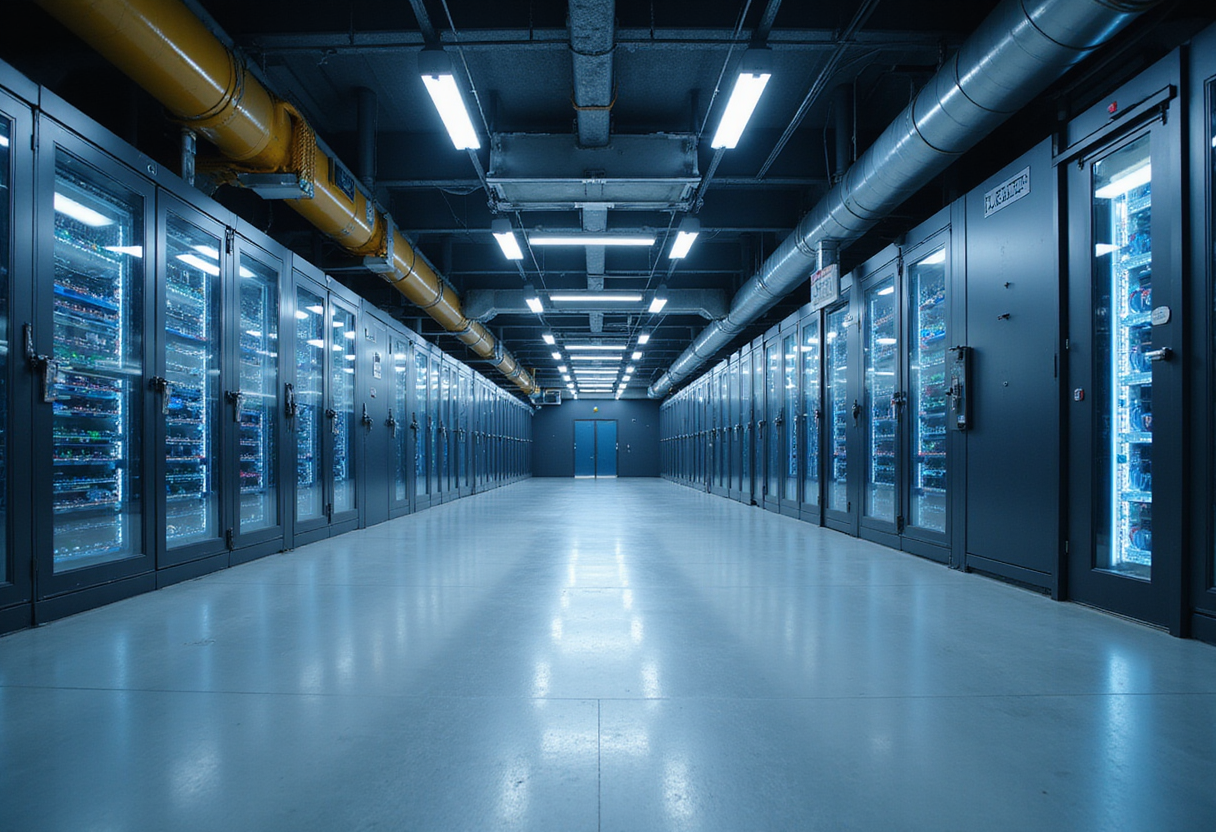
The Karlsruhe Institute of Technology (KIT) will spend an estimated €24 million ($27.2m) on an AI data center at its Campus North site in Baden-Württemberg, southwestern Germany, with construction due to complete by the end of 2029 and the site opening the following year.
The university says the facility will serve other higher education institutions, government organizations, and researchers. It will stand next to a combined heat and power plant on Campus North, and a system siphoning waste heat from the servers into the district heating network is also planned.
How much power will the data center draw?
The project's IT compute capacity has not been determined yet, but KIT predicts a power consumption of 2MW. The data center will be built in phases, with an option to scale the power supply to 10MW if demand for its services remains high.
That demand-following design extends to day-to-day operations. The site will run biphasic, shifting workloads between AI training and conventional scientific computing depending on the time of day.
Dr. Martin Nußbaumer, a director at KIT's Scientific Computing Center, said: "Our aim is to build a system that can 'breathe' with demand. During the day, it provides more capacity for AI applications when demand for them is particularly high. At night, it uses the same infrastructure for resource-intensive simulations, for example in climate research."
He added that the approach prevents idle capacity while strengthening digital sovereignty through AI services that make use of existing resources.
What does the heat recovery change?
Waste heat reuse is a central part of the project's design rather than an afterthought. Professor Kora Kristof, KIT's vice-president for digitalization and sustainability, framed the facility as both an infrastructure and climate investment.
"With the new data center, we're laying the foundation for tomorrow's research and AI applications," Kristof said in a statement. "At the same time, we use the waste heat generated to heat buildings on campus and optimize the data center's operations in line with sustainability criteria. This strengthens our digital infrastructure and drives KIT's decarbonization and other sustainability efforts forward."
Coupling the data center to the adjacent combined heat and power plant and the district heating network positions the facility within Germany's broader push to cut the carbon footprint of compute infrastructure.
Where does the project fit in the regional market?
Baden-Württemberg currently hosts 32 data centers, according to DataCenters.com. KIT's project adds AI-specific academic capacity to that base at a time when other institutions in the state are building their own facilities.
Recent examples include:
- University of Stuttgart — began constructing its own supercomputer data center at its campus in Stuttgart in December 2025.
- Caritas Hospital, Bad Mergentheim — a medical training facility that started building a 78kW data center in August 2026.
KIT is not the only higher education institution in the state to build its own data center in the past year, and the KIT facility is by far the largest of these projects by power draw. At 2MW initially, with a 10MW scaling path, it exceeds the Bad Mergentheim facility by more than an order of magnitude.
What happens next?
Construction at Campus North is scheduled to finish by the end of 2029, with operations beginning in 2030. Key open questions remain: KIT has not specified the IT compute capacity, the hardware vendors, or the specific AI workloads the site will host at launch. The university also has not broken down how the €24 million budget splits across construction, IT equipment, and the heat recovery system.
DCD has approached KIT for comment.
via kit.edu (Original)
More from Marcus Bennett
Show full bio
News editor covering marketplaces and e-commerce at Die Signal.
276 articles
Same lot · LOT-C1C6
- DSG-84453nmFoxconn Prices NVIDIA Vera Rubin Datacenter at $47B per Gigawatt
- DSG-864814nmNation Data Center Breaks Ground on 7MW Facility in Vélizy-Villacoublay
- DSG-95397nmNVIDIA and SB Energy Plan 10-GW AI Data Center Complex in Ohio
- DSG-70307nmCX Tech files plans for £16.5bn 1GW campus at Chapelcross
- DSG-999314nmKonin Data Center: €3bn, 260MW Project Signed in Poland LOI