Test report DSG-2051 · Rev F · tested November 14, 2026
AI Datacenter InfrastructureDevice under test
Germany's Grid Bottleneck Could Stall AI Expansion for a Decade
Grid connections, not capital, now gate Germany's AI build-out: 700 applications, 270 GW, and no free substation slots until the 2030s.
- Read
- 4 min
- Words
- 776
- Node
- 10nm
- Operator
- Priya Raman
Spec summary
- Schwarz Group invests 5.6 billion euros in a 240 MW data center in Dummerstorf, scalable to 1 GW by 2045.
- 91 percent of surveyed operators name grid access as a top-three challenge, per Bitkom.
- Over 700 applications totaling 270 GW were pending at end of 2025; three-quarters for battery storage.
- New substation connections at Tennet open no earlier than 2030; at TransnetBW and Amprion, 2032.
- Bundestag vote on the grid package postponed, likely to December, over curtailment dispute.
By Priya Raman
Germany's high-voltage grid is booked solid into the 2030s, and this congestion — not capital or chips — now sets the pace of the country's AI build-out. Industry expects at least ten years of queueing.
What decided the Dummerstorf deal?
At the end of August, Mecklenburg-Vorpommern's premier Manuela Schwesig and Schwarz Group chief Gerd Chrzanowski announced one of the largest single investments in the state's history: a data center in Dummerstorf, southeast of Rostock. The group behind Lidl and Kaufland will invest 5.6 billion euros in a server farm of initially 240 megawatts, potentially reaching one gigawatt by 2045, in a community of 8,000 residents.
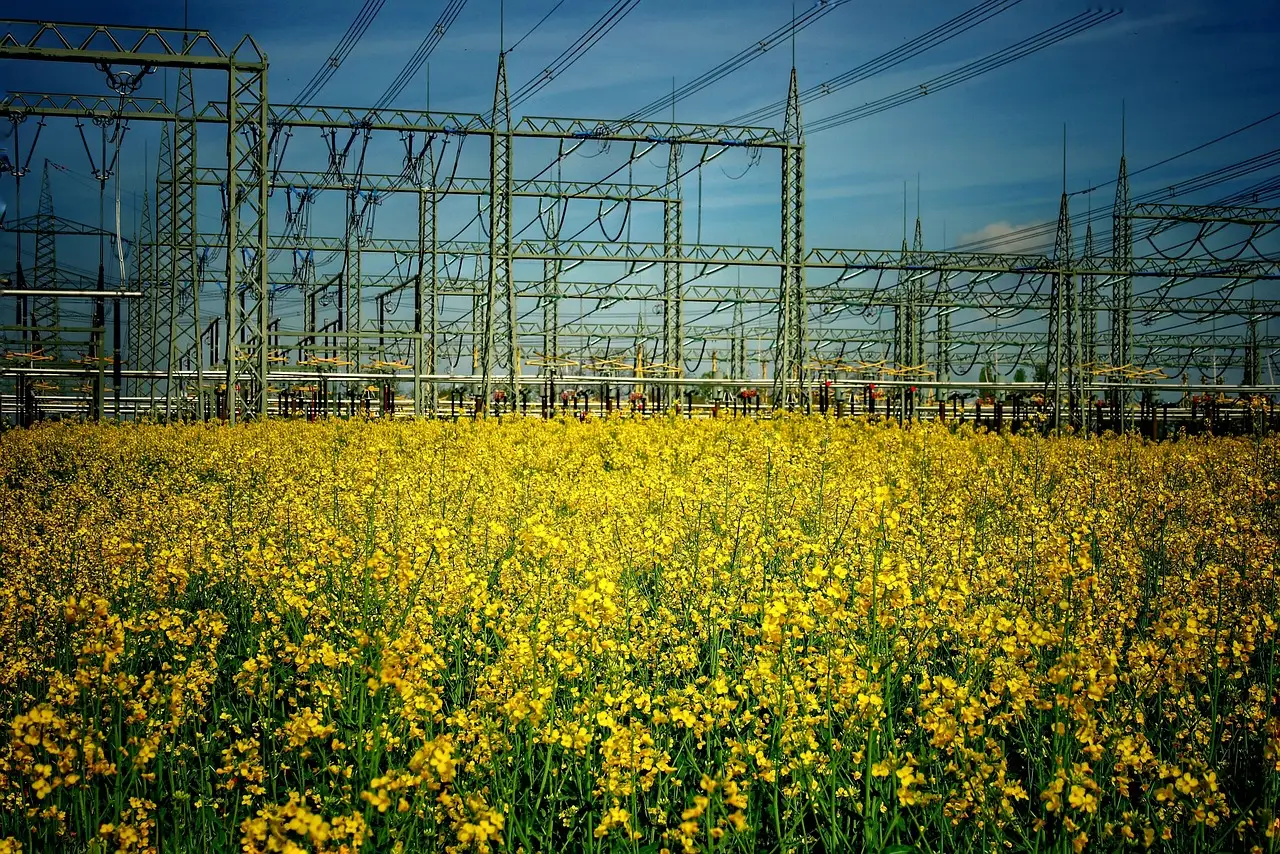
The press release mentioned the decisive location factor almost in passing: "Am angedachten Standort ist auch ein Anschluss an das 380-Kilovolt-Höchstspannungsnetz möglich." A 380-kilovolt transmission line (the highest voltage level in the German grid) from operator 50Hertz runs through the municipality, and it is being reinforced anyway to carry wind power from the Baltic Sea. Not fiber, not proximity to customers. A power line.
What happened 60 kilometers east?
Demmin shows the counterfactual. A 300-megawatt AI data center was planned there: one billion euros, 1,250 jobs, waste heat for the district heating network. Demmin sits amid wind and solar parks. It lacked exactly one thing — a high-voltage connection point. The project collapsed.
The two cases bracket the problem. German IT connection capacity is projected by digital industry association Bitkom to triple from roughly 3.3 gigawatts today to about 9.7 gigawatts by 2035, with more than half destined for AI and high-performance computing. China is expected to reach 90 gigawatt by then; the United States, 160.
"Die Verfügbarkeit ausreichender Stromanschlussleistungen wird aktuell als die mit Abstand größte Herausforderung für den Ausbau von Rechenzentren in Deutschland gesehen," Bitkom stated, citing a survey of operators. "91 Prozent der Befragten nennen den Zugang zu Strom und Netzkapazitäten als eine der drei größten Herausforderungen."
How do operators ration the queue?
Data center developers compete with battery storage, electrolyzers and other large consumers for scarce connection points. The four transmission system operators — 50Hertz, Tennet, Amprion and TransnetBW — were so flooded with applications that in April they introduced a contested points-based scheme. First-come-first-served is gone; projects are scored on criteria the operators set themselves: purchased land, secured corridors, supply contracts for equipment, and grid-relief effects.
The operators call this "meritokratische Priorisierung" — a maturity-based ranking. They concede the process "könnte unter Umständen kleinere Akteure oder komplexere Projekte benachteiligen." The operators say they see no alternative. Nearly all free connection points on the transmission grid are reserved for the next five years. Existing applications will exhaust available connections well into the 2030s.
More than 700 applications totaling 270 gigawatts were pending by the end of 2025 — three-quarters for battery storage, more than any grid development plan anticipated. The first cycle under the new rules drew 347 applications totaling 156 gigawatts, despite fees and deposits. Secondary markets for grid reservations have formed, where capacities are traded or strategically withheld, the operators report. They warn of displacement of projects central to decarbonization and industrial transformation: data centers, chip fabs, electrolyzers.
When do slots open again?
Law firm Gleiss Lutz writes that the first cycle will likely allocate a substantial share of the capacity available over the next ten years; later rounds will offer only new or freed capacity. In Tennet's control zone, substation connections free up from 2030 at the earliest; at TransnetBW and Amprion, from 2032 — and only "provisionally." Jones Lang LaSalle puts average waiting times for new data center connections at seven years in Paris, Frankfurt and London, and ten in Amsterdam. Dublin's grid is so overloaded that no new applications are permitted until 2028.
The federal government concedes the problem. Its data center strategy speaks of an "Antragsstau," yet it wants to quadruple AI computing capacity by 2030. A legislative grid package meant to frame the maturity process is stuck: the Bundestag vote, planned for this week, was postponed again, likely to December. The holdup is a dispute over curtailment rules for wind and solar parks — Economics Minister Katherina Reiche wants new installations in overloaded grid areas partly curtailed without compensation. The sector objects. The operators argue fixed technology quotas, for data centers or batteries, are unavoidable.
Even winners wait. Schwarz Group secured its connection, reportedly confirmed by 50Hertz months before the new procedure took effect. Construction starts late 2027 or early 2028; operations begin in 2032. The company says the start depends largely on when the power infrastructure is ready.
via n-tv.de/rss (Source)
More from Priya Raman
Show full bio
Correspondent covering money, funding and market shifts around hardware layer of artificial intelligence at Die Signal.
573 articles
Same lot · LOT-362A
- DSG-44147nmNebius to anchor Volt's 600MW Rotterdam AI data center campus
- DSG-154728nmTeraWulf Scales Muskie Site to 1 GW; SpaceX Weighs TSMC for Terafab
- DSG-182145nmSesterce Plans $10bn, 600MW AI Data Center Campus in Finland
- DSG-999314nmKonin Data Center: €3bn, 260MW Project Signed in Poland LOI
- DSG-120614nmGoodman's FRA02 to deliver 50 MW of waste heat to Neu-Isenburg district network