Test report DSG-4831 · Rev F · tested November 2, 2026
AI Datacenter InfrastructureDevice under test
Envision claims world-first 800VDC data center running live in China
Envision says its Galaxy AI data center in Ulanqab, China is running live workloads on an 800VDC power system, a world first combining solid-state transformers and battery storage.
- Read
- 3 min
- Words
- 599
- Node
- 7nm
- Operator
- Marcus Bennett
Spec summary
- Envision claims the world's first 800VDC data center, running live workloads in Ulanqab, China
- The Galaxy AI site has a planned capacity of 3GW across 120,000 sqm and supports up to one million AI accelerators
- The site's solid-state transformers convert 10kV grid AC to an 800VDC busbar
- Envision targets 5GW of green data center capacity by 2030 under its Mission Gobi initiative
- Microsoft and Meta have proposed a 400VDC rack design, Mount Diablo, through the OCP
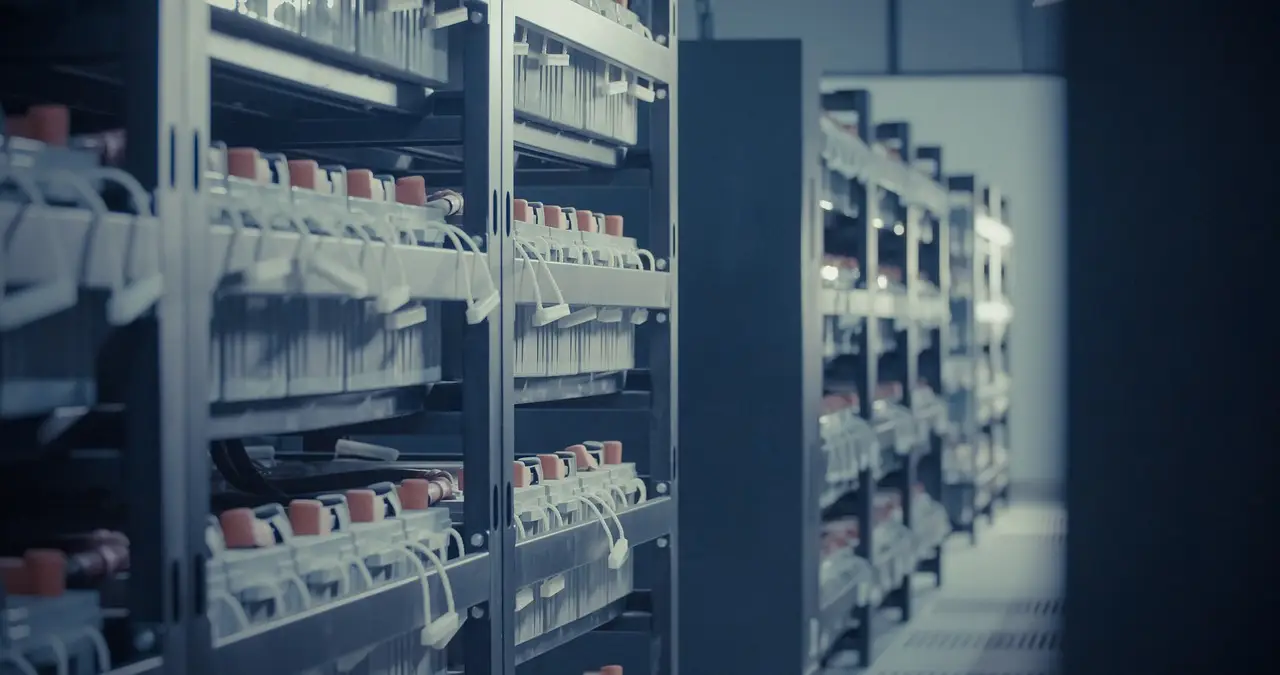
Green technology firm Envision says it is running the world's first 800VDC data center, with live compute workloads at its Galaxy AI site in Ulanqab, in China's Inner Mongolia region.
The data center opened in August. Envision has not disclosed the size of the 800VDC system currently deployed at the facility, nor the type of hardware it is running. No other operator is known to run an 800VDC power setup anywhere in the world, though many companies are developing solid-state transformers that are likely to reach the market within the next year.
Why move to 800 volts DC?
A conventional data center power chain is inefficient by design. The grid delivers alternating current (AC). The site converts it to direct current (DC) for its battery or UPS, back to AC for distribution to the IT racks, then down to DC again to feed the server and its components.
An 800VDC architecture cuts this to a single conversion, from AC to DC, at the point where power enters the building. DC then runs directly to the racks. The industry sees this as a way to deliver more power into the server hall, because future generations of AI hardware will likely demand far more electricity than today's data centers can supply.
An Open Compute Project white paper on 800VDC, published earlier this year, proposed delivering power to servers via a busbar, cables, or a mixture of the two.
What does Envision's system actually do?
The company says its deployment combines three elements:
- solid-state transformers (SST), which convert 10kV medium-voltage AC from the grid to an 800VDC busbar serving the hardware;
- battery energy storage (BESS);
- equipment that adjusts DC voltage for the computing hardware.
Envision has also built a controller called Dubhe. It runs on the company's own foundation AI model, Dubhe Energy, and coordinates the transformers and batteries in real time. The goal is to match power supply with computing demand and absorb sudden load swings.
Kevin Huang, senior vice president of Envision Energy and president of energy storage and AIDC Power Systems, laid out the reasoning: "AI data centers need power systems that coordinate renewable energy, energy storage, and the grid to meet computing demand."
Huang added: "Our integrated 800VDC system is now powering live computing workloads, demonstrating an end-to-end architecture that connects renewable energy supply with computing demand. This is a critical step in turning power-compute coordination from a strategic vision into an operational reality."
How big is the site?
The Galaxy AI data center will span 120,000 sqm (1.2 million sq ft). Its planned capacity is 3GW, and the design supports up to one million AI accelerators. Envision says the facility runs on 80 percent renewable energy.
Envision was founded in 2007 as a wind turbine company. It claims 100GW of installed wind turbines to date, with 20GW installed globally in 2025 alone. Under its Mission Gobi initiative, the company wants to bring 5GW of 'green' data center capacity online by 2030.
What does this change for the rest of the market?
Not much yet, in practical terms. One live site, of undisclosed system size, proves the architecture works but does not make it a commodity. The wider transition is already taking shape through the OCP, where Microsoft and Meta have proposed the Mount Diablo rack design, which uses a power sidecar to deliver 400VDC to servers.
The jump from 400VDC prototypes to an 800VDC production site is significant. If Envision's claim holds, Ulanqab becomes the reference point every vendor and operator will study.
via Data Center Dynamics (Source)
More from Marcus Bennett
Show full bio
News editor covering regulation, policy and their impact on hardware layer of artificial intelligence at Die Signal.
591 articles
Same lot · LOT-3609
- DSG-456728nmGoogle, Microsoft and Nvidia Back 800V DC Standard for AI Data Centers
- DSG-14853nmNVIDIA Publishes 800 VDC Architecture for AI Data Centers
- DSG-18625nmInfineon to supply Eaton SiC devices for 800VDC data center power
- DSG-537310nmEnteligent unveils three-stage 800VDC-to-chip power stack for AI racks
- DSG-68715nmABB Ships Infinitus: First Source-to-Rack 800VDC Portfolio for AI Data Centers