Test report · tested November 24, 2026
Memory & StorageDevice under test
DRAM Could Swing From 4% Shortage to 1% Glut by 2028
iM Securities models a worst case where delayed AI data centers and China curbs erase 9% of 2028 server DRAM demand, flipping a 4% shortage into a 1% surplus — while Micron says 75% of 2027 output is sold out.
- Read
- 4 min
- Words
- 775
- Segment
- Memory & Storage
- Operator
- Elena Vasquez
Spec summary
- Worst case: 2028 DRAM swings from a 4% supply shortfall to a 1% surplus, or 5% if HBM wafers convert to conventional DRAM
- Global AI-related corporate bonds totaled $489 billion as of early October; CoreWeave bond yields run 15-16%
- Q3 FCF deficits: Google -$9.07B, Meta -$2.12B, Oracle -$5.4B; Amazon -$42.4B over 12 months
- Micron CEO says 75% of 2027 memory output is sold out; next year's HBM supply fully booked
- China export rules blocking remote access to advanced AI chips took effect on the 19th
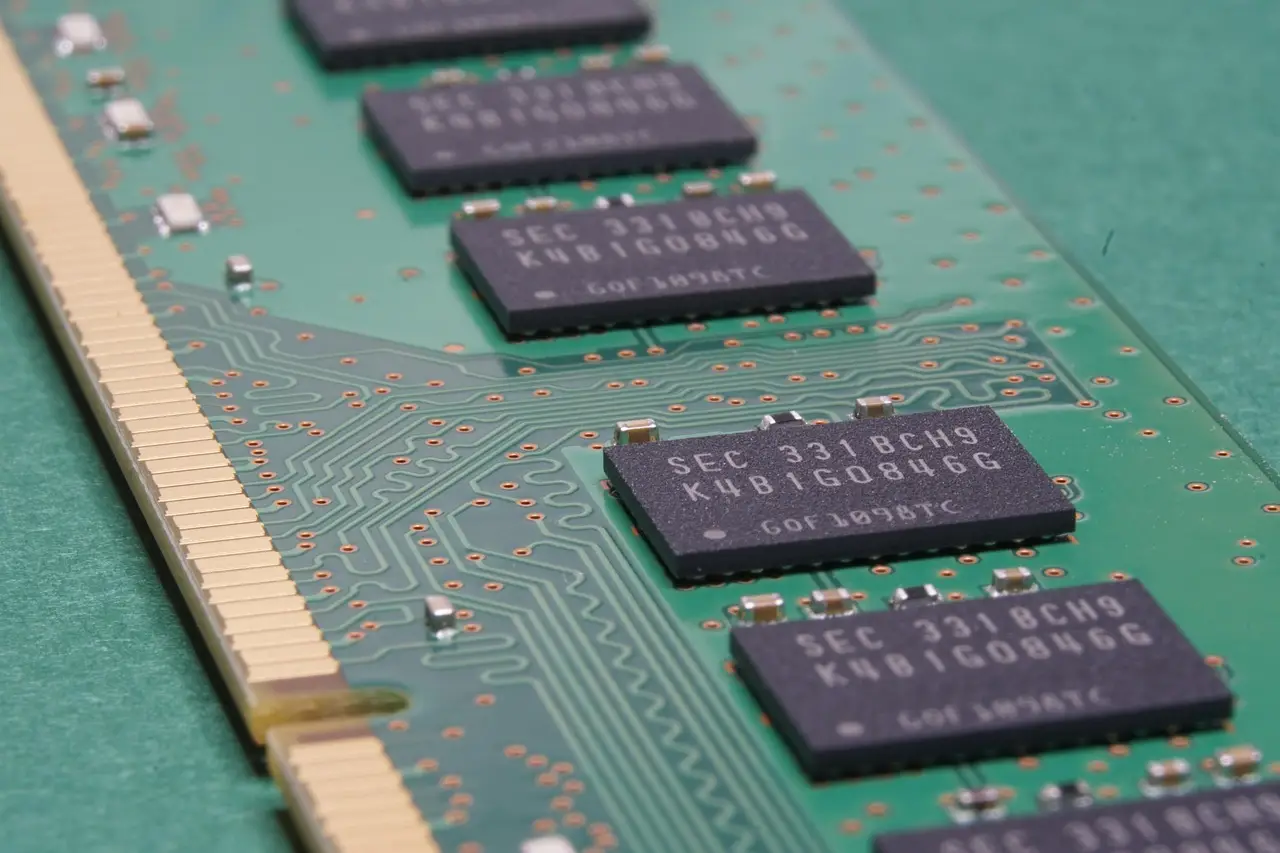
Server DRAM demand for 2028 could shrink by 9% under a worst-case scenario sketched by iM Securities, flipping the memory market from a projected 4% supply shortfall to a 1% surplus. The trigger isn't a demand collapse — it's slower data center construction and tighter China export controls squeezing the AI buildout from both sides.
Jensen Huang's abrupt return as Nvidia CEO has calmed the market's worst fears about a "collapsing circular ecosystem" in AI. Leadership-vacuum worries are gone, and doubts about weakening credit among AI developers and neocloud firms have eased. But the structural risks analysts flagged before his resignation haven't moved: high-rate funding burdens, unproven AI profitability, U.S. data center permitting, and export controls on China. The "AI bubble" debate is intact.
How bad is Big Tech's cash position?
The money numbers are still ugly. The U.S. 10-year Treasury yield touched 4.98% intraday on the 23rd, just after Huang's return, pressing against the 5% line. Corporate bond strain hasn't disappeared despite the stock rebound.
That's translating directly into negative free cash flow at the biggest spenders. Third-quarter figures tell the story:
- Google: negative FCF of $9.07 billion, its second straight quarterly deficit
- Meta: $2.12 billion in deficit
- Oracle: $5.4 billion in deficit
- Amazon: a net outflow of $42.4 billion over the trailing 12 months through September, despite strong retail cash generation
- Microsoft: the only major cloud player still posting positive FCF
Cash-short Big Tech is borrowing to keep the buildout going. Global AI-related corporate bonds totaled $489 billion as of early October, per the Korea Institute for International Economic Policy. Those bonds aren't cheap: CoreWeave's secondary-market yields now run 15% to 16% — several times the policy rate.
"Doubts about the sustainability of the AI investment cycle stem from a shortage of capital," said Hwang Soo-wook, a researcher at Meritz Securities. "Jensen Huang's return has eased concerns about Nvidia's willingness to supply capital, but it has not improved the capacity to supply the capital the AI industry as a whole requires."
What does this mean for Korea's memory makers?
The supply chain faces two medium-term headwinds. North American AI data center permitting is stalling after the Democratic Party's sweep of the U.S. midterms, with construction schedules slipping amid power grid overloads and local opposition. And on the 19th, new rules took effect blocking remote access to advanced AI chips in China, tightening controls further.
Nvidia's delayed 10-Q filing — due on the 4th of next month — is adding caution around China sales routed through Singapore and the related regulatory and accounting risks.
For Korean memory makers, the worst case iM Securities models assumes 10% of rerouted China sales still haven't returned by 2028 and 12 gigawatts of data center capacity slips to 2029. That would cut server DRAM shipments by 8.2 billion and 29 billion gigabits respectively, killing 9% of previously projected 2028 demand. Add a likely 2028 resolution of the semiconductor supply shortage — which should push memory prices lower — and the setup gets worse. If HBM demand falls, iM Securities said, another 12.6 billion gigabits' worth of wafers would convert to conventional DRAM, pushing the surplus to 5%.
Is the demand side actually cracking?
Counter-evidence is real. Nvidia raised its 2027 outlook in its latest earnings release even excluding China sales. AMD and Broadcom both issued aggressive demand forecasts. And Micron CEO Sanjay Mehrotra told the recent "TomorrowX Summit" that 75% of the company's 2027 memory output is already sold out, with 2028 supply under negotiation. "Memory supply and demand in 2027 and 2028 will be even tighter than this year," Mehrotra said.
A Korean memory company official put it bluntly: "On the ground, we are not seeing any moves by customers to cut volumes or capital spending, and our outlook for next year's earnings is unchanged." The official added that unless DRAM prices collapse to a third of current levels, long-term agreements locking in volume and price floors should hold.
Next year's HBM supply is already sold out, and more than half of 2028 capacity is booked, the official said. Samsung Electronics and SK hynix are responding to tighter U.S. export controls by broadening their memory customer bases and diversifying their sources of AI accelerators.
The bear case, in short, is a 2028 timing mismatch — not a demand cliff. Practitioners watching DRAM contract pricing should treat data center permitting timelines and the Nvidia 10-Q as the near-term tells.
via en.sedaily.com (Source)
More from Elena Vasquez
Show full bio
Senior reporter covering people, launches and day-to-day practice in hardware layer of artificial intelligence at Die Signal.
760 articles
Same lot
- Nvidia's $500 Billion AI Financing Plan Hangs by a Thread After Huang Exit
- Nvidia Sheds $650 Billion in a Week as Huang Exit Hits AI Sector
- Intel Drops 30%, Erasing $146-Billion in Worst Day on Record
- Five AI Stocks Fall 12%-16% in a Day, and Dell's $95B Faces the Test
- Nvidia at $168.89: Wall Street Prices In a Governance Risk Discount