Test report DSG-8205 · Rev B · tested November 17, 2026
Device under test
China Claims 64 Tbps Each Way Over 1,007 km of Hollow-Core Fiber
China Telecom, YOFC and ZTE report 64 Tbps per direction over 1,007 km of hollow-core fiber with 3.4 ms one-way delay. Every figure remains unconfirmed pending technical disclosure.
- Read
- 4 min
- Words
- 751
- Node
- 20nm
- Operator
- Marcus Bennett
Spec summary
- China Telecom announced the result on November 2; CCTV covered it on November 8.
- Reported link: 64 Tbps per direction over about 1,007 km, or 128 Tbps combined.
- One-way delay was about 3.4 ms versus about 5 ms for solid-core fiber, a roughly 30% cut.
- The link was assembled in a lab from more than 300 spools of 2-5 km each.
- No primary paper, error data, or independent validation exists for any figure.
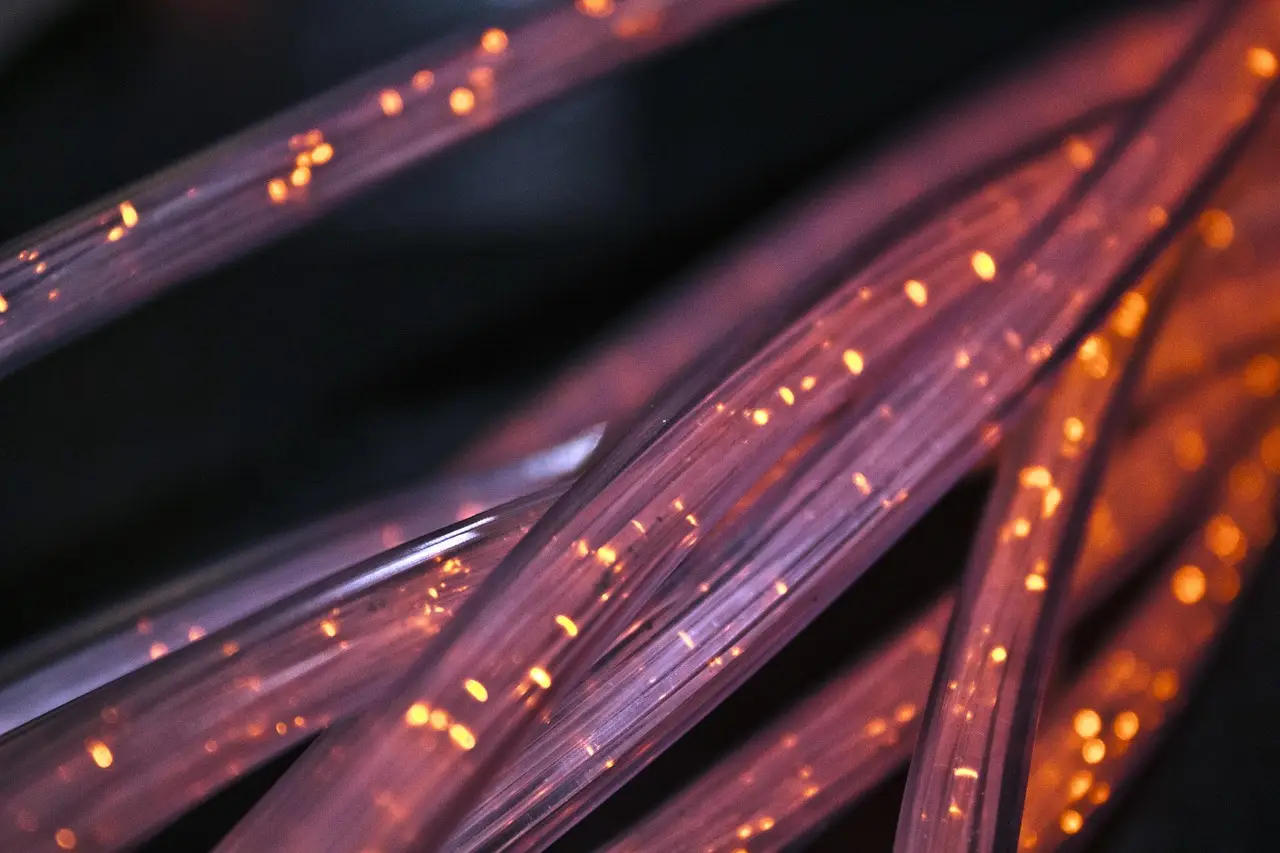
Chinese telecom researchers claim they pushed 64 Tbps in each direction through hollow-core fiber over roughly 1,007 km, with a one-way delay of about 3.4 milliseconds. China Telecom announced the result on November 2. China Central Television covered it on November 8. The work is credited to the China Telecom Research Institute, Yangtze Optical Fibre and Cable (YOFC), and ZTE Corporation, per TechRadar.
Combined capacity across both directions reaches 128 Tbps. The more interesting number for network engineers is delay. Reports put one-way travel time at about 3.4 ms, against about 5 ms for conventional solid-core fiber over the same distance. If the claim holds, this record is as much about latency as raw capacity.
What exactly was reported?
The claim has four parts:
- A link of about 1,007 km, or 1,007.5 km in one account, roughly 626 miles.
- Simultaneous two-way traffic at 64 Tbps per direction.
- A one-way signal time of about 3.4 ms, reported as 3.43 ms in one outlet.
- A label: a world record for real-time hollow-core-fiber transmission distance.
The real-time label matters. It suggests live traffic rather than a computed theoretical figure. Even so, no primary technical paper, named test protocol, or independent validation exists in the coverage. Three credible organizations stand behind the numbers, but readers should treat them as a lead, not a settled fact.
Why does hollow-core fiber cut latency?
Standard fiber guides light through solid glass. Hollow-core fiber guides it through an air-filled central channel held in place by microstructured cladding. Light moves faster through air than glass, so the same distance takes less time.
Wang Ruichun, chief scientist at YOFC, explained the mechanism to CCTV in a comment relayed by the South China Morning Post. He said: "The core of hollow-core fibre is air, and light travels through air at close to the speed of light in a vacuum, about 300,000km per second."
The arithmetic checks out. At 1,007.5 km and 3.43 ms, signals travel at about 293,700 km per second, near 98% of vacuum speed. Conventional fiber runs at roughly 200,000 km per second. The saving is 1.6 ms one way per 1,000 km, or 3.2 ms round trip. Small for a web page. Large for a trading engine or a synchronized AI training job. The proportional gain of about 30% matches the headline percentage in TechRadar's and SCMP's coverage.
The 160 4K films per second framing is TechRadar's calculation assuming 50 GB per film: 64 Tbps equals 8 TB per second, which divides into 160 films. It is arithmetic, not a measurement. Reports also mention 800 Gb/s per wavelength across extended C+L bands, implying roughly 80 wavelengths per direction, though that detail is unconfirmed.
Was this a real route?
No. SCMP reported the 1,000 km link was assembled from more than 300 spools, each holding 2 to 5 km of fiber, joined into one continuous laboratory path. Spool testing is standard practice for measuring loss over distance. It also removes field headaches: temperature swings, vibration, splice quality, and installation stress on a gas-filled core. TechRadar says the distance is about 50 times longer than earlier comparable hollow-core trials, though the comparison set is unspecified.
For context, TechSpot reported a hollow-core cable carrying 51.3 Tb/s across 200 km. A throughput-times-distance check gives the Chinese claim about 64,000 Tbps-km against about 10,000 for that test, but the configurations differ. Separately, nested anti-resonant fiber work involving Southampton and Microsoft has reached a best reported attenuation near 0.091 dB/km at 1,550 nm.
What does this change for buyers?
Nothing immediate. There is no confirmed product name, price, or lead researcher. CCTV-linked coverage claims a commercial financial line between Shenzhen and Hong Kong plus more than 10 commercial and pilot projects across Asia, Europe and elsewhere, but none of that is verified. Watch instead for a follow-up paper disclosing attenuation, amplifier spacing and error performance. Finance desks, cloud operators and AI cluster builders will adopt first. Expect procurement rules, not physics, to decide where this fiber actually lands.
The missing pieces are a primary paper, error data, and proof that field routes can match a spool-built link. Those will decide whether this November record is a turning point or a demo.
via shattered.io (Source)
More from Marcus Bennett
Show full bio
News editor covering regulation, policy and their impact on hardware layer of artificial intelligence at Die Signal.
681 articles
Same lot · LOT-362D
- DSG-433414nmChina's LineShine Tops June 2026 Top500 at 2.74 Exaflops Peak
- DSG-683828nmAI Fiber Shortage Pushes Ukraine Drone Cable to $29 per Kilometer
- DSG-347028nmByteDance Consumes One-Fifth of China's 24GW Data Center Market
- DSG-514945nmFortress Launches Modular In-Line Amplifier Platform for Fiber Operators
- DSG-338545nmFiber shortage throttles Ukraine’s drone output as AI demand rises