Test report DSG-1791 · Rev F · tested October 10, 2026
AI Datacenter InfrastructureDevice under test
America plans more AI datacenters than chips can equip
The Register reports that US AI datacenter plans now exceed available chip supply, exposing a structural mismatch between infrastructure ambition and silicon output capacity.
- Read
- 3 min
- Words
- 579
- Node
- 20nm
- Operator
- Priya Raman
Spec summary
- The Register reported that planned US AI datacenter capacity exceeds what the chip supply can equip
- Microsoft guided fiscal-2025 datacenter capex to roughly $80 billion; Alphabet raised 2024 capex guidance to about $50 billion
- CoWoS advanced-packaging capacity at TSMC has been the binding constraint on AI accelerator shipments since 2023
- The CHIPS and Science Act allocated $52.7 billion for US semiconductor manufacturing; no domestic fab yet produces leading-edge AI accelerators at scale
- Utilities in Northern Virginia and Texas have flagged multi-year grid interconnection queues, adding a power constraint on top of chip supply
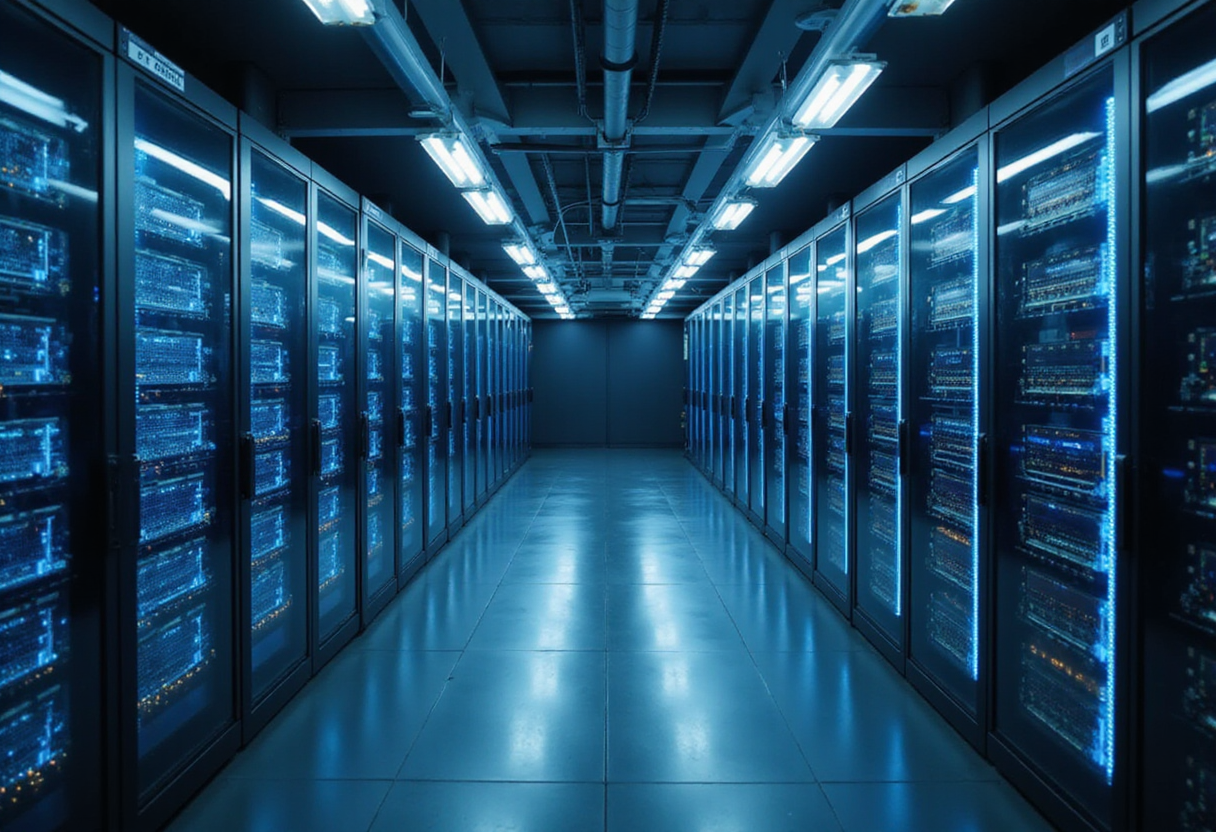
The Register has reported that planned AI datacenter capacity in the United States now exceeds the volume of accelerators the semiconductor supply chain can deliver. The publication framed the US AI buildout as supply-constrained at the silicon layer, even as project announcements continue to accumulate.
What the headline actually says
The Register's central finding: more datacenter capacity sits in the planning pipeline than the available chip supply can equip. The piece identifies a structural mismatch between announced infrastructure projects and the silicon required to bring them online — a gap that now defines the near-term ceiling on US AI compute expansion.
The buildout behind the gap
US hyperscalers and AI-focused operators have committed to record capacity expansions over the past 24 months. Microsoft guided fiscal-2025 datacenter capex to roughly $80 billion. Alphabet raised 2024 capex guidance to about $50 billion, with most of the increment tied to AI infrastructure.
Meta lifted its 2024 capex range to $35–40 billion, citing GPU cluster buildout. Amazon's AWS segment expanded in parallel, with the company confirming accelerated datacenter delivery schedules.
The accelerator side scaled to match. Nvidia's data-center revenue climbed to annualised run-rates that were considered out of reach as recently as 2023. The H100 generation shipped into 2024 with multi-quarter backlogs.
Successor product dynamics
Successor products — H200 and the Blackwell family — followed similar demand curves, with order books set months ahead of physical delivery. AMD's MI300X line entered the market with comparable allocation dynamics.
Where the chip squeeze sits
Three pressure points dominate the supply side:
- Advanced packaging: CoWoS (Chip-on-Wafer-on-Substrate) capacity at TSMC has been the binding constraint on AI accelerator shipments since 2023. TSMC has expanded CoWoS lines repeatedly; demand has continued to outrun output.
- High-bandwidth memory: HBM3 and HBM3E supply from SK Hynix, Samsung, and Micron tracks as the second bottleneck. Allocation, not wafer output, sets shipping volumes for 2024 and 2025.
- Domestic fabrication: The CHIPS and Science Act allocated $52.7 billion for US semiconductor manufacturing. TSMC Arizona, Intel Ohio, and Samsung Texas represent the headline projects. None yet produces leading-edge AI accelerators at scale; volume production at the 3-nanometer node in Arizona is scheduled for 2026-2027.
Power layers on additional friction
Datacenter plans also run into electrical limits. Utilities in Northern Virginia — the largest US datacenter cluster — and Texas have flagged multi-year grid interconnection queues.
Several announced projects have shifted site plans or pulled timelines to align with available power, adding a second binding constraint on top of chip supply. Colocation pricing in primary markets has risen accordingly.
Who captures the allocation
Operators with long-dated chip allocations — typically the largest hyperscalers running direct procurement programmes — retain a structural advantage. Smaller AI cloud providers and enterprise buyers have reported delayed deployments and elevated accelerator pricing as a consequence of the imbalance.
Nvidia CEO Jensen Huang has stated publicly during the company's 2024 earnings cycle that AI accelerator demand continued to outstrip production and that allocation decisions were being made on a multi-quarter basis.
What does the supply gap mean for the next cycle?
Expect continued bifurcation. The gap between operators with secured chip allocations and those without will widen over the next 12-24 months. Secondary markets for accelerator time and colocation capacity will continue to clear at premium pricing.
The bottleneck — not the announcement pipeline — now dictates the buildout cadence across the US AI sector.
via Google News: AI chip (Source)
More from Priya Raman
Same lot · LOT-C1C6
- DSG-247428nmAmazon to Buy 2 Million Nvidia Chips for Data Center Build-Out
- DSG-79205nmTSMC Posts NT$511.86 Billion September Revenue, Up Over 50% Year-On-Year
- DSG-662365nmCisco extends Nvidia alliance to ride AI data-center boom
- DSG-530928nmAmazon Seeks to Offload $8 Billion of Nvidia Chips to Investors
- DSG-381914nmAmazon Seeks to Offload $8bn of Nvidia Chips to Investors