Test report DSG-2256 · Rev E · tested October 10, 2026
Foundries & ManufacturingDevice under test
AMD Explores Samsung Foundry Deal to Expand AI Chip Supply
AMD has opened preliminary talks with Samsung Electronics' foundry division about additional chip manufacturing capacity as AI accelerator demand strains TSMC supply. Specific nodes, volumes, and timelines remain undisclosed.
- Read
- 3 min
- Words
- 615
- Node
- 3nm
- Operator
- Priya Raman
Spec summary
- AMD has begun preliminary discussions with Samsung Electronics' foundry business about additional wafer capacity.
- Samsung Foundry operates fabs in South Korea and is building capacity in Taylor, Texas.
- TSMC holds roughly 60% of global foundry revenue by capacity; Samsung holds approximately 10-12%.
- Samsung introduced gate-all-around 3 nm production and continues 2 nm development.
- The original report disclosed no contract value, volumes, nodes, or product allocations.
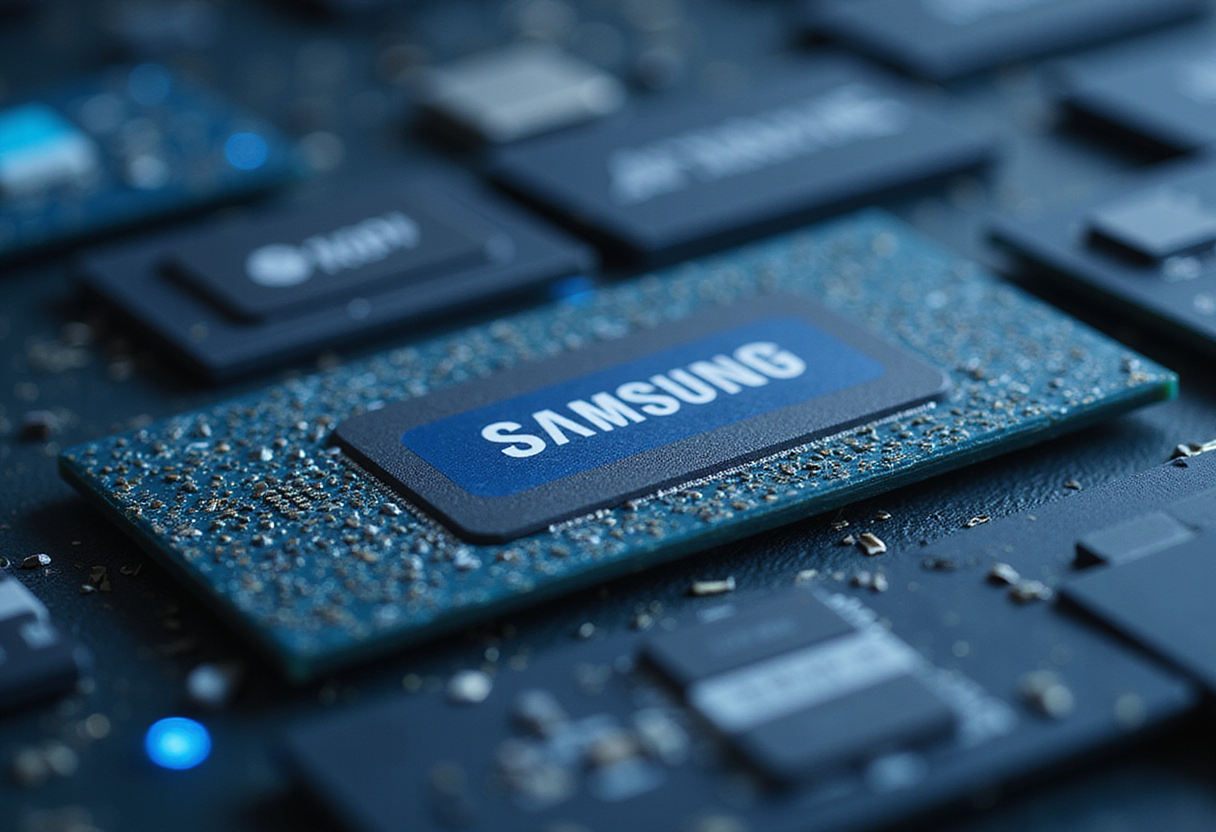
AMD has opened preliminary discussions with Samsung Electronics' foundry division about securing additional wafer capacity, driven by accelerating demand for AI accelerators and data-center processors. The talks, reported this week, point to a supply-diversification strategy at AMD, which has historically relied on Taiwan Semiconductor Manufacturing Company for advanced-node fabrication of its Ryzen CPUs, Radeon GPUs, and Instinct accelerators.
What does AMD currently manufacture?
AMD operates as a fabless semiconductor designer and outsources all wafer production to third-party foundries, principally TSMC. The product portfolio spans consumer Ryzen CPUs, EPYC server processors, Radeon discrete GPUs, Instinct data-center AI accelerators, and Xilinx-derived FPGAs and adaptive SoCs. TSMC's N5 and N4 nodes have produced recent-generation Ryzen, EPYC, and Instinct silicon, with select parts moving to N3-class processes.
Samsung Foundry competes in the contract-chipmaking market alongside TSMC and Intel Foundry Services. Samsung operates fabs in Giheung, Hwaseong, and Pyeongtaek in South Korea, with new capacity under construction in Taylor, Texas. The foundry was among the first to introduce gate-all-around (GAA) transistor architecture at 3 nm and continues to scale 2 nm development.
Why is AMD seeking additional capacity?
Demand for AI accelerators has expanded across cloud and enterprise buyers, with hyperscalers scaling inference and training infrastructure. Leading-edge wafer supply has remained tight industry-wide, creating allocation pressure on customers including Apple, Nvidia, Qualcomm, and AMD. Adding Samsung as a secondary foundry would give AMD redundancy against potential disruptions at TSMC, where leading-edge capacity is shared across many customers. Geopolitical concentration of advanced fabrication in Taiwan has shaped supply-chain planning across the semiconductor industry, including U.S. policy discussions on domestic capacity.
What hasn't been confirmed?
The original report did not disclose specific process nodes under consideration, contract value, wafer volumes, production timeline, facility location, exclusivity terms, or product categories allocated to Samsung. AMD has not issued a formal statement confirming or denying the discussions. Samsung Foundry has not commented on customer negotiations.
What could Samsung offer AMD?
Samsung Foundry's process roadmap includes 3 nm GAA nodes in volume production, with second-generation 3 nm and 2 nm variants in development. The foundry also operates mature 7 nm, 8 nm, 10 nm, 14 nm, and larger nodes serving analog, automotive, and embedded applications. For AMD, a Samsung relationship could span current and future products, though contract terms, product mix, and production volumes remain undisclosed. Older nodes could serve I/O dies, chipset silicon, or FPGA parts, while leading-edge nodes could host future CPU or accelerator tiles.
What does this signal for the foundry market?
A confirmed AMD-Samsung agreement would represent a marquee customer win for Samsung Foundry, which holds a smaller share of the leading-edge market than TSMC. Industry analyses typically place TSMC at roughly 60% of global foundry revenue by capacity, with Samsung at approximately 10-12%. Samsung has pursued market share through pricing competition, faster process-node ramps, and U.S.-based capacity investments under the CHIPS Act framework. An AMD contract would provide a high-profile customer reference for Samsung's process technology and 2 nm roadmap.
The discussions also align with a broader industry trend toward multi-foundry sourcing. Qualcomm and Apple have both split production between TSMC and Samsung for different product generations over the past decade, using dual sourcing to manage cost, capacity, and geopolitical risk.
What's next?
Industry observers will watch for AMD's next quarterly earnings call for any disclosure of foundry partner changes, and for Samsung's earnings commentary on foundry utilization and customer wins. A formal announcement, if it materializes, would likely include process node, product line, and timeline details.
via Google News: Semiconductor foundry (Source)
More from Priya Raman
Same lot · LOT-C1C6
- DSG-775610nmMusk excludes TSMC from Terafab, opening door for Intel foundry
- DSG-701410nmSamsung Projects Foundry Customer Base to Quadruple by 2029
- DSG-37557nmAMD courts Samsung for HBM supply and possible Korea foundry work
- DSG-464728nmSamsung Leverages HBM4 Supply Position in AMD Foundry Talks
- DSG-102920nmAMD CEO Visits Samsung to Negotiate HBM Supply, Foundry Deal on the Table