Test report DSG-5969 · Rev D · tested November 17, 2026
Supply Chain & PolicyDevice under test
Amazon Fell 3.34% to $257.75 — But Nobody Has Proven Why
Amazon closed down 3.34% at $257.75 on Nov. 16 after ULA lost 40 Leo satellites and BIS issued an AI chip export rule. Neither link to the drop is proven.
- Read
- 4 min
- Words
- 867
- Node
- 7nm
- Operator
- Elena Vasquez
Spec summary
- Amazon.com closed at $257.75 on November 16, 2026, down 3.34%.
- A ULA Vulcan rocket failed about 10 minutes after liftoff from Cape Canaveral, losing 40 Amazon Leo satellites.
- The U.S. Bureau of Industry and Security issued an interim final rule requiring licenses for advanced AI chip exports to Singapore, Malaysia, Thailand, Indonesia and Brazil.
- Neither ULA nor Amazon has published a root cause or a dollar value for the lost satellites.
- No source reviewed shows that either event directly caused the share-price decline.
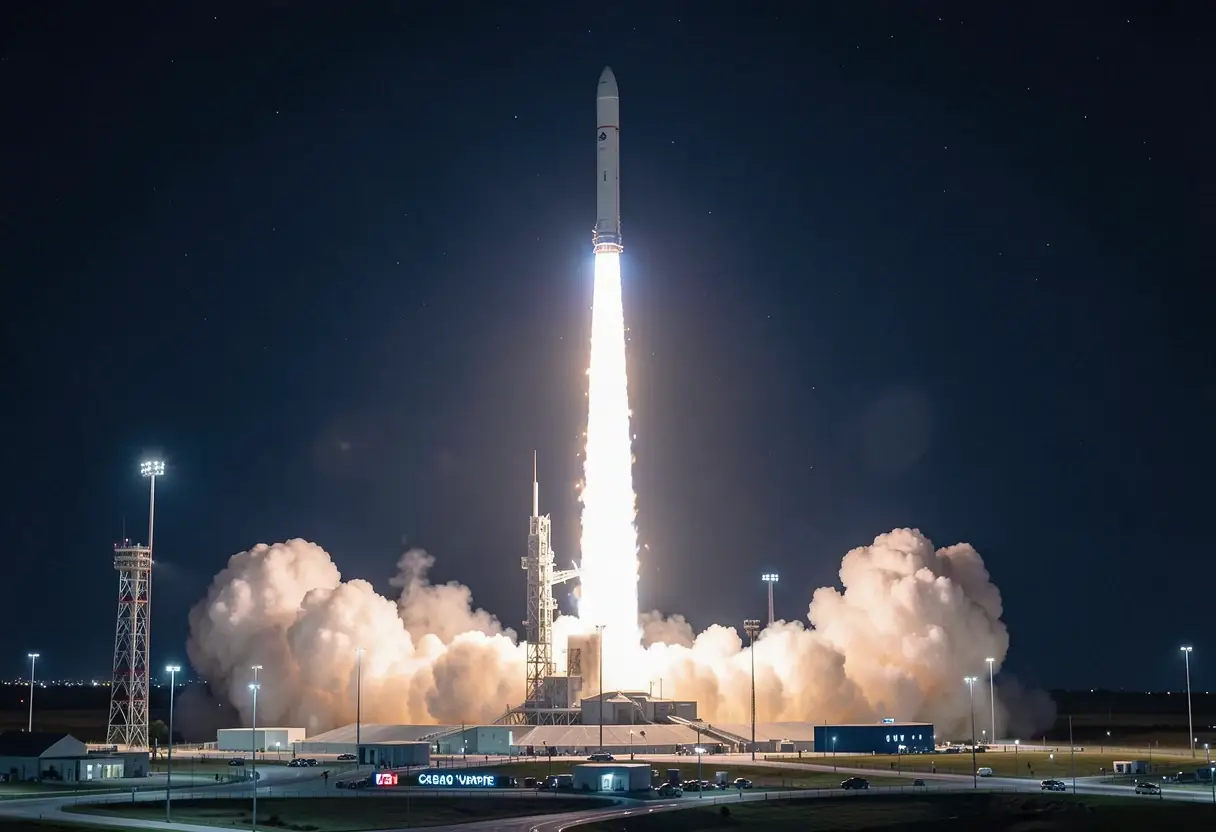
Amazon.com (NASDAQ: AMZN) closed at $257.75 on November 16, 2026, down 3.34%, on a day that delivered two negative headlines: a failed rocket launch carrying 40 of the company's Leo satellites, and a new U.S. AI chip export rule. What it did not deliver, despite what you may have read, is proof that either event moved the stock.
Here's what practitioners need to separate. The price drop is confirmed. The two news items are confirmed. The causal link between them is inference, and that distinction changes how you should model the next few weeks.
What happened on November 16?
A United Launch Alliance Vulcan rocket lifted off from Space Launch Complex 41 at Cape Canaveral Space Force Station in Florida. About 10 minutes into flight, something went wrong. ULA's statement is precise and deliberately narrow: "Based on data received by our Launch Director, we confirm that the Vulcan vehicle launched from Space Launch Complex 41 suffered an anomaly 10 minutes into the flight and failed to deliver the Amazon mission to orbit."
That's the entire confirmed account. No stage, engine, or subsystem has been named. No dollar value for the 40 lost satellites has been published, and there's no word on insurance or recovery. Every number floating around social media right now is an outsider's estimate.
The second shock came from Washington. The U.S. Bureau of Industry and Security issued an interim final rule the same day, reportedly requiring export licenses for advanced AI chips shipped to Singapore, Malaysia, Thailand, Indonesia, and Brazil. It also restricts remote access to those chips through overseas data centers.
Did either event actually cause the selloff?
Nobody has shown that. Reports describe the decline as associated with the news, not caused by it. No desk note, analyst downgrade, or Amazon statement in the available material assigns a share of the drop to either event.
A 3.34% single-day move on a mega-cap can come from plenty of places: index-wide selling, sector rotation, positioning ahead of earnings. Nvidia's results were on the calendar that week, which makes AI-linked names jumpy on any headline. If that was the driver, Amazon's decline owes more to the tape than to the news.
The two shocks also differ sharply in scale:
- The launch failure is directly Amazon's, but it touches one program inside a very large company. Losing 40 satellites in one shot hurts Leo's schedule more than the quarterly earnings.
- The export rule is industry-wide, but its link to Amazon is inferred. The reports don't name Amazon, quantify affected chips or revenue, or break down how much AI capacity sits in the five countries.
That asymmetry is why the tidy shared headline feels satisfying and tells you almost nothing.
Why the remote-access clause matters most
For cloud and AI infrastructure folks, the remote-access restriction is the part with real reach. Physical shipments are countable. Remote access isn't — a customer in one country can rent compute sitting in another. If the rule closes the overseas-rental workaround, developers in restricted markets face three options: accept license delays, downgrade to older hardware, or move workloads to an unrestricted jurisdiction. None is free.
Expect cloud contracts to grow customer-location attestations. Compliance is the cheapest response to a licensing regime, and providers already collect similar data. Smaller AI labs without legal teams will feel that burden hardest.
Remember the rule's status, too. An interim final rule takes effect while public comment continues, so details can shift. The definition of "covered access" hasn't been spelled out, and that definition will decide how much friction providers actually face.
What to watch next
- ULA's root-cause finding or return-to-flight statement
- Any Amazon disclosure on the cost of replacing 40 satellites
- BIS guidance on remote-access definitions and license timelines
- Peer cloud stocks over the same sessions — if Microsoft and Google drop in step, the cause is sector-wide
- Nvidia's earnings commentary on demand from the five named countries
Our predictions — judgment, not reported fact
Four calls, each ours and each possibly wrong:
- ULA names a preliminary cause before Amazon schedules another Leo launch on Vulcan. Customers rarely fly payloads on a vehicle with an open failure question.
- BIS issues clarifying guidance on remote access within the comment period. It's the least-defined part of the rule, and providers will lobby hard for precision.
- Cloud providers add customer-location attestations to AI contracts.
- Analysts split the two stories. Satellite loss becomes a Leo schedule risk; the export rule becomes a demand variable for AI cloud revenue.
The bottom line
Hold this story loosely. U.S. chip export controls have been rewritten repeatedly as regulators chase indirect routes, and launch failures follow their own familiar arc: investigation, fix, return to flight. Without a named cause for the Vulcan anomaly, there's no basis for a return-to-flight date. The coming weeks of ULA findings, BIS guidance, and Amazon disclosures will show which story, if either, carries lasting financial weight — and which was just a headline looking for a price to explain.
via shattered.io (Source)
More from Elena Vasquez
Show full bio
Senior reporter covering people, launches and day-to-day practice in hardware layer of artificial intelligence at Die Signal.
675 articles
Same lot · LOT-362D
- DSG-148720nmCisco Slides 5.4% Despite AI Beat: 93.5 Is the Line
- DSG-662545nmAMD Erases 17% Crash in Two Sessions, Closing Up 13% at $508.58
- DSG-20073nmCoreWeave Earnings Lift Samsung, SK hynix; Nvidia Diverges After Hours
- DSG-351720nmNvidia's $247B Loss Figure: Why Reports Disagree by $55 Billion
- DSG-587914nmSeven Tech Giants Reportedly Commit $26 Billion to Anthropic IPO