Test report DSG-7128 · Rev E · tested September 29, 2026
AI Devices & SystemsDevice under test
Qualcomm Redesigns Hexagon NPU for On-Device Agentic AI
Qualcomm has redesigned the Hexagon NPU architecture in its Snapdragon platforms to run agentic AI workloads locally, repositioning the accelerator for multi-step, on-device intelligence.
- Read
- 3 min
- Words
- 557
- Node
- 65nm
- Operator
- Grace Kim
Spec summary
- Qualcomm has redesigned the Hexagon NPU architecture specifically to support on-device agentic AI workloads.
- Agentic workloads differ from single-pass inference: agents loop through planning, tool calls, and revision, requiring stateful continuous execution on the processor.
- The redesign positions Qualcomm against Apple, Google, MediaTek, and Arm-based rivals competing to accelerate the newest class of AI software on device.
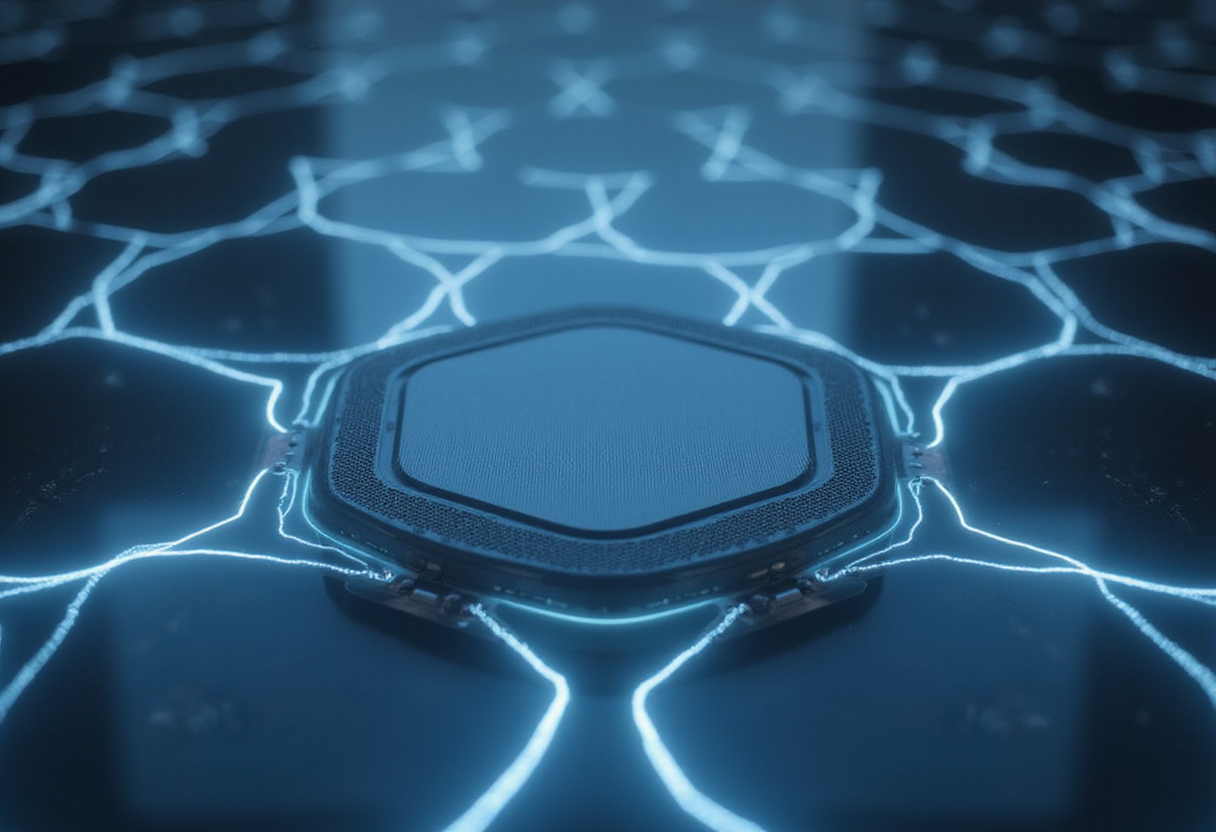
Qualcomm has redesigned the architecture of its Hexagon NPU, the neural processing unit at the core of its Snapdragon platforms, to support on-device agentic AI workloads.
The redesign marks a shift in how the company positions its silicon. Until now, Hexagon accelerators have been tuned primarily for inference tasks: running a trained model on incoming data and returning a result. Agentic AI imposes a different load profile. An agent operates in a loop — it plans, calls tools, observes results, and revises its approach. Sustaining that loop locally, without round-tripping to a cloud endpoint, changes the demands placed on the processor.
Qualcomm's decision to rearchitect the NPU around this workload signals where the company expects demand to move. Agentic systems are increasingly the dominant pattern in AI application development, and running them on a device rather than in a data center carries concrete implications: lower latency, reduced bandwidth consumption, and data that never leaves the handset, PC, or vehicle in which it was generated.
The move follows years of sustained investment in the Hexagon line. Qualcomm has iterated on the NPU across multiple Snapdragon generations, progressively increasing peak throughput, memory bandwidth, and power efficiency. Each generation has targeted larger and more capable models running locally — from early voice and vision workloads to multimodal systems with billions of parameters. The current redesign extends that trajectory toward workloads that are not single-pass but continuous and stateful.
For device makers, an NPU designed for agentic AI shortens the path to shipping products that can execute multi-step tasks — summarizing, scheduling, retrieving, composing — without depending on a persistent network connection or a per-request cloud billing model. For developers, it defines a concrete hardware target for agent frameworks that have so far been built around server-side execution.
The stakes are commercial as much as technical. Qualcomm competes for on-device AI work against Apple's Neural Engine, Google's Tensor silicon, and increasingly capable NPU blocks from MediaTek and Arm-based custom designs. Every vendor in this segment is racing to demonstrate that its accelerator handles the newest class of AI software better than rivals. A purposeful architectural redesign, rather than a throughput bump, is Qualcomm's clearest statement yet that it intends to compete on agentic workloads specifically.
On-device execution also aligns with regulatory and enterprise constraints. Privacy regimes in Europe and elsewhere restrict what user data may leave a device, and corporate deployments frequently prohibit sending sensitive context to external inference providers. An agent that plans and acts entirely within the SoC sidesteps both classes of constraint.
Details on the redesigned architecture — block diagrams, throughput figures, supported operator sets, and which Snapdragon tiers will carry it first — will determine how much of this positioning translates into shipping products. Qualcomm has a track record of pairing Hexagon revisions with concrete platform launches, and the coming product cycle will show whether the agentic redesign reaches flagship handsets, PCs, automotive platforms, or all three simultaneously.
What is already clear is the direction. Qualcomm has identified agentic AI as the workload that will define the next phase of on-device intelligence, and it has restructured the Hexagon NPU accordingly. The burden now shifts to the software ecosystem: developers of agent frameworks, toolchains, and runtime environments must expose the capabilities this architecture provides before end users see the benefit.
via Google News: NPU (Source)
More from Grace Kim
Same lot · LOT-C1BA
- DSG-493765nmQualcomm Teases Hexagon NPU Upgrade for On-Device 30B-Parameter AI Agents
- DSG-637710nmASUS Ascent QN10: Snapdragon X2 Elite Mini PC With 80 TOPS NPU
- DSG-932765nmGoogle Ships LiteRT QNN Accelerator for Qualcomm NPUs
- DSG-45597nmNvidia and Microsoft AI PC Chip Splits Chip Stocks in Premarket
- DSG-882328nmQuectel Announces FCM665D Module Aimed at Edge AI Workloads