Test report DSG-5979 · Rev B · tested October 10, 2026
AI Datacenter InfrastructureDevice under test
Nvidia Unveils AI Computing Module for Space-Based Data Centers
Nvidia has announced an AI computing module intended for space-based data centers, aiming to bring its terrestrial accelerator architecture onto satellites.
- Read
- 3 min
- Words
- 540
- Node
- 3nm
- Operator
- Grace Kim
Spec summary
- Nvidia has unveiled a computing module designed to run AI workloads in space-based data centers.
- The announcement extends Nvidia's data center product line beyond terrestrial infrastructure.
- The module targets satellites and orbital platforms rather than ground installations.
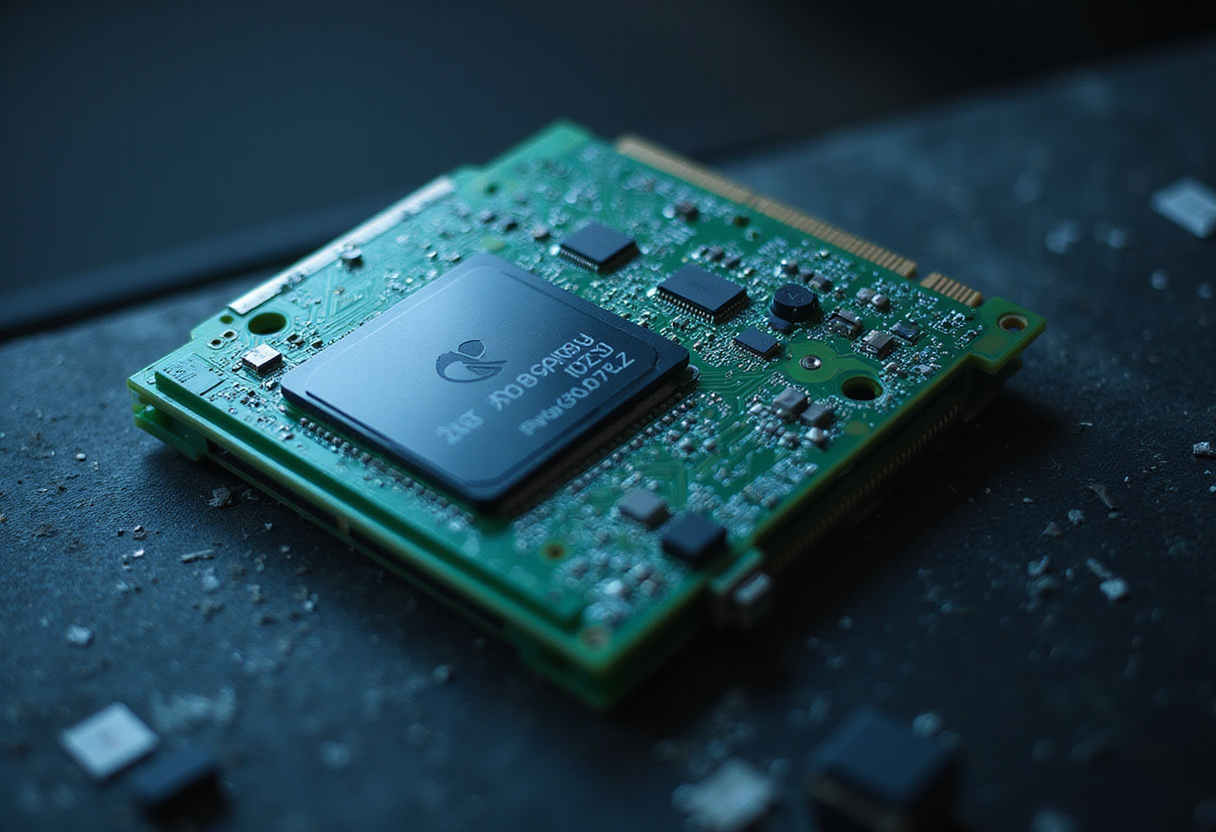
Nvidia has unveiled an AI computing module designed for space-based data centers, extending the company's accelerator portfolio beyond terrestrial server farms and onto orbital platforms.
The announcement, reported by SpaceNews, signals that the dominant supplier of AI training and inference hardware now treats space as a viable deployment environment for compute-intensive workloads — not merely a domain for sensors, relays and communications payloads.
What did Nvidia announce?
The company presented a computing module built to run artificial intelligence workloads aboard spacecraft. The product is positioned as a building block for data centers located in orbit, where processing can occur closer to where data is collected rather than on the ground.
For satellite operators, the implication is direct: imagery, signals and other sensor data generated in orbit could be processed on orbit, reducing the volume of raw data that must be downlinked to Earth over constrained connections.
Why does orbital AI compute matter now?
Two trends converge in this announcement.
- Demand side. AI models require dense compute wherever data is produced. Satellite constellations generate volumes of sensor data that currently strain downlink capacity.
- Supply side. Radiation-tolerant electronics and maturing smallsat platforms have made it increasingly practical to fly capable processors, not just hardened microcontrollers.
Nvidia's entry suggests the company sees a commercial market large enough to justify productizing hardware for this environment, rather than leaving orbital compute to specialized aerospace electronics vendors.
What remains to be seen?
Key specifications of the module — power envelope, radiation tolerance, thermal design and flight heritage — will determine which mission classes it can serve.
Several questions follow from the announcement:
- Which satellite bus standards will integrate the module, and at what power and mass budgets?
- Will initial deployments target Earth observation, communications processing, or defense payloads?
- How does the product fit alongside existing space-grade compute offerings from established aerospace suppliers?
Answers to these questions will shape whether space-based data centers remain a niche concept or become a recognized segment of the broader AI infrastructure market — a market Nvidia currently leads on the ground.
What is the competitive context?
Nvidia's move into orbital compute places pressure on suppliers of space-qualified processors. Historically, that field has belonged to aerospace electronics specialists rather than commercial chipmakers, because radiation hardening and long mission lifetimes demand qualification processes far removed from consumer semiconductor cycles.
A commercial AI hardware vendor entering the segment indicates the qualification gap has narrowed — or that customer demand for onboard AI has grown strong enough to justify closing it.
SpaceNews, which first reported the unveiling, identifies the product explicitly as targeting space-based data centers: a phrase that frames satellites not as individual spacecraft but as nodes in distributed orbital infrastructure.
The bottom line
Nvidia has named space as a destination for its AI computing architecture. The announcement itself is the hard fact; the details — specifications, launch customers, mission timelines — will decide whether orbital data centers move from concept to procurement.
For satellite operators and constellation developers, the arrival of a mass-market AI hardware vendor in the segment reduces the barrier to onboard intelligence. For the broader industry, it marks another step in the migration of compute toward the edge — in this case, several hundred kilometers straight up.
via Google News: GPU datacenter (Source)
More from Grace Kim
Same lot · LOT-C1C6
- DSG-285265nmGoogle's First Suncatcher Satellite Reaches Orbit to Test AI Chips
- DSG-365910nmGoogle Tests AI Chips in Orbit for Space Data Centre Research
- DSG-346665nmStarcloud raises $250M for orbital data center network with Nvidia
- DSG-158114nmGoogle Sends AI Chips Into Space to Test Orbital Data Centres
- DSG-156045nmNvidia, Google and Emerald AI launch flexible data center consortium