Test report DSG-6804 · Rev A · tested October 10, 2026
AI Devices & SystemsDevice under test
NVIDIA, Microsoft Open RTX Spark Laptop Preorders, Preview DGX Station
Microsoft and NVIDIA opened RTX Spark laptop preorders shipping October 16, with compact desktops in November. MXC hit general availability and DGX Station for Windows was previewed at the San Francisco event.
- Read
- 3 min
- Words
- 692
- Node
- 45nm
- Operator
- Amara Osei
Spec summary
- RTX Spark laptop preorders opened Wednesday for October 16 ship date; compact desktops follow in November.
- RTX Spark combines up to 6,144 Blackwell GPU cores, a 20-core Grace CPU at 600 GB/s, 1 petaflop FP4, and up to 128GB unified memory.
- Microsoft Execution Containers (MXC) reached general availability as the OS-level substrate for persistent background agents.
- DGX Station for Windows uses the GB300 Grace Blackwell Ultra Desktop Superchip with 748GB coherent memory and up to 20 petaFLOPS FP4.
- RTX Spark systems ship from Acer, ASUS, Dell, HP, Lenovo, Microsoft, MSI and Gigabyte.
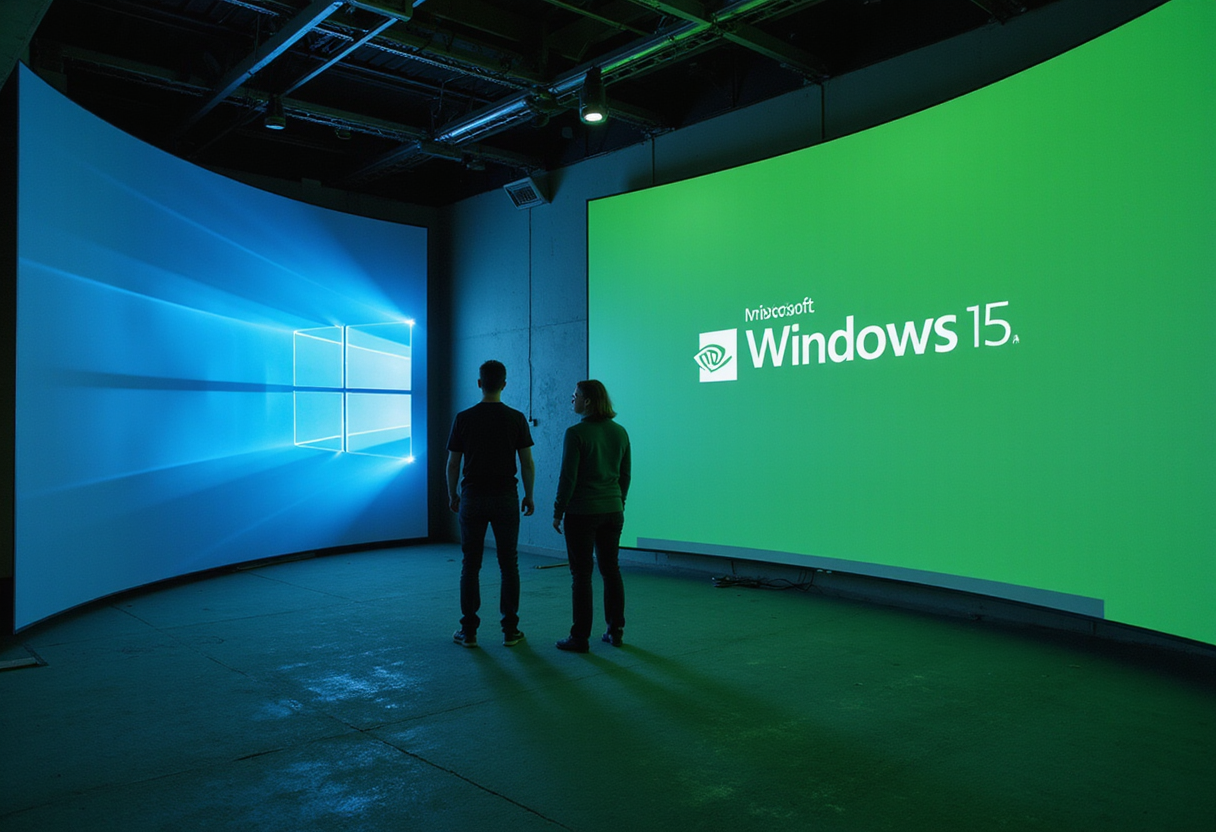
Microsoft and NVIDIA opened preorders on Wednesday for RTX Spark-equipped laptops shipping October 16, with compact desktops following in November. NVIDIA founder and CEO Jensen Huang and Microsoft CEO Satya Nadella framed the launch around on-device AI agents running natively in Windows at the Windows AI and Surface event in San Francisco.
The two CEOs appeared in a fireside chat hosted by Sriram Krishnan, a former senior White House policy advisor on AI, at Dogpatch Studios. Huang tied the moment to NVIDIA's founding era.
"If you look at the entire journey of our company, Windows was at the core of it," Huang said. "If not for Windows there would be no GeForce."
What does RTX Spark put on the desktop?
RTX Spark combines a Blackwell RTX GPU with up to 6,144 cores and an up to 20-core NVIDIA Grace CPU connected at 600 GB/s. The platform delivers one petaflop of FP4 AI performance and up to 128GB of unified memory.
NVIDIA said the configuration can run Qwen 3.8 Flash Next, a 125-billion-parameter model with 51-billion n-gram, locally without sending data to the cloud.
Microsoft's new Surface Laptop Ultra, introduced by EVP of Windows and Devices Pavan Davuluri, is built around the RTX Spark superchip.
"We built Surface Laptop Ultra around NVIDIA RTX Spark. With up to 128 gigs of unified memory and up to a petaflop of AI compute, you can run models on this laptop that simply don't fit on a traditional machine," Davuluri said.
Systems ship from Acer, ASUS, Dell, HP, Lenovo, Microsoft, MSI and Gigabyte in slim laptop and compact desktop form factors. The compact desktop targets always-on agent operation.
Use cases outlined at the event:
- Developers run the same NVIDIA AI stack from RTX Spark up to DGX Station without rewriting code.
- Creators get 5th-generation Tensor Cores with NVFP4 support, hardware-accelerated AV1, and 4:2:2 encode and decode, plus DLSS and RTX ray tracing.
- Gamers target AAA titles at 1440p over 100 fps with DLSS 5, Reflex and G-SYNC.
How does Microsoft secure agents on the OS?
Microsoft used the event to announce general availability of Microsoft Execution Containers (MXC), OS-level infrastructure that runs agents persistently in the background under Windows control.
"We are building these primitives directly into Windows, so agents can be secured, observed and governed," Davuluri said.
Huang called MXC a foundational shift comparable to DirectX.
"Just as Windows and DirectX revolutionized how applications were built, MXC is going to revolutionize how agents are built and deployed," Huang said.
Nadella set the goal in plain terms: "We needed to make the desktop the most secure place for agents to execute."
What does DGX Station for Windows add for enterprise?
NVIDIA previewed DGX Station for Windows, the first deskside AI supercomputer carrying GB300 Grace Blackwell-class infrastructure into the Windows ecosystem. The workstation uses the GB300 Grace Blackwell Ultra Desktop Superchip, delivering 748GB of coherent memory and up to 20 petaFLOPS of FP4 AI compute. NVIDIA said it can run models up to a trillion-parameter scale locally.
Until this release, DGX Station ran on Linux only, forcing enterprise developers to maintain dual environments for AI workloads and Windows productivity tools.
"This unlocks the power to run frontier-class models locally. Capabilities that once required renting a cluster, now in a deskside supercomputer," Davuluri said.
The vast majority of Fortune 500 companies standardize on Windows, NVIDIA said, and the Linux/Windows split had pushed developers to choose between AI compute access and their primary OS. Linux toolchains remain reachable through WSL.
"The personal computer is the ultimate tool, it's my ultimate tool, and for a whole generation of people, it's our ultimate tool. What happens in the era of agents, when the agent is on your computer? It is now your personal assistant," Huang said.
Nadella credited the partnership's longevity. "The thing that I really give Jensen all the credit for, quite frankly, is that consistency of vision of what this can be — not today, not tomorrow, but as a secular trend," Nadella said.
via nvidia.com (Original)
More from Amara Osei
Same lot · LOT-C1C6
- DSG-69337nmNvidia Launches 'RTX Spark' AI PC Chip, Targeting Intel and AMD
- DSG-340910nmNvidia Sets October Launch for RTX Spark AI PCs
- DSG-769120nmWIRED Runs First Hands-On with Nvidia RTX Spark 'Superchip'
- DSG-889165nmMicrosoft Ships First NVIDIA RTX Spark Systems: Surface Laptop Ultra, Dev Box
- DSG-10507nmNvidia Sets October Launch for RTX Spark AI PCs