Test report DSG-3218 · Rev A · tested November 13, 2026
AI Datacenter InfrastructureDevice under test
NSE India deploys direct-to-chip liquid cooling for GPU expansion
NSE has deployed direct-to-chip liquid cooling on-premises, targeting 80 GPUs this quarter and 224 across high-density racks, with GPU models undisclosed.
- Read
- 3 min
- Words
- 636
- Node
- 7nm
- Operator
- Priya Raman
Spec summary
- NSE deployed direct-to-chip liquid cooling at its on-premises data center.
- Up to 80 GPUs are planned this quarter, expanding to 224 GPUs in high-density racks.
- GPU models and vendors were not disclosed.
- In 2024, NSE planned to triple its Mumbai colocation data center to 4,000 racks.
- The Exchange Plaza-to-data-center conversion, revealed in 2025, is set for completion within three years.
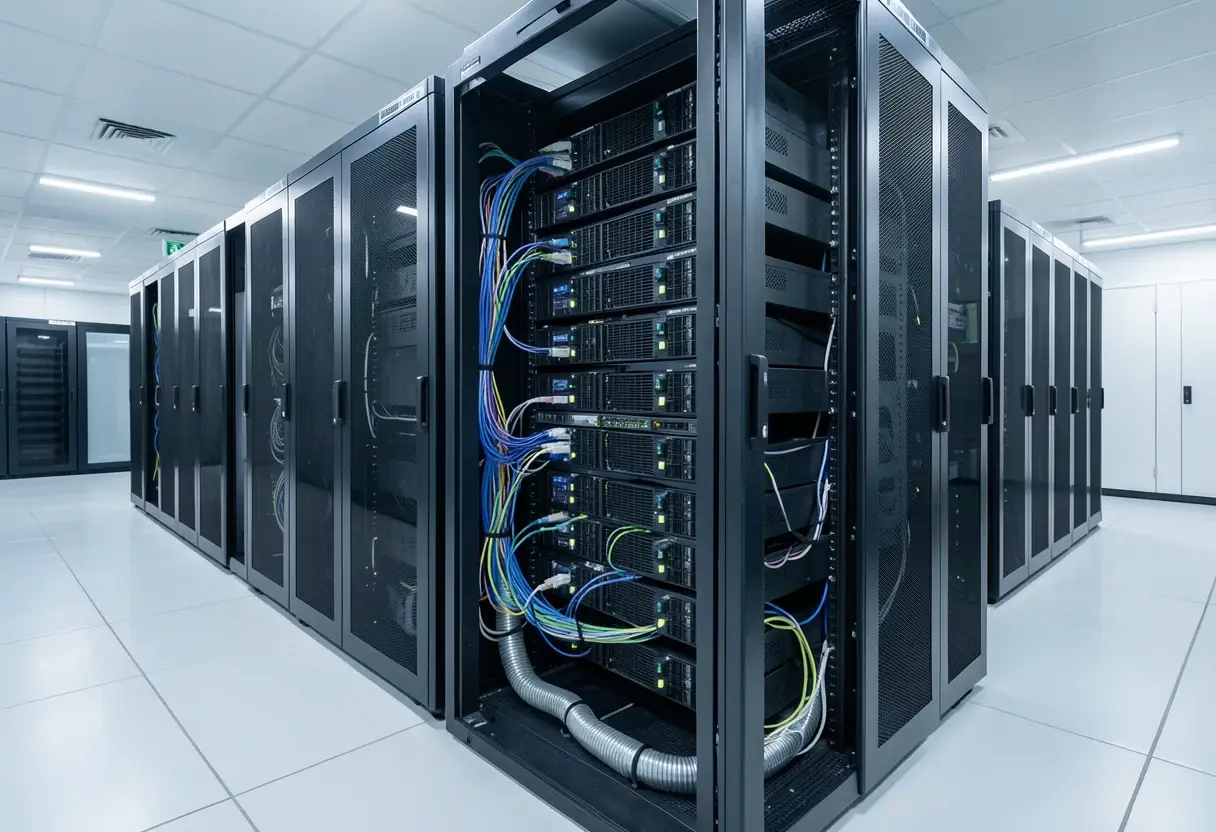
India's National Stock Exchange has deployed direct-to-chip liquid cooling (DLC, a method that pumps coolant directly onto processor cold plates rather than circulating air) at its on-premises data center. The exchange plans to deploy up to 80 GPUs this quarter and to expand eventually to 224 GPUs across what it calls high-density racks. Neither the GPU vendor nor the specific models have been disclosed, and that gap matters when assessing cooling and power claims.
The stated goal is AI capacity expansion. Beyond the GPU count, NSE has released no figures on rack density, power draw, or cooling capacity. Direct-to-chip cooling typically becomes necessary when rack densities exceed what air cooling can economically remove, but NSE has not published the thresholds its design targets.
Why keep the deployment on-premises?
NSE says the on-premises approach lets it retain control over its data, computing resources and access. The exchange frames this as strengthening data sovereignty and security governance in line with regulations. No specific regulation was cited.
One caveat follows the sovereignty claim: the plan includes extending direct-to-chip cooling to NSE's colocation data center, subject to customer requirements. Colocation customers rent space and would operate under different control arrangements than an fully internal deployment.
What did the CTO say?
Sampath Manickam, CTO of NSE, said: "AI is driving a fundamental shift in technology infrastructure, with significantly higher demands on compute density, power, and cooling. At NSE, our approach is to anticipate these requirements and build ahead of demand."
He added: "The DLC deployment provides a scalable and energy-efficient foundation for high-density GPU computing and strengthens our readiness for the next generation of AI workloads. As we expand these capabilities, our focus will remain on building resilient, scalable and future-ready infrastructure that supports NSE's evolving technology needs and the continued growth of India's capital markets."
The energy-efficiency claim carries no supporting metrics. No power usage effectiveness (PUE, a ratio of total facility energy to computing energy) or comparable efficiency figure accompanied the announcement.
How does this fit NSE's broader data center plans?
The cooling deployment sits inside a larger real estate and infrastructure shift. NSE is moving out of its Exchange Plaza headquarters, which houses critical operations and the IT division, according to a report from the Economic Times. The exchange will convert the entire building into a large data center.
The new headquarters will occupy G Block of the Bandra Kurla Complex in Mumbai. The move, revealed in 2025, carries a three-year completion timeline. Three years is a long window for a headquarters relocation, and the announcement did not specify how the Exchange Plaza conversion would be phased relative to that schedule.
This is not NSE's first data center commitment:
- In 2022, NSE announced an "exclusive data center" on the outskirts of Mumbai for colocation customers.
- In 2024, the exchange revealed plans to triple that facility's capacity to 4,000 racks.
- In 2025, it disclosed the Exchange Plaza conversion and the Bandra Kurla Complex headquarters move.
What remains unsaid?
The announcement omits several operational details an infrastructure buyer would want. The GPU vendor, rack density targets, total power capacity, cooling supplier and project cost all remain undisclosed. The 224-GPU endpoint has no attached date.
For comparison, 224 GPUs would represent a modest deployment against hyperscale AI clusters, which now run into the tens of thousands of accelerators. NSE's build is proportionate to an exchange's internal workloads rather than a cloud-scale ambition, and the exchange has not said whether excess capacity would serve external customers.
The expansion to the colocation site "depending on customer requirements" suggests NSE sees demand beyond its own operations. No timeline, pricing or capacity figure for that extension was provided.
via datacenterdynamics.com (Source)
More from Priya Raman
Show full bio
Correspondent covering money, funding and market shifts around hardware layer of artificial intelligence at Die Signal.
573 articles
Same lot · LOT-3629
- DSG-56553nmLiquid Cooling Moves to the Forefront of India's AI Data Center Builds
- DSG-24285nmMHS Builds GPU Cold Plate That Cuts Coolant Demand
- DSG-307214nmSupermicro Adds 250 kW Rack Cooling Unit to AI Portfolio
- DSG-44953nmNVIDIA Qualifies Shell Fluid for Direct Liquid Cooling in AI Data Centres
- DSG-663810nmCooler Master Announces 2.5MW In-Row CDU for AI Data Centers