Test report DSG-1846 · Rev E · tested October 30, 2026
AI Datacenter InfrastructureDevice under test
Meta scales Ohio Prometheus campus toward one million GPUs
Meta's Prometheus campus in New Albany, Ohio already runs hundreds of thousands of GPUs and has trained its Muse models, with a target of roughly one million GPUs at full scale.
- Read
- 3 min
- Words
- 612
- Node
- 20nm
- Operator
- Priya Raman
Spec summary
- Prometheus in New Albany, Ohio houses hundreds of thousands of GPUs today, targeted at roughly one million at full scale.
- GB300 raises HBM capacity per GPU from 192GB to 288GB, a 1.5x increase, per Meta.
- Each building-level Ethernet fabric interconnects up to 20,736 GPUs.
- The Backend Aggregation network spans 2km to over 100km on Arista 7800 chassis with Broadcom Jericho3 silicon.
- The cluster has already trained Meta's Muse foundation models.
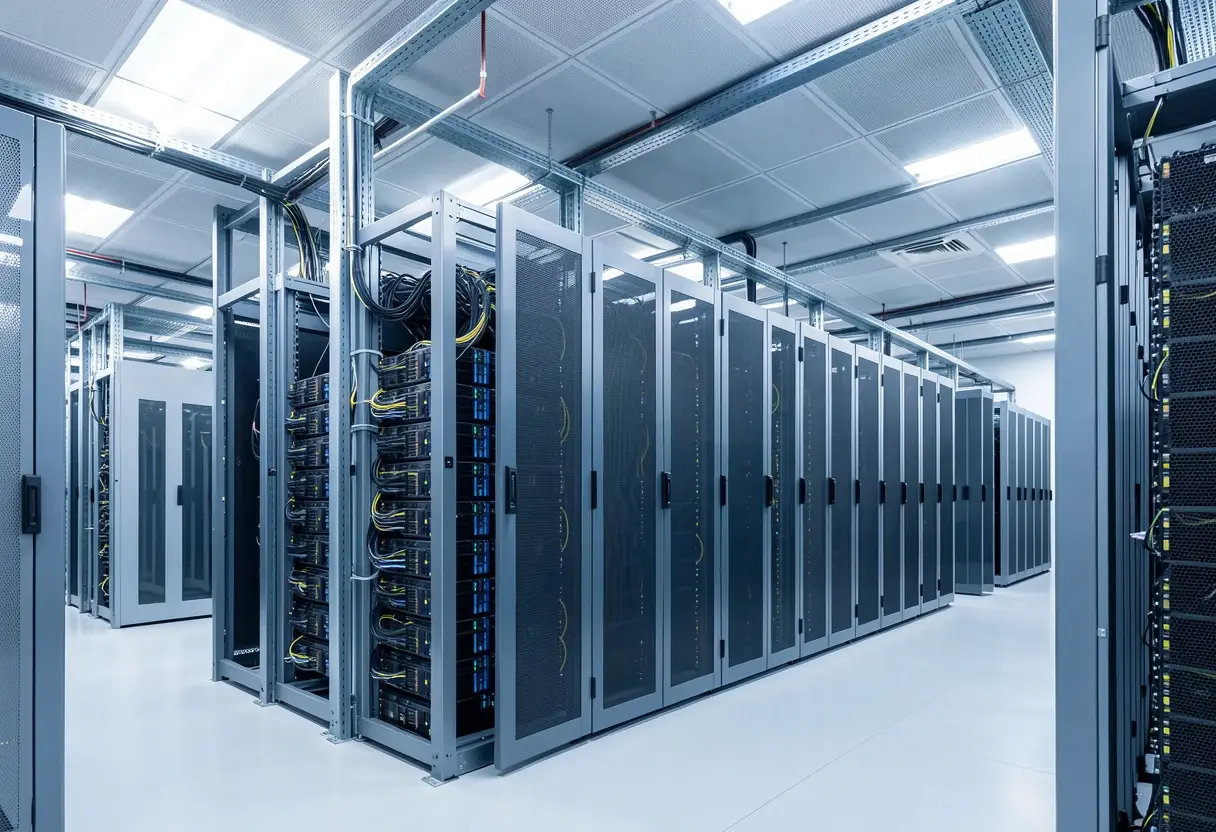
Meta now runs hundreds of thousands of GPUs across its Prometheus data center campus in New Albany, Ohio, and plans to scale the site to roughly one million distributed GPUs. The company disclosed the figures in a blog post detailing the conversion of the facility from a traditional Facebook data center into the first phase of its AI-focused supercluster.
The deployment is not a lab. Meta said the cluster has already trained its Muse foundation models. The site combines traditional data center buildings, AI-optimized buildings and rapid deployment structures, all interconnected into a single system.
What hardware sits inside Prometheus?
The campus houses Nvidia GB200 and GB300 chips, with the Vera Rubin generation described only as "arriving soon." No date was given. That absence is worth noting, given how much of the roadmap Meta has specified elsewhere.
The GB200 deployment uses Nvidia's Catalina rack architecture. Meta deployed what its engineers call "the Ariel variant, a two-rack configuration in which 36 GPUs per rack are interconnected via NVLink to form a unified 72-GPU domain." NVLink is Nvidia's proprietary GPU interconnect. Each Blackwell GPU pairs with a Grace CPU at a 1:1 ratio, plus two ConnectX-7 400G network cards, supporting 800G of input-output per GPU.
For GB300, Meta uses the Clemente platform. Cooling is flexible: Clemente accepts either Meta's modular Air-Assisted Liquid Cooling (AALC) or Facility Liquid Cooling (FLC), where the building's water loop connects directly to the racks.
How much faster is GB300 in practice?
Meta quoted concrete uplifts rather than marketing multiples. "GB300 raises HBM capacity per GPU by 1.5x, from 192GB to 288GB, and dense FP4 throughput by a similar factor, while roughly doubling attention (softmax) acceleration," the company said. HBM is high-bandwidth memory; FP4 is a four-bit floating-point format used for inference. Softmax is a mathematical operation central to transformer attention.
The claim covers memory and compute benchmarks. It does not cover end-to-end training throughput, which depends on the network fabric as much as the silicon. Meta addressed that constraint separately.
Did Meta fix the GB200's networking limits?
By its own admission, scale-out was a constraint on GB200 NVL72. Meta stated: "At the platform level, scale-out is no longer the constraint it was on the GB200 NVL72: Nvidia ConnectX-8 SuperNICs deliver 800G per GPU natively, so the capability we deployed early on Ariel becomes the baseline."
In other words, the workaround Meta engineered for GB200 arrives as standard on GB300. That framing concedes the earlier generation required special effort to reach the bandwidth that GB300 provides out of the box.
At the building level, each Ethernet-based fabric interconnects up to 20,736 GPUs through a multi-layer topology. Building-level fabrics then connect through the Backend Aggregation (BAG) network, spanning 2km to over 100km. "It is built with Arista 7800-series chassis running deep-buffered Broadcom Jericho3 silicon, delivering multiple Pbps of bandwidth per region pair," Meta said. One petabit equals one thousand terabits per second.
What remains unspecified?
The blog post omits several operational details. Meta did not state total power draw, the number of buildings completed, the timeline for reaching one million GPUs, or when Vera Rubin hardware will enter service. A campus of that scale implies grid commitments that Meta has not detailed here.
The gigawatt target itself deserves scrutiny. Reaching one million GPUs requires sustained supply of racks, power and cooling at a pace the industry has not yet demonstrated publicly. Prometheus is live, and the first phase has trained real models. The rest of the roadmap remains a claim, not a deployment.
via engineering.fb.com (Original)
More from Priya Raman
Show full bio
Correspondent covering money, funding and market shifts around hardware layer of artificial intelligence at Die Signal.
467 articles
Same lot · LOT-C204
- DSG-198128nmNvidia Vera CPUs Go Solo on Oracle Cloud: 1.2 TB/s Memory Play
- DSG-558214nmVera Rubin racks and Vera CPUs now generally available on OCI
- DSG-236510nmAleria plans 8,640 Blackwell GPUs and 28 Vera Rubin racks
- DSG-112814nmOracle Lines Up Nvidia, Google and Cerebras AI Chips for Its Cloud
- DSG-156045nmNvidia, Google and Emerald AI launch flexible data center consortium