Test report DSG-1524 · Rev A · tested October 10, 2026
Edge AI SiliconDevice under test
Hygon Announces 1000 Series x86 Embedded Processors
Hygon has unveiled its 1000 Series x86 embedded processors, targeting industrial robotics and edge AI workloads in the domestic Chinese industrial market.
- Read
- 3 min
- Words
- 550
- Node
- 5nm
- Operator
- Marcus Bennett
Spec summary
- Hygon has unveiled a new embedded processor family named the 1000 Series
- The processors use the x86 instruction set architecture
- Hygon targets industrial robotics and edge AI as the two named application domains
- Pricing, core counts, TDP and availability dates remain unannounced
- The launch extends Hygon beyond its server CPU business into embedded industrial compute
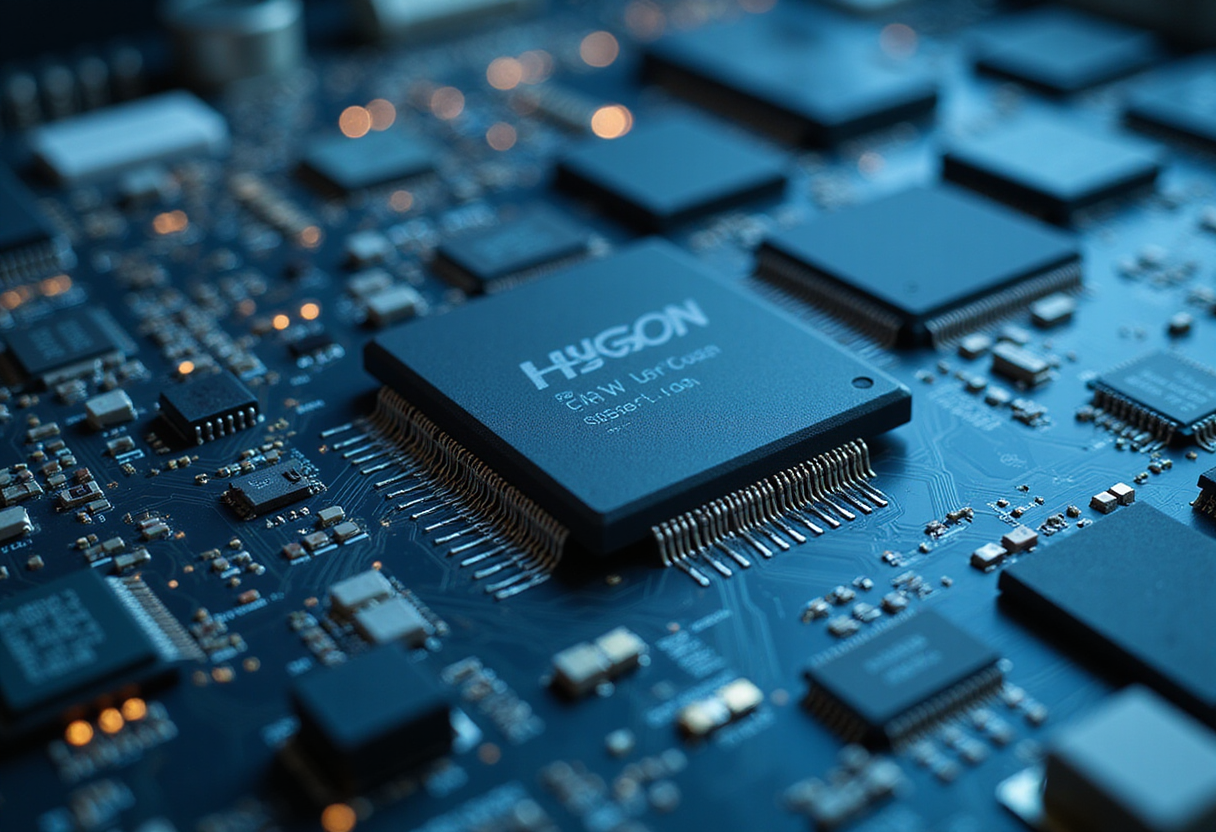
Hygon has unveiled its 1000 Series x86 embedded processors, a product line the company positions specifically for industrial robotics and edge AI applications. The announcement places Hygon — a Chinese x86 CPU vendor founded out of the AMD joint-venture licensing era — directly into the embedded and industrial compute segment, a market long dominated by Intel's embedded x86 lines and, increasingly, by Arm-based alternatives.
The disclosure is recent, and the initial announcement does not yet publish a full specification sheet. What is confirmed at this stage is the product family name, the x86 instruction set architecture, the embedded positioning, and the two named target domains: industrial robotics and edge AI. Pricing, clock speeds, core counts, TDP envelopes and availability dates remain unannounced.
What does the launch signal for the embedded x86 market?
The embedded processor market differs sharply from the desktop and server segments Hygon has previously addressed with its Dhyana-line CPUs. Embedded customers buy on long product lifecycles, guaranteed supply commitments, validated thermal envelopes and industrial-temperature tolerance rather than peak performance.
Hygon's entry into this segment with the 1000 Series points at three strategic calculations:
- Domestic substitution. Chinese industrial-equipment makers face continued pressure to reduce reliance on US-origin silicon in control systems, motion controllers and machine-vision platforms.
- Edge AI demand. Robotics cells and factory-floor inference workloads need on-device compute with deterministic latency, a fit for embedded x86 parts paired with accelerators.
- Architecture continuity. Existing industrial software stacks are overwhelmingly x86; a domestic x86 embedded option lets integrators migrate without recompiling control code.
Why does edge AI matter for the 1000 Series?
Edge AI deployment in industrial settings imposes constraints that cloud-scale inference does not: fanless cooling, 24/7 duty cycles, vibration tolerance and power budgets measured in single-digit or low-double-digit watts depending on the controller class. An embedded x86 processor aimed at this space competes not only with Intel's Atom and Core embedded SKUs but also with Arm Cortex-A based SoCs from NXP, Texas Instruments and Renesas, plus GPU-accelerated modules from NVIDIA's Jetson line.
Hygon has not disclosed whether the 1000 Series integrates dedicated AI acceleration — for example NPU blocks or vector extensions suited to inference — or whether it relies on discrete accelerators over PCIe. That detail will largely determine which robotics and vision workloads the parts can realistically serve.
What remains unknown?
Several commercially decisive parameters are absent from the initial announcement:
- Core counts, frequencies and cache configuration
- TDP range and supported thermal profiles
- Fabrication node and, given Hygon's history of export-control constraints on leading-edge lithography, which process technology the parts use
- I/O inventory: PCIe lane counts, Ethernet, industrial fieldbus support
- Longevity and supply guarantees, the standard 10-to-15-year commitments embedded buyers expect
- Volume pricing and channel availability
What comes next?
Watch for a follow-on datasheet release and the first named design wins. In embedded markets, the announcement of an OEM or robotics integrator committing to the platform matters more than launch-day specifications, because it validates the supply and support chain that industrial customers depend on. Until those design wins surface, the 1000 Series stands as a directional commitment by Hygon to extend x86 domestic silicon beyond servers and into the factory floor.
via Google News: Edge AI processor (Source)
More from Marcus Bennett
Show full bio
News editor covering marketplaces and e-commerce at Die Signal.
278 articles
Same lot · LOT-C1C6
- DSG-581614nmHygon Expands Beyond Data Centres Into Robotics and Edge AI Chips
- DSG-250620nmHygon pushes into physical AI with chips for robots and factories
- DSG-991345nmIntel and Softbank Announce Z-Angle Memory to Challenge HBM
- DSG-67193nmSK Hynix Eyes Opportunity Inside Intel's $100B U.S. Fab Plan
- DSG-57137nmAMD Expands Ryzen AI Embedded P100 Line for Edge AI