Test report DSG-9214 · Rev C · tested October 10, 2026
Memory & StorageDevice under test
CXMT Overtakes Intel in Market Value After Shanghai Listing Debut
Chinese DRAM maker CXMT now commands a market value above Intel after its Shanghai stock debut, pressuring SanDisk and Micron in the memory market.
- Read
- 3 min
- Words
- 571
- Node
- 65nm
- Operator
- Priya Raman
Spec summary
- CXMT's market value now exceeds Intel's following its Shanghai stock debut
- SanDisk and Micron face renewed competitive pressure from the Chinese DRAM maker
- CXMT is the first Chinese DRAM specialist to surpass Intel in valuation
- The listing provides CXMT with a domestic capital-markets funding channel
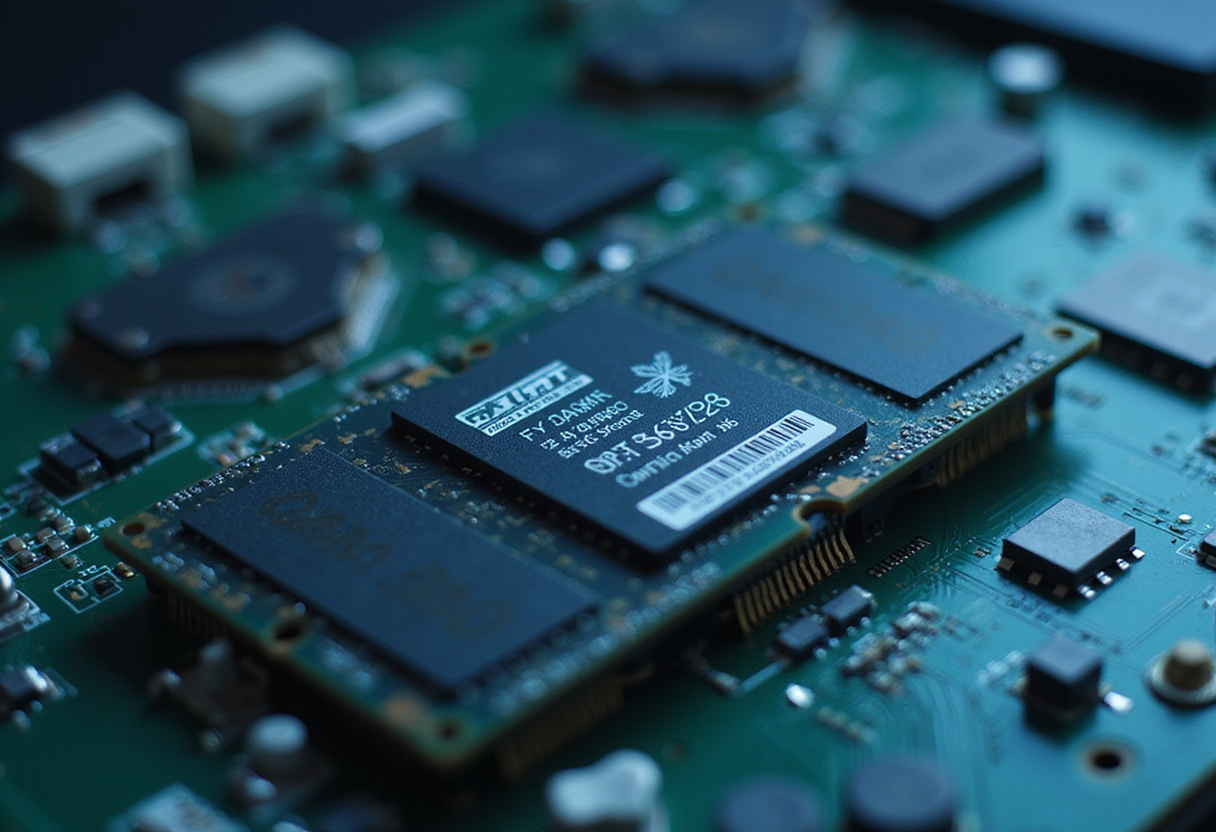
Chinese DRAM manufacturer CXMT is now worth more than Intel following its debut on the Shanghai stock market, a milestone that puts the memory-chip competitive hierarchy under new pressure and has investors repricing exposure at SanDisk and Micron.
The Shanghai listing turned CXMT into one of the most valuable semiconductor companies in the region, leapfrogging a US chipmaker that long ranked among the industry's largest by market capitalization. The debut's scale signals how far China's domestic memory program has advanced in a market previously dominated by Samsung, SK Hynix, Micron and SanDisk's parent Kioxia.
What does the valuation flip signal?
A Chinese DRAM specialist outvaluing Intel marks a symbolic break with the established order of the global chip industry. Intel, which once sat atop the semiconductor valuation table, now trails a company that only recently began volume production of competitive DRAM.
For investors, the repricing reflects two assumptions:
- CXMT's domestic position will keep growing as Chinese system builders and device makers qualify its memory.
- Western suppliers — above all Micron and SanDisk — face share erosion in one of the world's largest end markets.
The scale of the debut also demonstrates the depth of capital available to China's semiconductor champions through domestic listings, a funding channel US and Japanese rivals cannot replicate on the same terms.
How are SanDisk and Micron affected?
Both companies count China among their most important demand pools, and both now compete there against a state-backed rival whose valuation signals long-term ambition rather than short-term profit pressure.
SanDisk, the NAND flash supplier that separated from Western Digital, and Micron, the only US-headquartered DRAM producer, saw their competitive positioning reassessed in the wake of the debut. The concern for both is straightforward: if CXMT expands beyond commodity DRAM into adjacent memory segments, pricing power across the industry weakens.
Micron faces the more direct threat. DRAM is its core business, and CXMT has narrowed the technical gap in mainstream memory nodes. SanDisk's exposure is more indirect — through overall memory pricing dynamics and the possibility that Chinese capacity expansion eventually extends further into NAND.
Why does the listing matter now?
The debut arrives as the memory industry cycles through a pricing recovery, with suppliers constraining output to support margins. A well-capitalized Chinese entrant changes that calculus. CXMT now has a listed-currency acquisition tool, a higher-profile balance sheet and investor expectations that reward volume growth over margin discipline.
For policymakers in Washington, the valuation milestone lands at an awkward moment. Export controls were designed to hold back China's most advanced memory capabilities, yet the market has assigned CXMT a value exceeding one of America's flagship chipmakers. That gap between policy intent and market outcome will fuel the next round of semiconductor policy debate.
What comes next?
Three variables will determine whether CXMT's new valuation holds:
- Execution on advanced DRAM nodes and its ability to close remaining gaps with Samsung and SK Hynix.
- Whether Micron and SanDisk respond with capacity or pricing moves of their own in markets where CXMT competes.
- The trajectory of trade restrictions, which could either cap CXMT's toolchain access or accelerate China's domestic equipment substitution.
The Shanghai market has already rendered its verdict on CXMT's prospects. The verdicts from Boise and Milpitas — and from customers deciding whose silicon fills their next product cycle — will take longer to arrive.
via Google News: DRAM chip (Source)
More from Priya Raman
Same lot · LOT-C1C6
- DSG-45297nmCXMT Claims Advanced DRAM Mass Production, Targeting Big Three
- DSG-285745nmCXMT Commits 34.9 Billion Yuan to DRAM R&D and Testing
- DSG-62293nmCXMT begins mass production of new memory-chip platform
- DSG-752245nmCXMT Pushes China's DRAM Into Fifth-Generation Technology
- DSG-818765nmHP, Asus, Acer Quietly Adopt Limited CXMT Chips as DRAM Supply Tightens