Test report DSG-7092 · Rev E · tested October 30, 2026
Processors & AcceleratorsDevice under test
Cadence Claims Up to 30% Quality Gains From Nvidia-Tuned EDA Models
Cadence says 20-30% of chips in development use AI agents; its Nvidia-tuned Maestro models gained up to 30% output quality and 5x token efficiency over generic LLMs.
- Read
- 2 min
- Words
- 493
- Node
- 3nm
- Operator
- Amara Osei
Spec summary
- 20-30% of chips in development today use AI agents, per Cadence's Paul Cunningham
- Maestro models fine-tuned on Nvidia Nemotron showed up to 30% output quality gains and up to 5x token efficiency
- Cadence released four AI Super Agents in the past year: AuraStack, ChipStack, InnoStack, ViraStack
- Maestro runs via API, secure VPC or on-premises; customization offered as a managed service
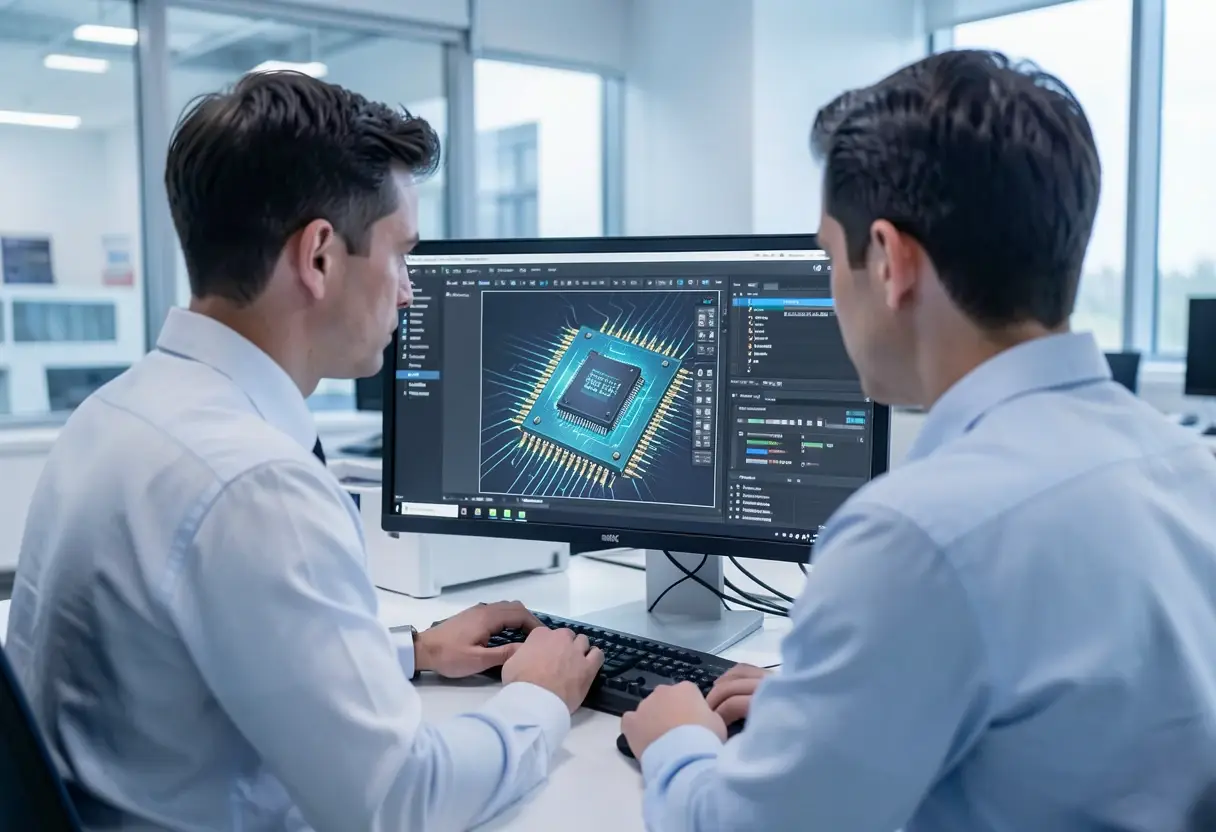
Between 20 and 30 percent of chips now under development are being designed with the help of AI agents, according to Cadence senior VP Paul Cunningham — and that share is growing rapidly. This week Cadence formalized its push into that market with the Maestro AI model family, fine-tuned on Nvidia's Nemotron models to interpret the outputs of Cadence's own design tools.
What did Cadence launch?
Over the past year, Cadence has released a series of AI agent harnesses it calls "AI Super Agents":
- AuraStack — advanced packaging and PCB layout
- ChipStack — SoC design and verification
- InnoStack — PHY routing
- ViraStack — analog circuit design
Like Anthropic's Claude Code or OpenAI's Codex, these harnesses orchestrate LLMs to automate design and testing flows across Cadence's existing EDA, test and verification tools. The approach mirrors why AI code assistants took hold among software engineers: code either compiles or it doesn't, and Cadence has tests that verify whether a design works as intended.
The limitation, as with code assistants, is that effectiveness depends on how closely training data resembles the inputs and outputs the models receive. Cadence's early agents ran largely on off-the-shelf LLMs, which limited their exposure to specialized formats such as RTL.
"It's not the case that these amazingly powerful out-of-the-box foundation models are just going to do everything. They're the starting point, and you can still specialize," Cunningham said.
What do the tuned models deliver?
Early testing of the Maestro models showed up to a 30 percent increase in output quality and up to 5x greater token efficiency compared with general-purpose foundation models, according to Cadence. Post-training on Cadence's own tools made the models both more capable and cheaper to run.
The Maestro platform also supports customization on customer data, though Cunningham said this will be offered as a managed service rather than something customers configure themselves.
Deployment options match Cadence's existing agent stack: access via API, execution in a secure VPC, or fully on-premises for customers with the necessary hardware.
Where does this fit in the wider AI-HPC picture?
Cadence is not alone in using AI agents to orchestrate HPC workloads. Nvidia has spent years pushing HPC and AI toward convergence — its GPUs serve workloads beyond AI training and inference, even if those dominate its sales.
AI-driven labs also form a core component of the Department of Energy's Genesis Mission, which has produced a wave of new large Nvidia-based supercomputers.
Researchers at Sandia National Labs recently demonstrated AI agents developing and testing new hypotheses in what they described as a self-driving lab — though those experiments predated modern agent harnesses and LLMs. For publicly funded researchers with limited budgets, a lab assistant that keeps working after the humans go home is an obvious draw.
Fine-tuned models beat generic ones in EDA, and Cadence now sells that advantage in three deployment modes.
via theregister.com (Original)
More from Amara Osei
Show full bio
Staff writer covering money, funding and market shifts around hardware layer of artificial intelligence at Die Signal.
507 articles
Same lot · LOT-C204
- DSG-736865nmCadence Deepens AI Chip Design Partnership Work
- DSG-373328nmEDA agents in 2026: 50x RTL claims meet Level 5 autonomy pitches
- DSG-995565nmCadence's Maestro Claims 30% Better Chip Design Results, 5x Token Efficiency
- DSG-335614nmNvidia and ChipAgents Start Evaluation of AI-Powered Chip Design
- DSG-38065nmCadence Secures TSMC A14 Tool Certification, Cuts Design Iterations 2.5X