Test report DSG-5549 · Rev B · tested October 10, 2026
AI Datacenter InfrastructureDevice under test
Alibaba Targets 20 GW Data Center Capacity by 2032 Backed by V900
Alibaba has set a target of more than 20 GW of data center capacity by 2032, anchored by its V900 AI accelerator claimed to scale to 500,000-card clusters and billed as China's most powerful domestic chip.
- Read
- 3 min
- Words
- 553
- Node
- 5nm
- Operator
- Marcus Bennett
Spec summary
- Alibaba is targeting data center capacity of more than 20 GW by 2032
- The V900 AI accelerator is claimed to scale to clusters of 500,000 cards
- Alibaba describes the V900 as China's most powerful AI chip
- The announcement positions Alibaba as a domestic challenger to Nvidia in the Chinese market
- Nvidia currently ships the downgraded H20 part into China under US export-control thresholds
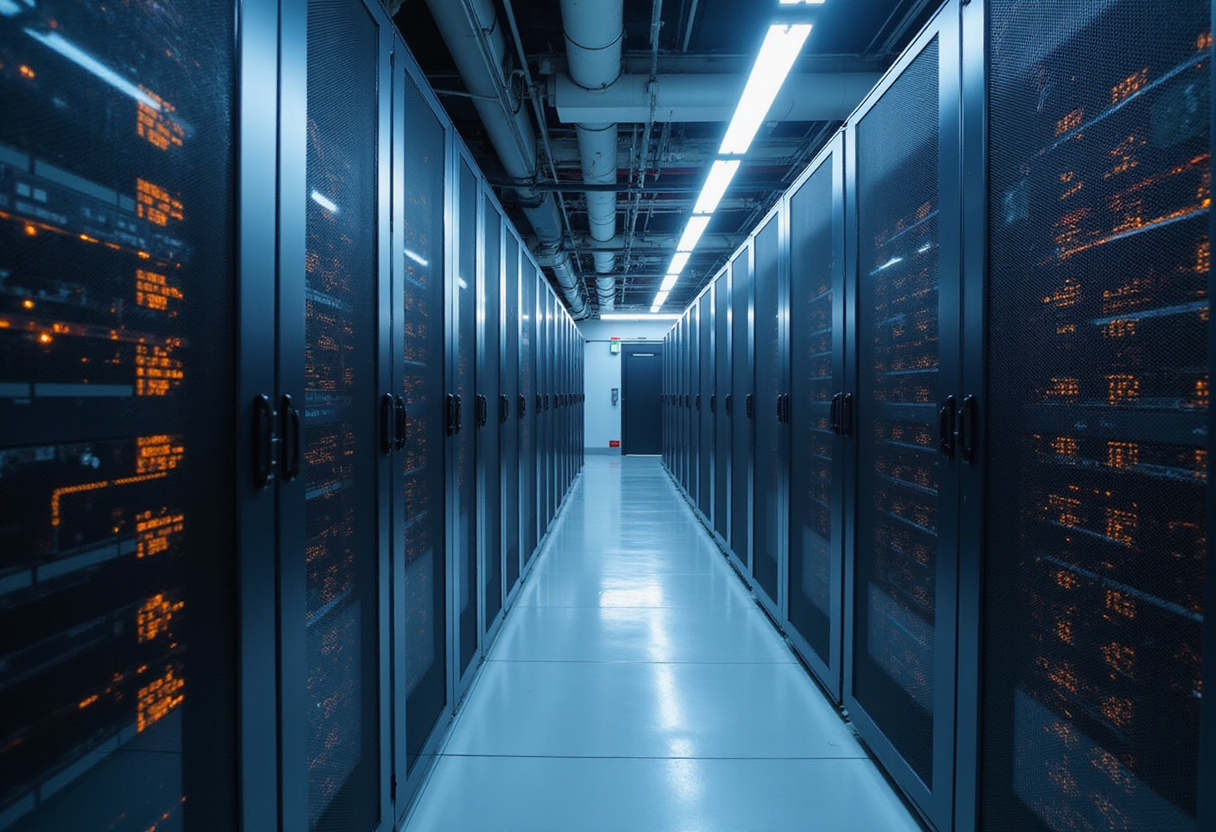
Alibaba has set a target to push its data center capacity beyond 20 gigawatts (GW) by 2032, the company announced, anchoring the build-out around its new V900 AI accelerator, which Alibaba says can scale to clusters of 500,000 cards. The specification, if delivered, would place the Chinese cloud operator within reach of the largest AI training topologies currently assembled on Nvidia hardware.
The disclosure positions Alibaba as the clearest domestic challenger to Nvidia in the Chinese market at a moment when US export controls on advanced accelerators have reshaped procurement for Chinese hyperscalers. Whether the V900 — billed locally as "China's most powerful AI chip" — can displace Nvidia GPUs in production workloads remains the open question.
The 500,000-card headline sets a benchmark. Western hyperscalers have publicly described cluster fabrics in the several-hundred-thousands range built on Nvidia platforms. Alibaba's stated target is competitive at the top of disclosed scale, but per-card throughput against Nvidia's B100, B200, and GB200 series will determine whether raw scale translates into usable compute.
What does 20 GW actually mean?
Twenty gigawatts of IT capacity, sustained over a multi-year build-out, would rank among the largest dedicated compute footprints announced by any operator worldwide. A single 1 GW campus already counts as hyperscale; Alibaba's roadmap implies 15 to 20 such sites operating in parallel by the early 2030s, drawing on expansions of existing campuses in Hangzhou, Beijing, and Shanghai alongside greenfield builds in lower-cost inland provinces.
Power availability, not chip supply, is likely to set the actual pacing. Grid build-outs in inland provinces are increasingly coordinated with compute rollouts under national policy frameworks, and the 20 GW figure should be read as a ceiling rather than a guaranteed delivery schedule.
How does the V900 cluster math work?
A 500,000-card training fabric requires a high-bandwidth interconnect capable of sustaining all-reduce traffic across that footprint with tolerable latency. Nvidia's NVLink and Spectrum-X platform serves as the reference design for this class of system; Alibaba has not disclosed the interconnect topology inside the V900 cluster.
Cluster-scale operations also depend on software: collective communication libraries, scheduling, and resilience frameworks have matured over multiple generations on Nvidia's CUDA stack. Catch-up timelines on CUDA-equivalent tooling typically take three to five years of sustained engineering, and Alibaba's T-head division has indicated continued investment in this layer.
Will the V900 displace Nvidia in China?
Inside China's borders, Nvidia currently ships downgraded parts such as the H20 in compliance with US thresholds. The V900's positioning inside that regulatory ceiling will govern how much of the Chinese market Alibaba can capture without further recourse to imported Nvidia silicon.
Three variables will determine the answer:
- Per-card inference and training throughput against H20 and successor parts
- Maturity of the compiler stack, kernel libraries, and model-porting tooling
- Power and rack-density economics in the deployments Alibaba already operates
The 500,000-card headline, and the 20 GW build-out behind it, signals capacity intent rather than verified benchmark performance. Until independent MLPerf-style results and production telemetry emerge, the V900 remains a procurement option for Chinese operators weighing sovereignty, supply continuity, and per-token cost against the Nvidia parts they can still legally import.
via Google News: GPU datacenter (Source)
More from Marcus Bennett
Show full bio
News editor covering marketplaces and e-commerce at Die Signal.
274 articles
Same lot · LOT-C1C6
- DSG-823214nmUpscale AI launches platform to interconnect rival-vendor AI chips
- DSG-405628nmNVIDIA Vera Rubin NVL72 Delivers Up to 30x Throughput Per Megawatt
- DSG-986810nmAmazon Seeks to Offload $8bn of Nvidia Chips to Investors
- DSG-247428nmAmazon to Buy 2 Million Nvidia Chips for Data Center Build-Out
- DSG-58117nmAlibaba unveils new GPU as it expands AI chip roadmap